

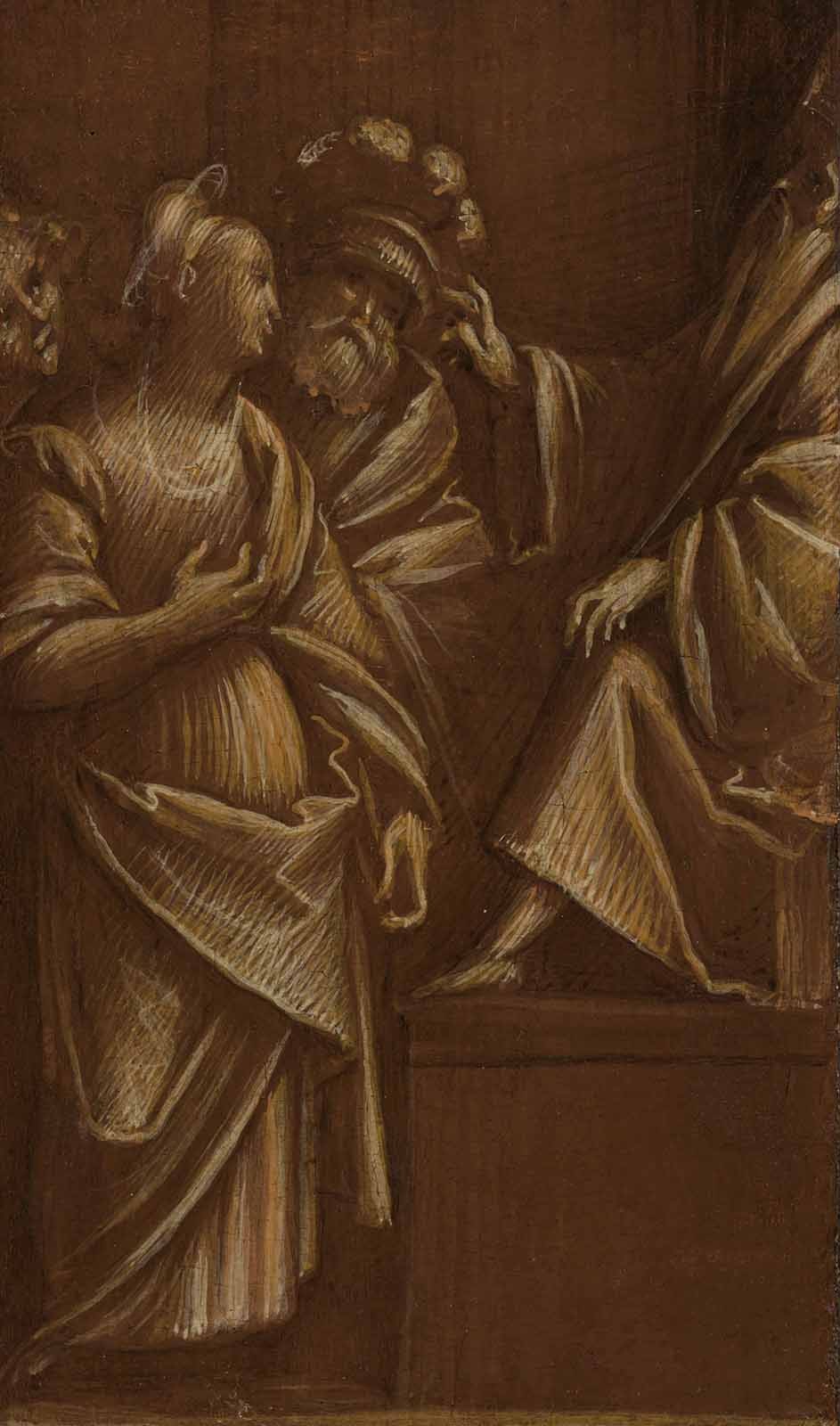
Gaudenzio Ferrari
(Valduggia 1475 - 1546 Milan)
Saint Catherine of Alexandria before the Judges, 1530-1535
oil on panel, 31,5 x 18 cm (12.40 x 7.09 inches)
Gaudenzio Ferrari
(Valduggia 1475 - 1546 Milan)
Saint Catherine of Alexandria before the Judges, 1530-1535
oil on panel, 31,5 x 18 cm (12.40 x 7.09 inches)
Re: 943
Provenance
Private collection
Essential Literature
F.M. Ferro, Gaudenzio a Romagnano Sesia, in «Paragone», XXXIV, 401-403, 1983, p. 75
R. Cara, Regesto dei documenti, in Il Rinascimento di Gaudenzio Ferrari, exhibition catalogue edited by G. Agosti and J. Stoppa, Milan 2018, p. 561, doc. no. 106
C. Falcone, in Il Rinascimento di Gaudenzio Ferrari 2018, pp. 463-466 (with complete bibliography)
The panel entered the scholarly literature on Gaudenzio Ferrari in 1983, when it was published by Filippo Maria Ferro in "Paragone." On that occasion the scholar hypothesized that the fragment came from the predella of the altarpiece with the Mystic Marriage of Saint Catherine painted by Gaudenzio Ferrari for Novara Cathedral, also associating with it the scene of the saint's martyrdom, of horizontal format, today belonging to the Pinacoteca di Varallo1.
At the same time Casimiro Debiaggi made known, in the "Bollettino della Società Piemontese di Archeologia e Belle Arti," two small panels similar in size and pictorial handling to the one presented here ("two small panels of unmistakably Gaudenzian style reveal the same characteristics found in so many of the master's chiaroscuro predellas, rendered with a swift, summary, almost flashing touch, of most vivid mimetic effect")2. These predella elements had appeared some years earlier on the English antiques market, already with the correct attribution to Gaudenzio3. Debiaggi's essay likewise proposed a connection with the panel from Varallo, and it was hypothesized that the "banchetta" thus reconstructed might perhaps once have completed the altarpiece of Novara Cathedral.
Subsequent studies have proposed identifying, in some of these monochrome figures, the contribution of a collaborator, perhaps the young Lanino4.
Restoring the original appearance of the Novara altar, however, presented a rather complex problem, because over the centuries the work underwent numerous relocations and adaptations that altered its structure. The recent studies of Sergio Monferrini, who traced the commission document for the altarpiece, have finally shed new light on the question5.
The Mystic Marriage of Saint Catherine was commissioned from Ferrari on 25 February 1530 directly by the church's two chaplains, to be placed on the parish altar located in the choir of the Cathedral; payment in full for the work, however, dates to 1534. The agreement stipulated that Gaudenzio was to paint, in the central panel, some of the principal saints venerated by the local community: Catherine, Gaudenzio, Joseph, Agabius and Peter Martyr (the latter, however, was never executed). Above were placed the images of the Stoning of Saint Stephen and Saint John the Baptist in the Desert — now lost — while the predella consisted of a series of putti dancing and playing music6.
A different origin must therefore be identified for the predella partially reconstructed by Ferro and Debiaggi. On the basis of the hagiographic texts devoted to the young martyr, the correct order of the surviving scenes, from left to right, must have been the following: Saint Catherine Converting the Philosophers as They Are Burned Alive, Saint Catherine of Alexandria before the Judges, Saint Catherine of Alexandria Subjected to the Torture of the Wheel and the Beheading of Saint Catherine7.
The small panels, executed with great skill on a fine walnut support, are stylistically datable to the 1530s and slightly precede the predella — likewise in imitation bronze relief — of the Maggianico polyptych8. It may therefore be hypothesized that the scenes from the life of Saint Catherine originally belonged to a lost altarpiece that decorated the altar of the upper sacristy of Vigevano Cathedral, a work probably executed by Gaudenzio around 1534 with the assistance of his collaborator Giuseppe Giovenone9. This commission has long been connected with a beautiful sheet in pencil, watercolour and lead white depicting the Mystic Marriage of Saint Catherine of Siena and Saint Catherine of Alexandria, today in the National Museum in Oslo, which may constitute a study by the master for the main scene. Studies in recent years have moreover tended to identify in Gaudenzio's extraordinary Lamentation over the Dead Christ, today in Budapest, as the crowning panel of this prestigious commission10.
1 Ferro 1985, p. 75; the essay was republished in F.M. Ferro, L'anima dipinta. Scritti di arte lombarda e piemontese da Gaudenzio Ferrari a Ranzoni, Novara 2010.
The fullest bibliographical entry on the Varallo panel — from the Cibrario collection in Turin — is the catalogue entry by M. Caldera and C. Falcone in Dossier gaudenziani. Restauri alla Pinacoteca di Varallo, edited by S. Amerigo and C. Falcone, Varallo 2014, pp. 140-145.
2 C. Debiaggi, Due inedite tavolette gaudenziane, in «Bollettino della Società Piemontese di Archeologia e Belle Arti», XXXV-XXXVII, 1981-1983, pp. 57-62
3 The two fragments of vertical format, depicting Saint Catherine Converting the Philosophers as They Are Burned Alive and Beheading of Saint Catherine, were sold at auction at Sotheby's London on 1 November 1972 (lot 70) and then again in April 1989 (lots 4-5); they are further documented in the Fototeca Zeri (record nos. 23363 and 23335).
4 M. Caldera and C. Falcone, in Dossier gaudenziani 2014, pp. 142-145.
5 S. Monferrini, Il contratto di Gaudenzio Ferrari per il "Matrimonio mistico di Santa Caterina" nel Duomo di Novara, in «Arte Lombarda», New series, vol. 178, no. 3 (2016), pp. 69-72
6 Some of these can be identified with the panels today in the Accademia Carrara in Bergamo: Monferrini 2016, p. 71; M. Caldera, in Il Rinascimento di Gaudenzio Ferrari 2018, pp. 444-445 (with complete bibliography).
7 C. Falcone, in Il Rinascimento di Gaudenzio Ferrari 2018, p. 466.
8 The fragmentary predella is preserved in the collections of the Castello Sforzesco in Milan: M. Romeri, in Il Rinascimento di Gaudenzio Ferrari 2018, pp. 488-491.
9 Cara 2018, p. 561. Between 1534 and 1535 the Fabbrica of Vigevano Cathedral made a series of payments for carving and painting work to Giovanni Pietro da Sesto and Giuseppe Giovenone, close collaborators of Gaudenzio, so it is reasonable to hypothesize that Ferrari himself was the author of the altar in question.
10 R. Sacchi, Il disegno incompiuto. La politica artistica di Francesco II Sforza e di Massimiliano Stampa, Milan 2005, I, pp. 206-208; G. Renzi, in Il Rinascimento di Gaudenzio Ferrari 2018, pp. 415-421.
The Oslo drawing, made known by Morelli at the end of the nineteenth century but then long neglected by scholarship, was brought back into the Gaudenzio debate by Giovanni Romano, who proposed a dating not far from the Brera frescoes, which came from Santa Maria della Pace in Milan (1537): G. Morelli, Kunstkritische studien über italienische malerei. Die galerie zu Berlin, Leipzig 1893, reproduced between pp. 152 and 153; G. Romano, Il coro di San Lorenzo, Alba 1969, pp. 23-24, fig. 17.