

Carlo Garofalo
(Naples, documented from 1688 to 1705)
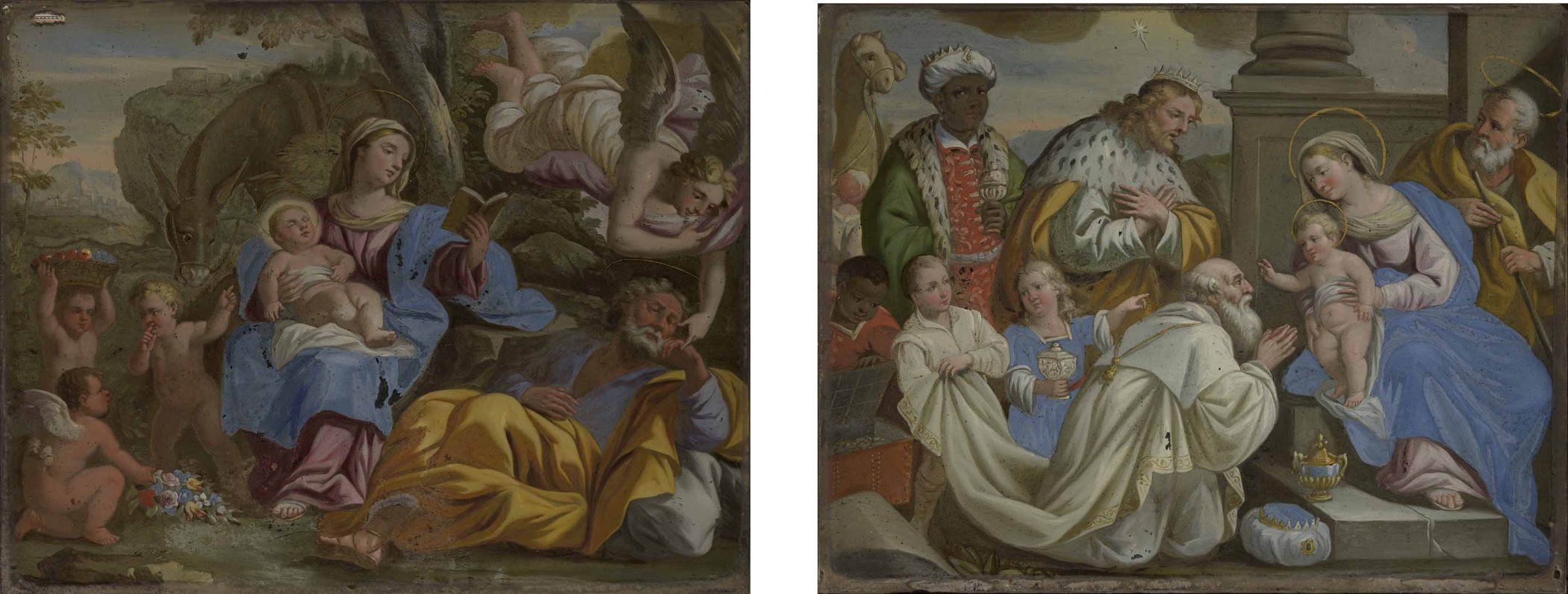
Adoration of the Magi - The Rest on the Flight into Egypt, c. 1695
oil on glass, 33,3 x 42,8 cm (13.11 x 16.85 inches)
Carlo Garofalo
(Naples, documented from 1688 to 1705)
Adoration of the Magi - The Rest on the Flight into Egypt, c. 1695
oil on glass, 33,3 x 42,8 cm (13.11 x 16.85 inches)
Re: 941
Provenance
Private collection
In front of a balustrade on which the base of a classical column rests, the Virgin and the blessing Child receive the Magi, who bring gifts to the Saviour. To the right, somewhat set back, Saint Joseph observes the scene, while on the opposite side, behind three children accompanying the kings of the East, a camel appears with its neck raised, as though it too wished to take part in the epiphany. In the second composition, the Holy Family rests in the shade of a tree, sheltered by a rocky outcrop. The rest during the flight into Egypt is enlivened by three putti, one of them winged, busy preparing garlands, while another angel is rousing Joseph, who lies dozing on the bundle of travel gear, urging him to resume the journey.
These refined paintings, executed as a pendant pair, are rare examples of the technique of reverse glass painting. This is an intricate procedure in which the artist had to hold the entire composition in mind from the outset and execute it in reverse directly on a sheet of glass, so that the glass would function as a kind of lens1. Unlike what occurred with painting on more conventional supports, where the details of the figures were refined at a later stage after the composition had been laid in, in the reverse-glass technique the figures had to be painted first; the setting was then defined, and finally the sky in the background. Reverse glass painting achieved such refinement as to emulate the sumptuary art of enamel "fissione", and thus qualified as a particularly precious technique: it was accordingly used above all in the decorative-arts workshops of the cities of Central Europe, known throughout the continent as centres for the production of sumptuous ceremonial objects2. In Italy, the production of glass is, naturally, more flourishing in the coastal cities, which were nonetheless open to cultural contacts with other areas of Europe. In Naples, particularly from the first half of the seventeenth century, genuine specialists in the reverse-glass technique began to appear on the art market; one of them, the Monogrammist V.B.L., identified by scholarship with the documented master Vittorio Billa, frequently signed his works, attesting to the pride of being esteemed almost on a par with painters of canvases and frescoes3. Aware of the potential of this kind of production, Luca Giordano himself also tried his hand at the technique; he certainly produced painted glass panels, but above all he supplied models to his numerous pupils so that they could reproduce his compositions on glass4. Bernardo De Dominici drew up a list, within Giordano's school, of painters who specialized in reverse-glass painting5: it includes Carlo Garofalo, Andrea Vincenti of Lecce, Domenico Perrone, Francesco della Torre — probably to be identified with the master today known as the "Monogrammist F.D.T."6 — and Domenico Coscia, the latter remembered above all as the author of glass panels that decorate the fronts of wooden cabinets.
Starting precisely from De Dominici's account, historiography has attempted to reconstruct the activity of some of these artists. The most highly regarded of the group was certainly Carlo Garofalo, the artist to whom the glass panels examined here are to be attributed7. Early sources already describe Garofalo as "the best of all"8 and from 1688 he was active at the court of Charles II of Spain as a painter "of large and small glass panels," to quote his own words9. In 1692 he was appointed royal painter by the sovereign; he then returned to Naples, where he died in 170510. Among the most important glass panels recognized as by Garofalo is certainly the Adoration of the Magi, formerly in Rome in the Funaro collection and sold at auction in Milan in 201011. This prototype's composition is in turn drawn from a work by Giordano — known through the variants of the canvas formerly in the Spencer Collection at Althorp House (Northamptonshire, United Kingdom)12 and of the glass panel signed by the head of the school together with its pendant depicting the Adoration of the Shepherds, today both in the collections of the Royal Palace of La Granja de San Ildefonso13 — other glass panels recently attributed to Garofalo by Elisa Acanfora are derived14. This thematic group certainly also includes the Adoration of the Magi illustrated here, very close to the formerly-Funaro version even in the repetition of certain details, such as the child lifting Melchior's cloak and the presence of Balthasar's black page — here absorbed in reading, whereas in the formerly-Funaro painting he closely watches over the chest full of gold.
A precise comparandum for the glass panel with The Rest on the Flight into Egypt can instead be identified in the analogous subject by Garofalo in a private collection, attributed to the master by Elisa Acanfora15. Here too we are dealing with the interpretation of a Giordano prototype, in this case the painting formerly in the collection of the Princes of Seclì of Lecce16, replicated by the head of the school on a smaller scale on the copper panel now in the Pinacoteca Comunale in Macerata (and in other, more loosely painted canvases, though considered equally autograph)17. In the glass panel published by Acanfora — the central section of a triptych that also includes a Nativity of the Virgin and a Christ in the Garden of Olives18, Garofalo freely interprets the model, deriving from it a vertical composition and changing the rural landscape on the left into a river landscape, with a stream flowing through rapids; here, by contrast, adherence to the prototype — though obviously in reverse, since the glass panel is executed as a mirror image — is substantially maintained, with the sole variation of the rocky outcrop on the left, which has lost its vegetation and now bears, rising from it, not a simple bastion as in Giordano's version on copper but a fully-fledged castle. A significant added detail is the fortified town that appears at the foot of the rocky mountain on the left, in which the artist displays remarkable executive refinement in sketching, against the light with fine touches of lead white, the profiles of the towers and the bell tower.
The paintings under examination thus stand as admirable evidence of the art of one of Giordano's most highly regarded pupils, capable of translating the master's manner into an affable eloquence of a character at once narrative and evocative — a quality, moreover, intrinsic to the technique in which he excelled. Garofalo's personal success, attested by the fact that in his most prestigious works he always signs himself with the epithet "Pictor Regius" or "Pictor Regis Catt." to underscore the honour received from the King of Spain, is borne out by a body of work for the market that is certainly more extensive than has so far been established by scholarship. The pendant pair presented here consequently represent important additions to the reconstruction of this remarkable master's catalogue.
1 On the technique of reverse glass painting and its development through the centuries, see: F. M. Tasso, entry Vetro dorato (graffito e dipinto), in Arti minori, Milan 2000, pp. 394-401; E. Borsook, Prefazione, in G. Funaro, E. Rivelli, Vetri dipinti italiani, Sant’Angelo in Vado, 1998, pp. VII-XVI.
2 On the art of painted glass, in particular in the German cities: F. Ryser, Verzauberte Bilder. Die Kunst der Malerei hinter Glas von der Antike bis zum 18. Jahrhundert, Munich 1991.
3 A. Gonzáles-Palacios, Il tempio del gusto. Le arti decorative in Italia tra classicismi e barocco. Roma e il regno delle Due Sicilie, Milan 1984, I, p. 231; Id., Il gusto dei principi. Arte di corte del XVII e del XVIII secolo, Milan 1993, I, pp. 133-137, II, pp. 115-124, figs. 194–214.
4 A. Gonzáles-Palacios, Un adornamento viscerale per Napoli, in Civiltà del Seicento a Napoli, exhibition catalogue (Naples, Museo di Capodimonte and Museo Pignatelli, 24 October 1984 – 14 April 1985), II, pp. 241-306, in particular pp. 294-296; L. Martino, Vetri dorati e graffiti e vetri dipinti a Napoli nel Seicento, in Barocco napoletano, edited by G. Cantone, conference proceedings (Centri e periferie del Barocco. Corso internazionale di alta cultura, Naples, 22 October – 7 November 1987, II), Rome 1992, pp. 711-728, in particular pp. 716-719.
5 B. De Dominici, Vite de’ pittori, scultori ed architetti napoletani, Naples 1742-1745, edition edited by F. Sricchia Santoro and A. Zezza, Naples 2017, pp. 860-861.
6 On this artist see: R. Ruotolo, Sul mobile napoletano del secondo Seicento: rivenditori e scrittoriari, scrittoi con cristalli dipinti e pittori su vetro, in “Ricerche sul ’600 napoletano”, 1999, pp. 111-116 (p. 115); L. Martino, in Ritorno al barocco. Da Caravaggio a Vanvitelli, edited by N. Spinosa, exhibition catalogue (Naples, Museo di Capodimonte and various venues, 12 December 2009 – 11 April 2010), Naples 2009, II, p. 160, no. IV.54.
7 On Carlo Garofalo: A. Schaller, entry Garofalo (Garofolo), Carlo, in Allgemeines Künstlerlexikon. Die bildenden Künstler aller Zeiten und Völker, 49, Munich, Leipzig 2006, p. 394 (with earlier bibliography); M. A. Pavone, Pittori napoletani della prima metà del Settecento. Dal documento all’opera, Naples 2008, pp. 104-105; E. Acanfora, Vetri dipinti e pratiche di copia nell’officina di Luca Giordano, in “Paragone”, LXXIII, 2022, 165-166, pp. 22-42 (pp. 24-29).
8 De Dominici cit., [1742-1745], 2017, p. 861.
9 J. R. Sánchez del Peral y López, Carlo Garofalo en España. Puntualizaciones sobre un pintor “giordanesco”, in "Goya", 2002, 288, pp. 172-180 (pp. 172, 176, doc. 1.1). The quotation is from a letter sent from Spain in 1691 by the painter himself.
10 O. Giannone, Giunte sulle vite de’ pittori napoletani, ms. [1771-1773], edition edited by O. Morisani, Naples 1941, p. 166.
11 G. Funaro, Il Seicento e Settecento e i vetri napoletani, in Funaro, Rivelli cit., 1998, pp. 39-85 (pp. 43, 61, pl. 15); Christie's, Dipinti antichi, Milan, 24 November 2010, no. 63.
12 K. J. Garlick, A catalogue of pictures at Althorp, in "The Walpole Society", XLV, 1974-1976, p. 33, no. 240. The work was sold at auction in London in 2012: Sotheby's, Old Master & British Paintings Evening Sale, London, 4 July 2012, no. 33.
13 O. Ferrari, G. Scavizzi, Luca Giordano. L’opera completa, Naples 2000, I, p. 322, no. A435, II, p. 705, fig. 568.
14 Acanfora cit., 2022, pp. 26-27, pls. 13a-15.
15 Achille Della Ragione had previously published the glass panel with an attribution to Domenico Coscia: A. Della Ragione, Nuovi saggi sui pittori napoletani del Seicento, Naples 2011, pp. 20-21, pl. 70; Acanfora cit. 2022, p. 28, pl. 7.
16 Ferrari, Scavizzi cit., 2000, I, p. 298, no. A280, II, p. 620, fig. 389.
17 R. Lattuada Attribuzioni a Christian Berentz, Rosa da Tivoli, Luciano Borzone, Charles Mellin e Luca Giordano per dipinti della Pinacoteca Comunale di Macerata, in Per la storia dell’arte in Italia e in Europa. Studi in onore di Luisa Mortari, edited by M. Pasculli Ferrara, Rome 2004, pp. 370-373.
18 Acanfora cit. 2022, pp. 22-23, 27-29, figs. 4b, 9. The Christ in the Garden of Olives was sold at auction in Genoa in 2008: Rubinacci, Asta di antiquariato, Genoa, 29 October 2008, no. 448.