

Lippo di Andrea di Lippo
(Florence c. 1370 - 1451 Florence)
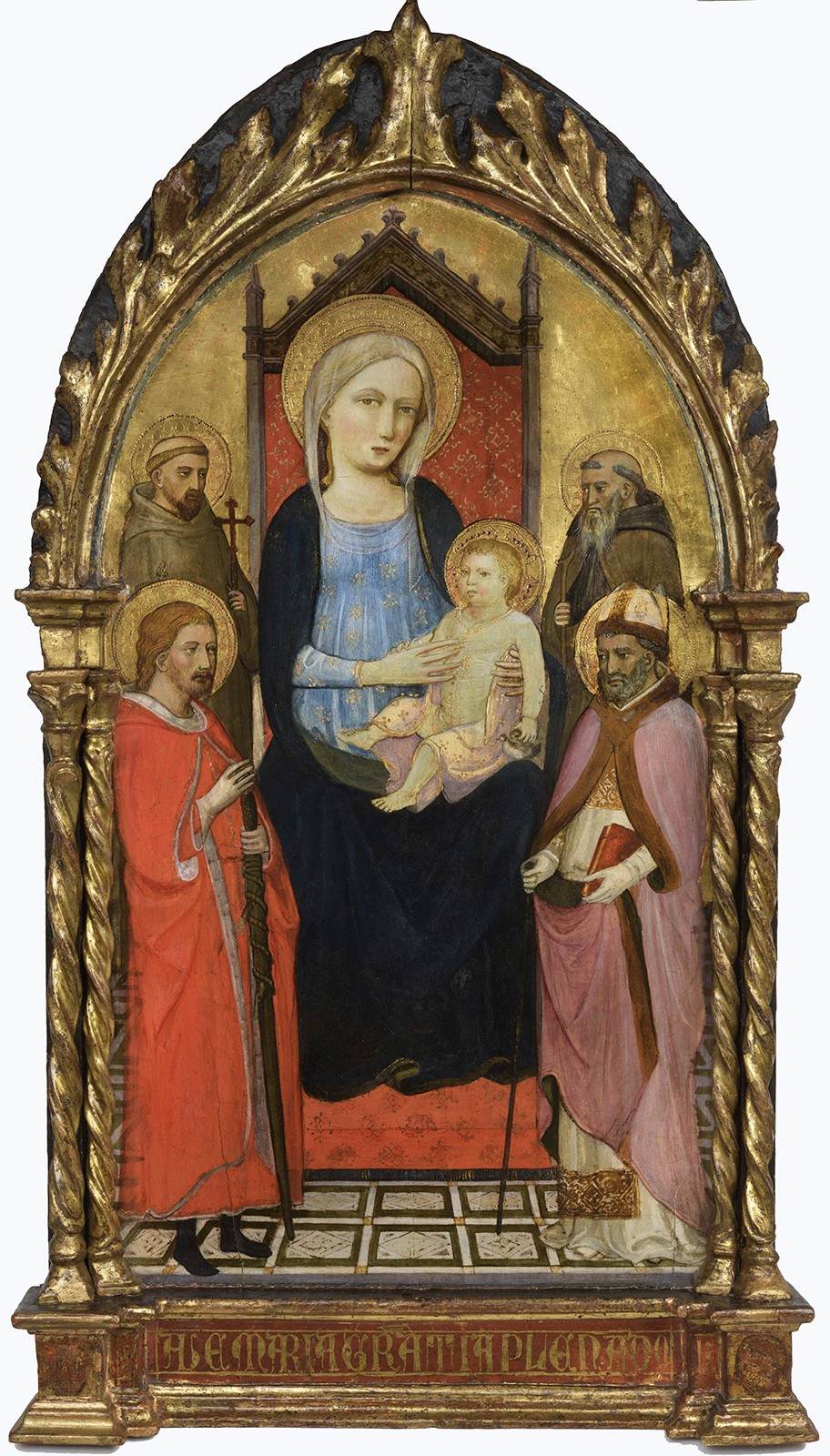
Madonna and Child Enthroned with Saint Francis of Assisi, Saint Anthony the Abbot, Saint Julian and a Bishop c. 1425
tempera on panel, gold ground, 76,5 x 43 cm (30.12 x 16.93 inches)
Lippo di Andrea di Lippo
(Florence c. 1370 - 1451 Florence)
Madonna and Child Enthroned with Saint Francis of Assisi, Saint Anthony the Abbot, Saint Julian and a Bishop c. 1425
tempera on panel, gold ground, 76,5 x 43 cm (30.12 x 16.93 inches)
Re: 932
Provenance
Milan, Finarte 20 October 1964, lot 10
Milan, private collection
Literature
R. Freemantle, Florentine Gothic Painters, Florence, 1975, pag. 424, no. 872
The publication by Ugo Procacci of the archival documents relating to the painter has made it possible to outline a sufficiently coherent biographical profile, thereby giving substance to the artistic personality of the “Florentine Lippo,” vaguely mentioned by Vasari and other Renaissance sources.1
Born in Florence around 1370–71, the artist was resident in the quarter of Santa Maria Novella, in the gonfalone of the White Lion, and is recorded as having been enrolled in the Arte dei Medici e Speziali by about 1395; in 1411 he appears among the members of the Compagnia di San Luca. Further documents from the same year attest to his involvement in the now-lost decoration of the Palazzo del Ceppo in Prato, while in 1416 he is documented in San Miniato al Tedesco, where he was engaged, among other works, in frescoing the high chapel of the church of San Domenico. A modern inscription, probably copied from the original, records the date 1420 at the base of the polyptych in the Yale University Art Gallery, New Haven, depicting the Madonna and Child enthroned with Saints Albert, Peter, Paul, and Anthony Abbot. In 1424 Lippo is mentioned together with Masolino. The prestigious position attained by the painter within the Florentine artistic milieu is further evidenced by the commission he received in 1436 from the Operai of the Cathedral of Santa Maria del Fiore, together with Rossello di Jacopo Franchi, Bicci di Lorenzo, and Giovanni dal Ponte, to paint in fresco the figures of the Apostles on the occasion of the cathedral’s consecration, a cycle that has unfortunately not survived. At the time of his declaration to the Catasto of 1446–47, the artist described himself as ill and unable to work for several years, and by 1451 he is recorded as deceased.
It was Serena Padovani who first proposed the identification of the “Florentine Lippo” with Lippo d’Andrea and begun the reconstruction of his artistic corpus on the basis of the surviving frescoes in the Nerli Chapel in the church of Santa Maria del Carmine in Florence.2 On the strength of these paintings, it has been possible to reassign to Lippo d’Andrea the majority of the works that Van Marle had previously attributed to the so-called Pseudo-Ambrogio di Baldese, with the sole exception of a group of paintings now assignable to the rediscovered Ventura di Moro, an artistic personality in certain respects parallel to that of Lippo, yet clearly distinct from him.3
Our painting, intended for private devotion, still has its original frame and arrived to us in very good condition, both with regard to the painted surface and the wooden support, as is further attested by the reverse of the panel. On the base plinth, the opening words of the salutatio angelica, “AVE MARIA GRATIA PLENA DO[MINUS]…” are inscribed in gilded capitals, while only faint traces survive of the coats of arms originally placed at either end. The Virgin supports the Child with both hands and is seated on a marble throne with a high back, enriched by a red textile decorated with gilded motifs and surmounted at the top by a robust, gabled triangular finial. With the exception of the bishop saint in the right foreground, whose attributes, consisting of a book and a staff, are too generic to allow for a secure identification, the identities of the remaining three saints are beyond doubt: Saint Francis of Assisi in the upper left, holding a cross in his left hand marked with the Stigmata; Saint Anthony Abbot in the upper right; and Saint Julian, depicted as a young knight, in the left foreground. Particularly noteworthy, and relatively rare within the artist’s oeuvre, is the pavement composed of rectangular panels rendered in strict perspective, each enclosing a lozenge containing a quatrefoil motif.
The painting appeared for the first time on the art market in Milan in 1964, attributed to the so-called Pseudo-Ambrogio di Baldese, and under this provisional critical designation it was reproduced in the photographic repertory compiled by Richard Fremantle. It resurfaced more recently in Milan with the generic attribution to a “Tuscan Master of the fifteenth century.”4 The attribution to Lippo d’Andrea now imposes itself with compelling clarity, in light of the numerous comparisons that may be drawn between the present painting and works long recognised as autograph by the artist. Particular attention may be drawn to the precise derivation of the divine group, and especially of the throne, from that in the aforementioned polyptych in the Yale University Art Gallery, New Haven (inv. 1871.22a–d), originally in the Carmelite convent of Santa Maria delle Selve at Lastra a Signa and bearing the date 1420.5
This comparison above all allows the present painting to be placed chronologically at an intermediate moment between the Yale polyptych and that in the Galleria dell’Accademia, Florence (inv. Dep. 18), datable to around 1430 and originally from the Ospedale di San Paolo in Piazza Santa Maria Novella, Florence, an institution founded in the thirteenth century and occupied until the late fifteenth century by the Friars of Penance of the Franciscan Third Order.6Our painting proves particularly exemplary of the significant effort at stylistic renewal undertaken by the artist, by then in his fifties, beginning with the aforementioned Yale polyptych. This process involved the assimilation and grafting, onto the trunk of his unwavering “Neo-Giottesque” cultural formation, of stylistic elements and accents derived from the most eminent artists active in Florence during the third decade of the fifteenth century. The classicising tone of the divine group and the interest in a more clearly articulated spatial setting, attested by the perspectival pavement, relate the present work to the contemporary experiments of artists such as Masolino da Panicale, first and foremost, but also Rossello di Jacopo Franchi and Giovanni dal Ponte, and even Fra Angelico, particularly with regard to the vivid chromatic range and the pervasive luminosity.The most plausible chronological placement for the present painting therefore appears to be around the mid-1420s, within a Florentine context of extraordinary cultural vitality that witnessed the emergence of the new Renaissance vision, while still offering ample scope to artists of solid quality such as Lippo d’Andrea, who worthily represented—enjoying the broad favour of both bourgeois and ecclesiastical patrons, the deeply rooted Late Gothic cultural matrix still active in the city.
1 U. Procacci, Letter to Roberto Salvini with Recollections and Some Information on Lippo d’Andrea, a Modest Painter of the Early Fifteenth Century, in Studies in the History of Art in Honour of Roberto Salvini, ed. by C. De Benedictis, Florence, 1984, pp. 213–226
2 S. Padovani, in Treasures of Ancient Art in San Miniato, ed. by P. Torriti, Genoa, 1979, pp. 55–56
3 For the so-called Pseudo-Ambrogio di Baldese, see R. Van Marle, The Development of the Italian Schools of Painting, vol. IX, The Hague, 1927, pp. 86–92. For Ventura di Moro, cf. E. Neri Lusanna, “Ventura di Moro: A Reassessment of the Circle of Pesello,” in Paragone, XLI, no. 485, 1990, pp. 3–20. On Lippo d’Andrea and the related bibliography, see at least A. Tartuferi, in The Martello Collection. Further Paintings, Drawings and Miniatures, 13th–18th Century, ed. by M. Boskovits, Florence, 1992, pp. 90–93; L. Pisani, “Late Gothic Painting in Florence in the 1430s: The Case of the Pseudo-Ambrogio di Baldese,” in Mitteilungen des Kunsthistorischen Institutes in Florenz, XLV, 2001 (2002), pp. 1–36; S. Chiodo, “Lippo d’Andrea: Problems of Iconography and Style,” in Arte Cristiana, XC, no. 808, 2002, pp. 1–16; S. Chiodo, “The Frescoes of the Church of San Domenico in San Miniato: A Little-Known Chapter of Florentine Painting between the Late Fourteenth and Early Fifteenth Centuries (Part II),” in Arte Cristiana, XCVI, no. 845, 2008, pp. 86–90; D. Parenti, in Il Tardogotico, “Cataloghi della Galleria dell’Accademia di Firenze – Dipinti,” vol. III, ed. by C. Hollberg, A. Tartuferi and D. Parenti, Florence, 2020, pp. 89–95
4 According to an annotation on the reverse of the photograph of the painting in the Berenson Phototheca at Villa I Tatti, Florence, the panel was sold at auction in Milan, Finarte, on 29 October 1964, lot 10. See also R. Fremantle, Florentine Gothic Painters, London, 1975, p. 424, fig. 872.
5 Cf. L. Kanter and P. Palladino, Italian Paintings at the Yale University Art Gallery, vol. I, 1230–1420, New Haven, Conn., 2025, pp. 182–189
6 On this important work by Lippo d’Andrea and its provenance, see D. Parenti, “A Polyptych by Lippo d’Andrea for the Ospedale di San Paolo in Florence,” in Paragone, LXV, Third Series, nos. 114–115, 2014, pp. 66–79