

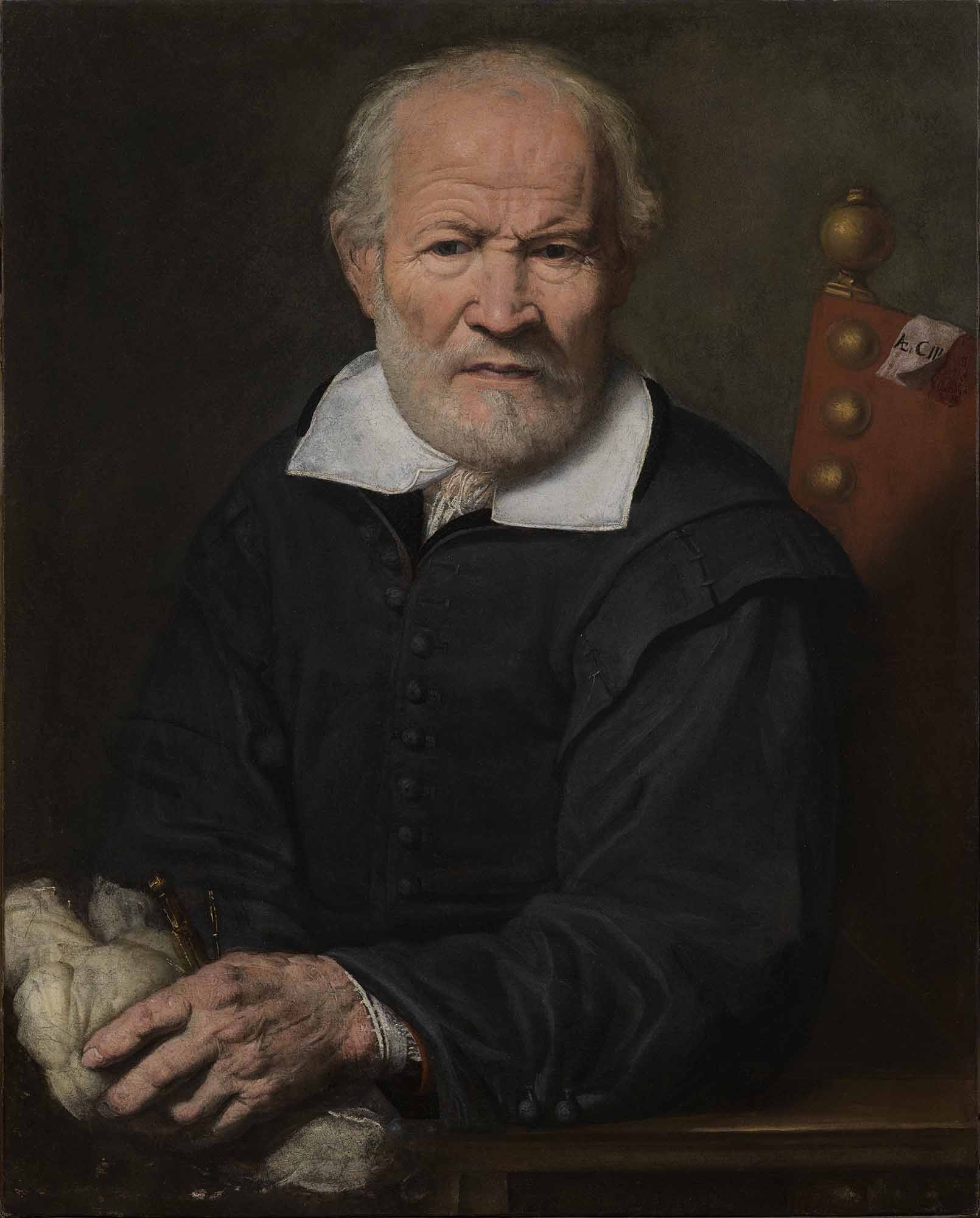
Pietro Bellotti (attr.)
(Roe' Volciano, 1625 – 1700 Gargnano)
Portrait of a Sculptor (Possibly Niccolo' Roccatagliata), c. 1660
oil on canvas, 86,5 x 69,5 cm (34.06 x 27.36 inches)
Pietro Bellotti (attr.)
(Roe' Volciano, 1625 – 1700 Gargnano)
Portrait of a Sculptor (Possibly Niccolo' Roccatagliata), c. 1660
oil on canvas, 86,5 x 69,5 cm (34.06 x 27.36 inches)
Re: 931
Provenance
Venice, private collection
Verona, private collection
Milan, private collection
Literature
L. Anelli, Pietro Bellotti 1625-1700, Brescia 1996, pp. 184, 402, n. R139.
Fondazione Federico Zeri
n. 32308
Fondazione Giorgio Cini Onlus
n. 70273
A mature gentleman is portrayed seated on an elegant leather chair adorned with a finial and gilt, sand-cast studs. His refined yet sober attire identifies him as a member of the educated bourgeoisie. In the hand extended toward the viewer he holds a roughly blocked piece of marble, perhaps the initial sketch of a classical deity, together with a sculptor’s drill. These attributes clearly identify him as an artist, while his deep, penetrating gaze, directed outward beyond the pictorial field, is plausibly aimed at the sitter whose physiognomy he is preparing to reproduce.
The painting, known for more than sixty years, constitutes a fascinating enigma within seventeenth-century portraiture in northern Italy. A photograph of the work preserved in the photo archive of Antonio Morassi, now part of his papers at Ca’ Foscari University of Venice, bears a note indicating that the canvas was located in a Venetian private collection in 19601. Morassi tentatively attributed the painting to Pietro Bellotti, a painter originally from Val Sabbia in the Brescian territory, but active primarily in Venice throughout his career as a formidable portraitist and painter of genre scenes.
Another photograph, however, now held at the Fondazione Giorgio Cini in Venice and originating from the photo archive of Rodolfo Pallucchini2, was filed by the scholar under the name of the Veronese painter Marcantonio Bassetti, a significant representative of an earlier generation, having been trained in Rome during an extended stay in close contact with the early followers of Caravaggio3. The reference to Bassetti reappears in an opinion by Giuliano Briganti, who, according to the testimony of the then owner, studied the painting in the 1980s, when it was held in a Veronese collection4. A third photograph of the work, now preserved at the Fondazione Federico Zeri in Bologna and accompanied by a letter from the owner dated 1986, was catalogued among anonymous Veronese painters5, thus confirming, albeit while rejecting the attribution to Bassetti, the shared perception of the painting’s cultural milieu.
The attribution to Bellotti, already suggested by Morassi, was advanced once again in 1996 by Luciano Anelli in his monograph devoted to the Lombard master6. Although Anelli had not been able to examine the painting firsthand and based his judgment solely on the old photograph from the Morassi archive, he noted that “one can detect magnificent passages of Bellotti’s painting in the hands, in the studs of the chair, and in the handling of the face,” concluding that “it is highly likely that, when the painting re-emerges from the collection that currently preserves it, we shall have yet another portrait by Pietro Bellotti.”
Anelli also discussed the cartellino affixed to the back of the armchair, which identified the sitter as Jacopo Sansovino. This identification, however, proved erroneous both in recording the age at which the Florentine sculptor and architect died, Sansovino died at the age of eighty-four, not ninety-two, as the inscription claimed, and in dating his death to 1620 rather than 15707. As demonstrated by a recent conservation treatment, the cartellino had been entirely manipulated during the eighteenth century: the inscription was therefore the result of a later overpainting, which was appropriately removed during cleaning. A new inscription has since come to light, this time original, reading: “AE(tatis) CIII.” Since it is entirely implausible that this refers to the age of the man depicted, who appears no older than sixty, it should instead be understood as a commemorative indication of the anniversary of birth of the sculptor portrayed.
The sitter cannot therefore be identified as Sansovino, born in 1486, nor as his Paduan follower Tiziano Aspetti, whose features are known to us through a portrait by Leandro Bassano, and which presents an entirely different physiognomy. It is possible, though this remains a hypothesis requiring further corroboration, that the sculptor depicted here may be identified as Nicolò Roccatagliata, born in 1559 and deceased in 1629, whose long Venetian career was marked by prestigious commissions for the major religious institutions of the lagoon and who was also a sought-after master of bronze statuettes and small marble works of a distinctly classicizing character8.
As far as attribution is concerned, the name of Marcantonio Bassetti appears entirely misleading, perhaps invoked precisely on account of the apocryphal date “1620” formerly recorded on the cartellino. The attribution to Bellotti, proposed by Morassi and reaffirmed by Anelli, rests on firmer ground, especially when considered in light of some of the Lombard master’s finest Venetian works, such as the celebrated Lachesis in the Staatsgalerie, Stuttgart, or the Fate Atropos in the Szépm?vészeti Múzeum, Budapest9. Nevertheless, the impression of robust realism, derived by Bellotti from the works of Monsù Bernardo and, more broadly, from northern masters active in Lombardy, is here ennobled by a disposition that looks instead toward official Renaissance portraiture, specifically recalling the legacy of Lorenzo Lotto and Giovanni Battista Moroni.
While maintaining Bellotti as the principal point of reference for the present inquiry, the author of this seductive and noble image should therefore be sought among the masters of eastern Lombardy, where stimuli arriving from Venice or from northern Europe were nonetheless integrated with the deeply rooted cultural substratum of a figurative tradition that had been sedimented over centuries.
1 The Antonio Morassi Archive, comprising over fifty thousand documents, is unfortunately not yet accessible online. The photograph of the painting was published by Luciano Anelli: L. Anelli, Pietro Bellotti 1625–1700, Brescia 1996, p. 184, fig. 145
2 Fondazione Giorgio Cini, Institute of Art History, Library, Pallucchini Archive, catalogue record no. 70273
3 For Marcantonio Bassetti, see: A. Ottani Cavina, Marcantonio Bassetti, in Arte antica e moderna, 26, 1964, pp. 151–166; and more recently: D. Dossi, Marcantonio Bassetti, Venezia e la pietra di paragone, in Arte documento, 30, 2014, pp. 96–99; and G. Papi, Tre dipinti di Marcantonio Bassetti, in idem, Senza più attendere a studio e insegnamenti. Scritti su Caravaggio e l’ambiente caravaggesco, Naples 2018, pp. 107–117
4 The owner’s letter, in which Briganti’s expertise is mentioned and which is dated 19 August 1986, is attached to the work’s record in the Fondazione Federico Zeri
5 Fondazione Federico Zeri, Fototeca Anna Ottani Cavina, n. 32308
6 L. Anelli, Pietro Bellotti 1625-1700, Brescia 1996, p. 184, ill. 145, p. 402, n. R139
7 On Jacopo Sansovino as sculptor and architect, see: M. Morresi, Jacopo Sansovino, Milan, Electa, 2000
8 On Nicolò Roccatagliata, see: C. Kryza Gersch, Nicolò Roccatagliata, in “La bellissima maniera”. Alessandro Vittoria e la scultura veneta del Cinquecento, edited by A. Bacchi, L. Camerlengo and M. Leithe-Jasper, exhibition catalogue (Trento, Castello del Buonconsiglio, 25 June – 26 September 1999), Trento 1999, pp. 441–457; L. Siracusano, “Roccatagliata, Nicolò,” in Dizionario biografico degli italiani, vol. 88, Rome 2017
9 For these works, see most recently: Pietro Bellotti e la pittura del Seicento a Venezia. Stupore, realtà, enigma, edited by F. Ceretti, M. Nicolaci and F. Piazza, exhibition catalogue (Venice, Gallerie dell’Accademia, 19 September 2025 – 18 January 2026), Florence 2025, pp. 104–105, 108–109, nos. 1, 3