

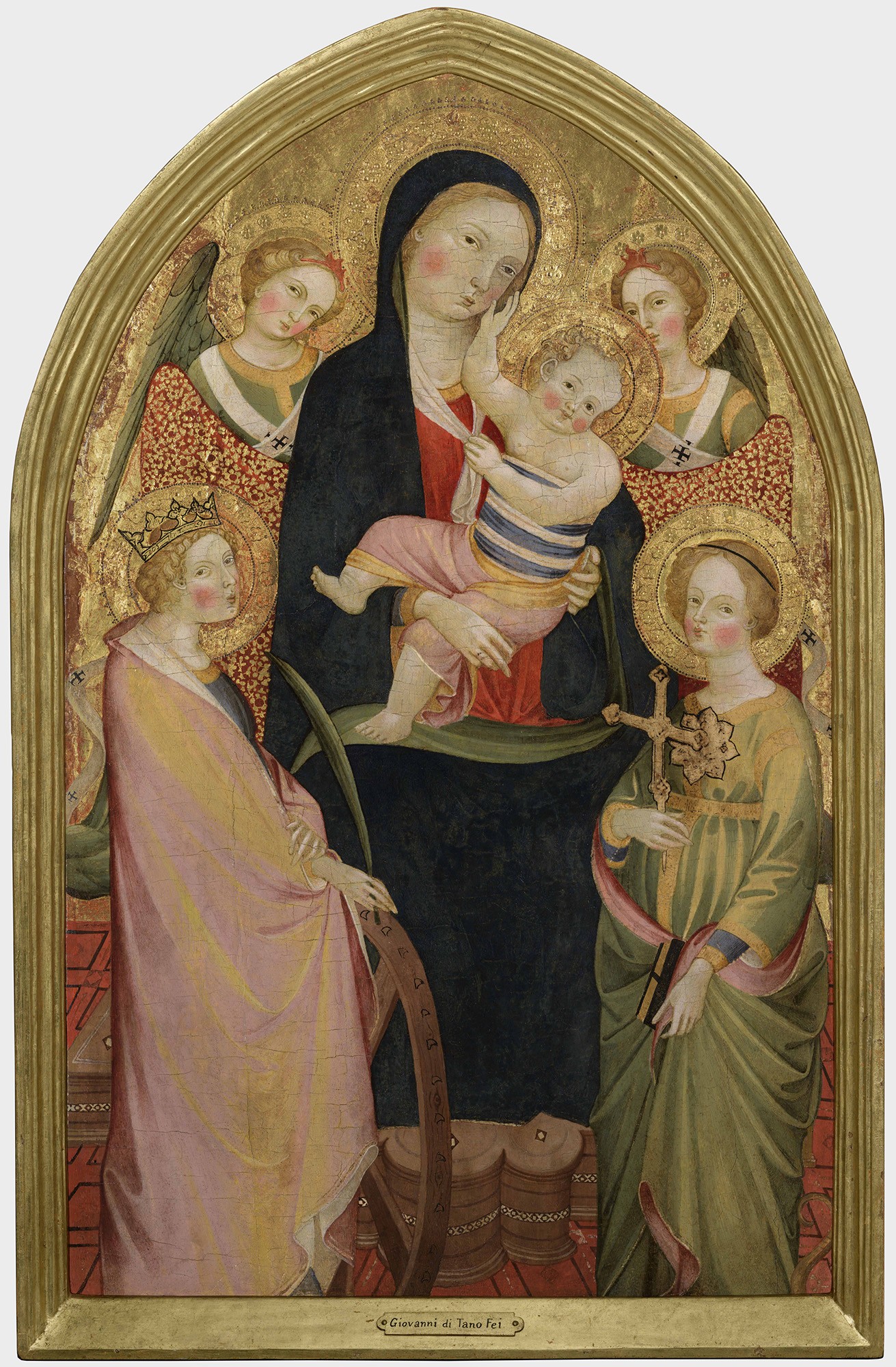
Giovanni di Tano Fei
(Florence documented from 1386 - active until 1415/1416 Florence)
Madonna Enthroned with Child Between two Angels, S. Catherine of Alexandria and S. Margareth, c. 1404
tempera on panel, gold ground, 82 x 51,5 cm (32.28 x 20.28 inches)
Giovanni di Tano Fei
(Florence documented from 1386 - active until 1415/1416 Florence)
Madonna Enthroned with Child Between two Angels, S. Catherine of Alexandria and S. Margareth, c. 1404
tempera on panel, gold ground, 82 x 51,5 cm (32.28 x 20.28 inches)
Re: 925
Provenance
Private collection
Fondazione Federico Zeri
No. 4902
This painting was already attributed to the Florentine painter Giovanni di Tano Fei by Federico Zeri, as recorded in entry no. 4092 of his Fototeca Zeri, which also notes its presence in a private collection in Naples1 in 1991. The painting, now lacking its original frame, has been trimmed by about twenty centimetres along the lower edge, yet the painted surface has survived in good overall condition. The missing predella may originally have contained, as was often the case, a Marian invocation or a sequence of saints—frequently shown half-length—flanking either a Man of Sorrows with the mourners, or a Nativity.
The Virgin, seated on a throne of which only portions of the trilobed base with its simple faux-inlay decoration are still visible, supports in her lap a lively, sturdy Child who kicks his legs playfully. With his right hand, the Christ Child tenderly caresses his Mother’s face, in a gesture of strikingly natural intimacy not found in the painter’s other known works. The throne and the two saints in the foreground rest on a bright red tiled pavement, a motif typical of many panels made for private devotion in Florence between the Trecento and Quattrocento, and one especially favoured by Giovanni di Tano Fei. The throne’s structure is entirely concealed by an elegant red cloth with gold decoration, held aloft by two angels; their long, cross-marked stoles—another motif the artist repeats in other works—spiral downward behind the two saints. A similar drapery, both in overall design and partly in its decorative pattern, appears in the Madonna of Humility with Two Angels once in the Gianfranco Luzzetti Collection and now in the museum bearing his name in Grosseto, which was published by A. Tartuferi2.
The two graceful, full-figured female saints can be identified as St Catherine of Alexandria on the left -depicted in profile in a strikingly natural pose as she turns toward the viewer- and, in all likelihood, St Margaret on the right, holding a processional cross, one of her most distinctive attributes3.
The artist’s training in the circle of Agnolo Gaddi, first hypothesised by Miklós Boskovits, remains a credible proposition; Boskovits also famously emphasised “his burlesque, almost savage expressionism,” a quality that had led Federico Zeri to suggest a possible Iberian origin. The more Spanish-tinged elements of his style are most probably explained by his familiarity with the works of Gherardo Starnina and, more specifically, of Scolaio di Giovanni -known as the Master of Borgo alla Collina- whose repertoire includes paintings remarkably close to Giovanni di Tano Fei’s results4. Also relevant are the documented ties with the celebrated merchant Francesco Datini of Prato, for whom the painter supplied works destined for the wealthy Avignonese market5.
Given the panel’s substantial dimensions, especially if one considers the extent of the lower section now lost, it seems plausible that the work originally stood on the altar of a chapel within a church rather than being intended for private devotion. It cannot be ruled out that the painting formed the central compartment of a triptych, although none of the works thus far attributed to the artist can be convincingly linked to it as wings or related elements.
The stylistic features of the panel appear to place it in a later phase than the group of works datable to around 1400, well represented by such key pieces as the triptych for the altar of the chapel of the Serristori Hospital in Figline Valdarno (dated 1399) and the surviving fresco fragments of the Ascension of Christ and the Noli me tangere between the first and second bays of the left aisle of Santa Croce in Florence, likely related to a document of April 14026.
This later phase shows the painter pushing to the extreme the more idiosyncratic elements inherited from the cultural matrix of Agnolo Gaddi -under whom he trained- coming closer to the strongly expressive solutions of painters such as Cennino Cennini and the Master of Sant’Ivo7. The decisive encounter with Gherardo Starnina’s painting, following the latter’s return from Spain to Florence around the end of 1404, inevitably shaped Giovanni di Tano Fei’s stylistic development from the second half of the first decade of the Quattrocento onward. The present panel seems to belong precisely to this moment, and an especially pertinent comparison -both in draughtsmanship and in style- can be made with the panels of the triptych in the Basilica of Santa Maria at Impruneta, near Florence. In particular, one notes the close similarity between the Madonna’s head in the two works, as well as the striking affinities between the two music-making angels at the base of the throne and the saints in the present panel: a convergence evident not only in the rendering of the draperies but also in the joyous, almost light-hearted emotional tone of the figures, which seems designed to encourage a less “austere” form of devotion—an aspect that must have pleased the artist’s patrons.
In conclusion, this is a work of notable quality, confirming Giovanni di Tano Fei as one of the most original painters of his generation, and among the most receptive to the innovations of the late Gothic style within the vibrant artistic milieu of early fifteenth-century Florence.
1 The artist’s personality was first identified by Richard Offner, who provisionally named him the “Metropolitan Master of 1394,” after the triptych with the Coronation of the Virgin and Four Saints now at the Metropolitan Museum of Art, New York (inv. 50.229.2). This work had been commissioned by Alderotto Brunelleschi for his chapel in the church of San Leo, Florence (see R. Offner – H. B. J. Maginnis, A Legacy of Attributions, “Corpus of Florentine Painting – Supplement,” New York 1981, p. 59). A first nucleus of works was attributed to this anonymous master some sixty years ago by Federico Zeri, who -based on his notes on the Lindenau Museum in Altenburg, published in “Bollettino d’Arte,” XLIX, 1964, pp. 49–50- described him as a “bizarre expressionist” Florentine painter trained in the circle of Agnolo Gaddi. The most important contribution to the reconstruction and chronological organization of the artist’s oeuvre, however, remains that of Miklós Boskovits, in his seminal volume Pittura fiorentina alla vigilia del Rinascimento, 1370–1400 (Florence 1975, pp. 131–132, 241 nn. 188–190, and 359–362). Boskovits not only proposed the now generally accepted critical designation “Master of 1399,” but also suggested identifying the painter with the documented Florentine artist Giovanni di Tano Fei. Further insights into the painter’s work have been provided by E. Merciai, Il probabile Giovanni di Tano Fei: un interprete bizzarro del gotico internazionale a Firenze, in “Arte Cristiana,” XCI, no. 815, 2003, pp. 79–91; and by A. Tartuferi, Giovanni di Tano Fei, in Dalla tradizione gotica al primo Rinascimento, exhibition catalogue, Moretti, Florence 2009, pp. 98–103; and idem, in Arte e Figline. Dal Maestro della Maddalena a Masaccio, exhibition catalogue (Figline Valdarno, Palazzo Pretorio, 16 October 2010 – 16 January 2011), ed. A. Tartuferi, Florence 2010, pp. 134–139.
2 A. Tartuferi, in Collezione Gianfranco Luzzetti. Dipinti, sculture, disegni, XIV-XVIII secolo, by A. Tartuferi, Florence 1991, pp. 49-51.
3 For the iconography of Saint Catherine of Alexandria, see G. Kaftal, Iconography of the Saints in Tuscan Paintings, Florence 1952, vols. 225–234; P. Assion, Katharina von Alexandrien, in Lexikon der Christlichen Ikonographie, ed. W. Braunfels, vol. VII, Rome–Freiburg–Basel–Wien 1974, cols. 289–297. For the iconography of Saint Margaret, see Kaftal 1952, cols. 661–665; A. Tartuferi, La decorazione miniata del codice Riccardiano 453 e la Leggenda di Santa Margherita di Antiochia nella pittura italiana fra Due e Trecento: alcune osservazioni, in Le leggende di santa Margherita e sant’Agnese, ed. G. Lazzi, Castelvetro di Modena 2009, pp. 11–28.
4 For further reference see A. Lenza, Il Maestro di Borgo alla Collina. Proposte per Scolaio di Giovanni pittore tardogotico fiorentino, Florence 2012, p. 25, which points out the interaction between the two artists.
5 Cf. A. Labriola, in Da Bernardo Daddi al Beato Angelico a Botticelli. Dipinti fiorentini del Lindenau-Museum di Altenburg, edited by M. Boskovits with D. Parenti, Florence 2005, p. 118 and note 14.
6 Cf. A. Labriola, in Da Bernardo Daddi al Beato Angelico a Botticelli. Dipinti fiorentini del Lindenau-Museum di Altenburg, edited by M. Boskovits with D. Parenti, Florence 2005, p. 118 and note 14.
7 For Cennino Cennini, see the seminal essay by M. Boskovits, Cennino Cennini – Pittore nonconformista, in Mitteilungen des Kunsthistorischen Instituts von Florenz, 2-3, 1973, pp. 201–222, and idem, in Pittura fiorentina …, cit., 1975, pp. 129–132 and 294–295.
For the Master of Sant’Ivo, see A. Tartuferi, A New Painting and Date, in The Ringli Triptych. A New Discovery by the Master of Sant’Ivo, Salamon Old Masters, Milan 2019, pp. 9–25; F. Baldini and G. Pedani, Maestro di Sant’Ivo, in Il Tardogotico, “Cataloghi della Galleria dell’Accademia di Firenze”, vol. III, edited by C. Hollberg, A. Tartuferi, D. Parenti, Florence 2020, pp. 141–150.
Cf. M. Boskovits, Pittura fiorentina —, cit., 1975, p. 241 note 188 and p. 361.
-