

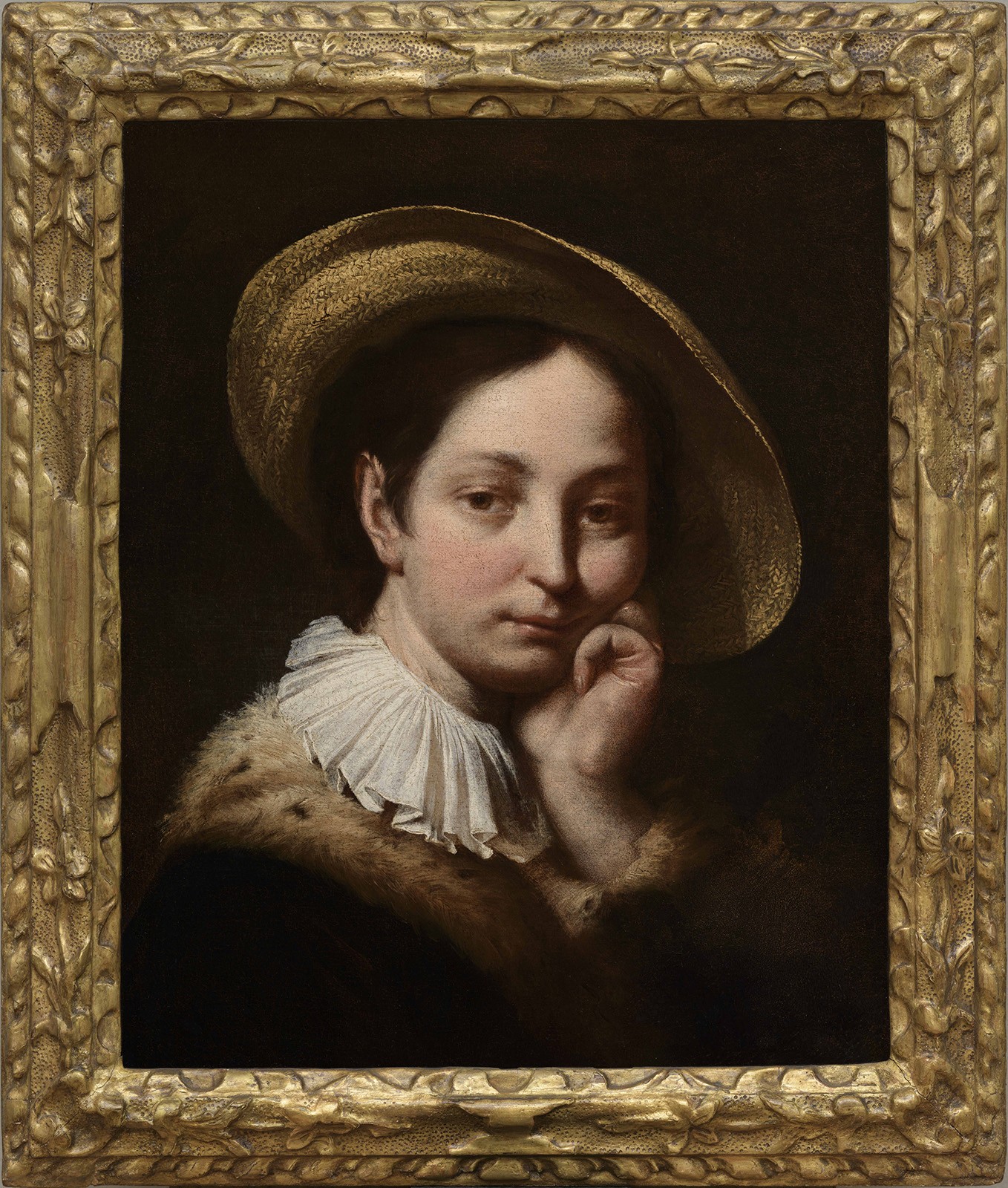
Domenico Fedeli, called Maggiotto
(Venice 1712 - 1794 Venice)
Portrait of a Young Boy with a Hat and a Fur Collar, c.1760
oil on canvas, 44,5 x 36,5 cm (17.52 x 14.37 inches)
Domenico Fedeli, called Maggiotto
(Venice 1712 - 1794 Venice)
Portrait of a Young Boy with a Hat and a Fur Collar, c.1760
oil on canvas, 44,5 x 36,5 cm (17.52 x 14.37 inches)
Re: 890
Provenance: Como, private collection
A young boy, depicted slightly in three-quarter view, looks intently towards the observer, while resting the left side of his face on his half-closed hand. His clothing conceals a sharp contrast between the straw hat, usual for shepherds, and the dark dress with fur collar and lapels, which presupposes the young man's belonging to a wealthy class, is striking. The boy's meditative attitude can provide the key to resolving this apparent contradiction: in a world of make-believe, in which the rich and powerful play at imagining themselves as shepherds, only the deepest aspect of humanity emerges in the end, beyond all social pretence. This interpretation is based on the literary and philosophical movement of Arcadia, which arose in Rome in 1690, but also of the many ‘pastoral’ fables in vogue throughout the European courts in the early 18th century. This portrait thus represents an exercise in style among the practice of ‘heads of character’. And becomes an apologue on the relationship between reality and appearance, following a leitmotif that was widespread in the literature and theatre of the Rococo era.
The painting is part of the conspicuous group of portraits with a naturalist imprint attributable to artists trained in the workshop of Giovan Battista Piazzetta (1682 - 1754)[i]. It is well known that, starting from the second decade of the 18th century, Piazzetta's school was a meeting place for young, sometimes very precocious talents, who trained their manner by copying the master's masterpieces. These painters were rather slow to achieve autonomy in their profession, as evidenced by their late registration at the Fraglia. Certainly in their youth, working side by side with the leader of the school, they measured themselves in the production of half-figure paintings of a devotional nature (Saints or Prophets) or genre subjects. These were often portraits of commoners and children, which were already customary in the master's poetics[ii].
The most long-lived of the artists of the Piazzetta school is Domenico Fedeli known as Maggiotto, author of the portrait presented here[iii].
Maggiotto, born in 1712, has been documented in Piazzetta's workshop from the age of ten. He remained there until the master's death, which was presumably in 1754, the same year that we can document Maggiotto’s first work for public use, the altarpiece with Saints Nicholas Bishop and Leonard and the Blessed Archangel Canetoli for the Venetian church of San Salvador[iv]. However, due to Maggiotto’s age being around forty years old by this time, we presume his beginnings are to be sought around twenty years earlier in paintings for private use depicting subjects of a popular nature. This is the case with the large Pastorale, now in the Kunsthalle collection in Hamburg[v]: a work with a distinctly Piazzetta influence, which reveals the taste for detail and portraiture that Maggiotto himself was known for. Indeed, the latter differs from the master by virtue of a less rapid and synthetic, and consequently a more analytical character held in the compositions. The boy in the Pastoral, who is riding on a black goat and gazing fixedly at the observer as he hands a cup of wine to the sleeping woman, is close in approach to the pensive young man described in our painting. And even more so is the Pollaiola, leaning on a plane beside her basket with a rooster, in an admirable portrait of Maggiotto held by the Galleria Sabauda in Turin[vi]. It is true that these figures show a more pronounced expressive character than the Giovinetto con cappello da pastore (Young Man with Shepherd's Hat) depicted here, which may presuppose a slight shift forward in chronology of the painting under examination compared to the above examples. As mentioned above Maggiotto was a faithful epigone of the master Piazzetta until his death. It is only after 1754 that he seems to dilute the strong chiaroscuro and broad gestures of the master's figures in a flatter way, in which the Piazzetta model is overlaid by those of the Chiarist painters and, especially in the portraits, Pietro Longhi. This is the case with the Two Children with a Wicker Basket from the Museum of Fine Arts in Boston[vii ] or the Woman Pouring Coffee from the collection of Stockholm University[viii], texts that are similar in style to the portrait presented here and that show the admirable capacity for introspection of one of the most perceptive narrators of Venetian art in the mid 18th century.
[i] For a comprehensive analysis of the artists trained at Piazzetta's school, see the catalogue Giambattista Piazzetta. Il suo tempo, la sua scuola, exhibition catalogue (Venice, Ca' Vendramin Calergi, 28 May - 25 September 1983), Venice 1983 and R. Pallucchini, La pittura nel Veneto. Il Settecento, II, Milan 1996, pp. 155-195. See also the numerous monographic contributions dedicated to these painters over about half a century of study by Ugo Ruggeri.
[ii] The richness and complexity of Piazzetta's production of this type of subjects - a group of which, of course, a conspicuous number of painted testimonies are still conserved today - can be well assessed by the enormous quantity of engravings that were produced in Venice, from the inventions of the leader of the school, in the second half of the 18th century: on this subject, see the catalogue L'eredità del Piazzetta. Volti e figure nell'incisione del Settecento, exhibition catalogue (Venice, Palazzo Ducale, Sala dello Scrutinio, 22 June - 15 September 1996), Venice 1996.
[iii] On Maggiotto see: C. Donzelli, I pittori veneti del Settecento, Florence 1957, pp. 138-139; R. Pallucchini, La pittura veneziana del Settecento, Venice-Rome 1960, pp. 160-161, 285; M. A. Bulgarelli, Profilo di Domenico Maggiotto, in ‘Arte veneta’, XXVII, 1973, pp. 220-235; F. Del Torre, Per un catalogo di Domenico Maggiotto, in ‘Atti dell'Istituto Veneto di Scienze, Lettere ed Arti’, CXLVI, 1987-1988, pp. 87-112; E. Merkel, voce Fedeli, Domenico, detto il Maggiotto, in Dizionario biografico degli italiani, 45, Roma 1995, pp. 596-600; I. Tozzi, voce Maggiotto, Domenico, in Allgemeines Künstler-Lexikon, 86, Berlin 2015, p. 324.
[iv] The altarpiece was left in the sketchy state by Piazzetta: Del Torre cit. 1987-1988, p. 99, no. 17.
[v] Inv. NK-30. M. Sitt, in Die Sammlungen der Hamburger Kunsthalle. Die deutschen, englischen, französischen, italienischen und spanischen Gemälde 1350-1800, edited by U. M. Schneede and M. Sitt, Hamburg 2007, I, pp. 144-146.
[vi] E. Merkel, in Giambattista Piazzetta cit. 1983, p. 158, no. 64.
[vii] Inv. 38.1733. A. Murphy, European paintings in the Museum of Fine Arts, Boston. An illustrated summary catalogue, Boston 1985, p. 173.
[viii] S. Karling, The Stockholm University collection of paintings, Uppsala 1978, p. 29.