

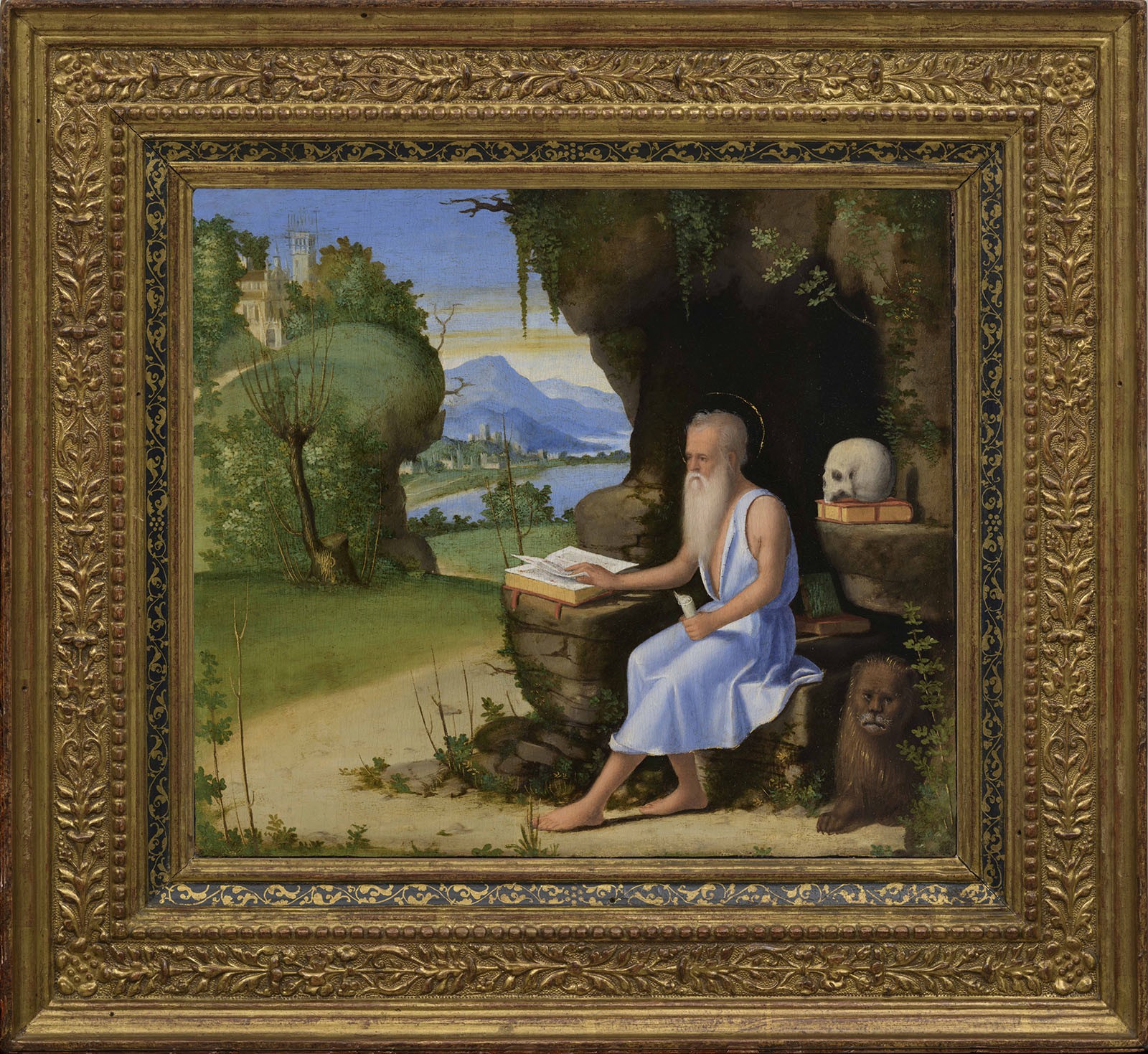
Andrea Previtali
(Brembate di Sopra c. 1480 - 1528 Bergamo)
S. Jerome Meditating in his Cave, c. 1515
oil on panel, 23,4 x 26,3 cm (9.21 x 10.35 inches)
Andrea Previtali
(Brembate di Sopra c. 1480 - 1528 Bergamo)
S. Jerome Meditating in his Cave, c. 1515
oil on panel, 23,4 x 26,3 cm (9.21 x 10.35 inches)
Re: 887
Provenance: Florence, Serristori collection
Literature
A. Colasanti, Due quadri inediti di Andrea Previtali, in “L’arte”, XI, 1908, pp. 52-53
F. Heinemann, Giovanni Bellini e i belliniani, Venice, 1962, I, p. 142, n. S.348
J. Meyer zur Capellen, Andrea Previtali, PHD Diss., University of Würzburg, 1972, p. 148, n. 26
I Chiappini, in I pittori bergamaschi dal XIII al XIX secolo. Il Cinquecento, I, Bergamo, 1975, p. 138, n. 62
F. Heinemann, Giovanni Bellini e i belliniani. Supplemento e Ampliamenti, New York, 1991, p. 51, n. S.348, fig. 94
M. Lucco, in Bergamo. L’altra Venezia. Il Rinascimento negli anni di Lorenzo Lotto 1510-1530, by F. Rossi, exhibition catalogue (Bergamo, Accademia Carrara), Milan 2001, p. 120
A. Tempestini, Giovanni Bellini e i pittori belliniani, Florence, 2021, p. 207, n. 751
FOTOTECA ZERI
No. 39654
Saint Jerome is depicted during his hermitage period, in the desert near the city of Chalcis in present-day Syria, barefoot and clad only in a pale blue robe, which opens revealing his chest over waist height. He is depicted alongside a lion, which according to the account narrated in the Golden Legend[i], Jerome himself had healed and welcomed into his monastery. The saint here is in the act of reading a volume, while with his left hand clenched into a fist he clutches a roll of parchment. His gaze, however, appears distracted from reading and lost in the void to the left: he is meditating on the imperfection of earthly knowledge, represented precisely by the book, in the face of divine illumination. In the Epistolae (22, 30) in fact, Jerolame recounts the episode of the so-called ‘Ciceronian dream’. This episode took place in Antioch and here Christ -the judge- appeared to him in a dream, ordering him to abandon the study of profane literature and turn only to the contemplation of God and nature. In this painting, the image of the desert, transformed into a luxuriant garden, alludes precisely to the saint's conversion, and thus to rebirth to new life.
The painting in question became known by Arduino Colasanti, who attributed it to the Bergamasque painter Andrea Previtali in an article published in 1908 in the magazine ‘L'arte’[ii]. Colasanti gave an account of the purchase of this panel by Marquis Serristori, which probably took place shortly before, ‘at the point when it (the painting) was about to be thrown on the antiques market’. The historian highlighted the Giorgionesque character of the landscape on the left, the true protagonist, in his opinion, of the composition (‘a country that, between two wings, seems to expand beyond the boundaries of reality’). Colasanti's astonished gaze on this masterful work was also shared by Fritz Heinemann (1962)[iii]. Heinemann further found a direct comparison in the altarpiece of the transfigured Christ, commissioned from Previtali by the Casotti de Mazzoleni family for their aristocratic chapel in the church of Santa Maria delle Grazie in Bergamo (today at the Brera Art Gallery, inv. 306)[iv]. The German historian did not fail to emphasise the influence that the Venetian master Marco Basaiti had on the painter, postulating, perhaps, the painting's similarity to the panel of the same subject painted by Basaiti and preserved today in the Gallerie dell'Accademia in Venice.
The fact that Previtali's style in this painting is substantially independent from the models of Lorenzo Lotto, who first came to Bergamo in the early months of 1513 to paint the altarpiece for the high altar of the church of Santi Bartolomeo e Stefano, led critics to date it within the first half of the century. Albeit this hypothesis was not entirely unanimous, it is consistent with other works by our painter from the same period, such as the Virgin and Child with St. John in a Landscape, a work signed and dated 1510, now in the Gemäldegalerie in Dresden.
Andrea Previtali[vi], originally from Brembate di Sopra and born into a family of rope and needle merchants, already presented himself as a pupil in the Venetian workshop of Giovanni Bellini[vii] in his first signed work, the Madonna and Child with Donor of 1502 in the Musei Civici agli Eremitani in Padua. The custom of young artists moving from the Bergamo valleys to Venice to complete their training in the ateliers of the lagoon islands was very frequent. Indeed, Palma il Vecchio, Giovanni Cariani and Girolamo da Santacroce have been attested to have followed the same custom. The influence of Bellini is clear throughout the first phase of Previtali's career, up to around 1506, when he showed a growing adherence to the manner of Giorgione. This is attested by the panels with the Stories of Damon and Tirsi, purchased by the National Gallery on the initiative of Kenneth Clark as autographs of the master from Castelfranco. Another significant influence for Previtali were the works of Dürer's second Italian sojourn (think of the Portrait of a Woman now in the Worcester Art Museum). Previtali's ductility and ability to acquire and sediment very different figurative experiences allowed him to take on a guiding role for local artists when he decided to return to Bergamo around 1511. From 1514 onwards, the comparison with the Bergamo works of Lorenzo Lotto became increasingly clear, which became the decisive aspect of his maturation in the last fifteen years of his activity.
The development of Previtali's career can be appreciated by comparing our painting with other paintings with the same subject about a decade later. If the San Girolamo penitente - already in the Sandor Lederer collection in Budapest[viii] and later at the Moos Gallery in Toronto[ix] - is a copy of Lotto's famous canvas now in the Art Museum in Allentown (Pennsylvania), the painting formerly in Arno Rota's collection in Bergamo[x] and the one from a private Milanese collection presented by Mauro Lucco in a 2001 exhibition at the Accademia Carrara[xi], which had already been published in 1938 by George Martin Richter in a short communication in Burlington Magazine[xii], are closer in composition to our panel.
In both these redactions, Jerome is kneeling and brings the stone to his chest in sign of contrition, while he turns his gaze to the crucified Christ who appears to him on the left side of the cave[xiii]. The landscape is limited to a wide cleft in the rock in the central area, and does not occupy the entire left side of the composition, as is the case in our painting. The first detail that leaps to the eye is the change in the pose of the saint.
While in the Serristori painting he appears seated on the rock, and thus replicates the similar figures in Giovanni Bellini's various precedents (especially in the panel in the National Gallery of Art in Washington), in Previtali's two other redactions he is kneeling. This iconography rather recalls Lotto's works now in the Louvre and the Museo Nazionale di Castel Sant'Angelo in Rome respectively, but above all it is the conceptual approach that has changed. In the painting analysed, as Arduino Colasanti had already recognised and Ileana Chiappini[xiv] reiterated, it is the landscape that takes on the role of the true protagonist, in a poetic interpenetration in the style of Giorgionesque mysticism and description of the natural world. The town of Chalcis, with the cathedral sprouting with its bell tower amidst the tree foliage on the hillside, is imagined as a Venetian village immersed in greenery. While in the distance the blue mountains dominate with a profile similar to that of the Dolomites. In the two redactions of Saint Jerome kneeling before the Crucifix, the landscape is confined to the opening of the cave and does not have the same symbolic importance. Here it is rather the silent conversation between Jerome and Christ on the cross that turns our gaze to a development that appears more narrative and less evocative. Therefore, the San Girolamo Serristori reveals itself as the closest point of connection between Previtali's art and the poetry of Giorgione's paintings, the latter suspended more often than not in a lyrical dimension that is foreign to the need for narrative. It is no coincidence that a pertinent comparison can also be made with another of Previtali's masterpieces, dense with silent Giorgioneism: the Nativity, presented in recent years by the Galleria Salamon in Milan[xv]. Here, too, the miracle of the incarnation is illustrated in an extremely luxuriant bucolic setting, with the green pastures endlessly disappearing behind the hut, and the shepherds unaware of the presence of the Holy Family, and thus continuing to peacefully tend their flocks. It is precisely this feeling for nature, with its almost romantic contours, that Previtali would pass on as a dowry to the Lombard, and especially Bergamasque, painters of the next generation, leaving his name among the great masters of the magnificent season of the Po Valley Renaissance.
[i] Jacopo da Varazze, Legenda Aurea, [1297], ed. edited by E. and L. Vitale Brovarone, Turin 1995, p. 807.
[ii] A. Colasanti, Due quadri inediti di Andrea Previtali, in ‘L'arte’, XI, 1908, pp. 52-53.
[iii] F. Heinemann, Giovanni Bellini e i belliniani, Venice 1962, I, p. 142, no. S.348.
[iv] On the altarpiece of Christ transfigured see P. Humfrey, La pittura veneta del Rinascimento a Brera, Florence 1990, p. 103, no. 20.
[v]. Meyer zur Capellen, Andrea Previtali, PHD Diss., University of Würzburg 1972, p. 148, n. 26.
[vi] On the painter see: M. Zanchi, Andrea Previtali. Il coloritore prospettico di maniera belliniana, Clusone 2001; A. Mazzotta, Andrea Previtali, Bergamo 2009; Id. voce Previtali, Andrea in Dizionario biografico degli italiani, 85, Roma 2016.
[vii] C. Furlan, in Da Bellini a Tintoretto. Dipinti dei Musei Civici di Padova dalla metà del Quattrocento ai primi del Seicento, edited by A. Ballarin and D. Banzato, exhibition catalogue (Padua, Musei Civici, 19 May 1991 - 17 May 1992), Rome 1991, pp. 104-105, no. 40.
[viii] G. Bernardini, La quadreria Sandor Lederer a Budapest, in ‘L'arte’, IX, 1906, pp. 96-107 (p. 100).
[ix] I Chiappini, in I pittori bergamaschi dal XIII al XIX secolo. Il Cinquecento, I, Bergamo 1975, p. 140, no. 74.
[x] Finarte, Vendita pubblica all'asta di dipinti dal XIV al XX secolo, Milan, 6 April 1965, no. 11.
[xi] M. Lucco, in Bergamo. L'altra Venezia. Il Rinascimento negli anni di Lorenzo Lotto 1510-1530, edited by F. Rossi, exhibition catalogue (Bergamo, Accademia Carrara, 4 April - 8 July 2001), Milan 2001, pp. 120-121, no. III.6.
[xii] G. M. Richter, Four Giorgionesque panels, in ‘The Burlington Magazine’, LXXII, 1938, p. 33. The painting had been exhibited by Marco Voena's gallery at the Biennale di Antiquariato Arte Antica ‘93 with the exact attribution.
[xiii] The pose is also replicated, albeit in counterpart, in the later panel now in the Accademia Carrara in Bergamo (inv. 1087).
[xiv] Chiappini cit 1975, p. 138, no. 62.
[xv] M. Lucco cit. 2001, pp. 144-145, n. III.15.