

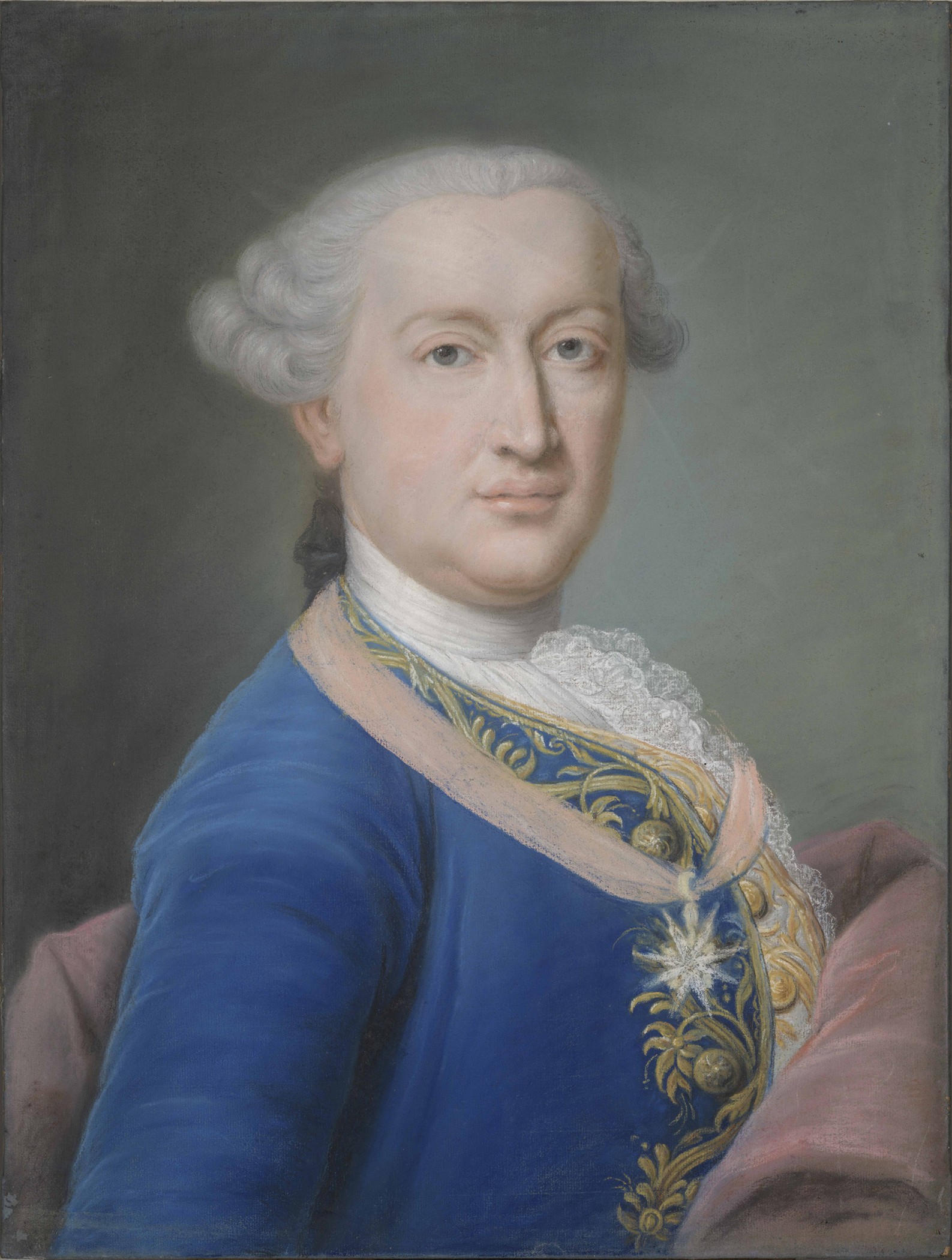
Marianna Carlevarijs
(Venice 1712 - after 1750)
Portrait of a Gentleman, c. 1750
pastel on blue paper, 59,7 x 44 cm (23.50 x 17.32 inches)
Marianna Carlevarijs
(Venice 1712 - after 1750)
Portrait of a Gentleman, c. 1750
pastel on blue paper, 59,7 x 44 cm (23.50 x 17.32 inches)
Re: 885
Provenance: Venice, private collection
Literature:
N. Jaffares, Pastellists before 1800, online edition, update 2024, Ji98.114
The transparency in the definition of the face and the careful definition of the details of the clothing reflect, despite the impeccable protocol pose of the representative portrait, a subtly characterised image and qualify this painting as the work of Marianna Carlevarijs, daughter of the well-known Friulian-born Vedutist and pupil of the famous Rosalba Carriera.
The earliest information on the artist is owed to Tomaso Temanza (Zibaldondi Memorie Storiche appartenenti ai Professori delle Belle Arti del Disegno, Venice 1738, reprinted 1963, p. 57), who reported a positive judgement on Marianna, ‘one of Luca Carlevarijs’ daughters’, defined as a “good portrait painter, and was a pupil of Rosalba Carriera”. Giannantonio Moschini (Della letteratura veneziana del secolo XVIII sino ai giorni nostri, Venice 1806, p. 88) also mentioned her as ‘distinguished in pastel and miniature painting’.
However, no paintings of Marianna were known, although Giuseppe Fiocco claimed to have seen in a private collection in Padua ‘two good portraits’ of Carlevarijs ‘marked and dated 1750’ (G. Fiocco, La pittura veneziana del Sei e del Settecento, Verona 1929, p.66). It was only in 1960 that the portrait painter finally took on ‘pictorial consistency’ with Terisio Pignatti's publication of four pastel portraits of the Balbi family, which arrived at Ca' Rezzonico with the traditional attribution to Marianna Carlevarijs. The scholar proposed a dating of the paintings around 1740-1750 and observed that Marianna's hand was ‘recognisable by the engraved drawing’ (T. Pignatti, Il Museo Correr di Venezia. Dipinti del XVII e XVIII secolo, Venice 1960, p.45). Finally, Rodolfo Pallucchini summarising previous contributions observed that painting, after the forced end of Rosalba's activity (1746), took over, at least in part, the atelier (La pittura nel Veneto. Il Settecento, Milan 1995, vol. I, p. 266, figs. 435-438).
In our pastel, we are struck by the careful luministic direction that firmly delineates the features of the face, subtracting it from iconic fixity by the puff of shadow on the right side that reaches the gaze, softens the prominence of the nose, and softens the sly crease of the lips. In the subtle contrast of luminosity, the rosy complexion enhanced by the whiteness of the abundantly powdered wig, the shirt with the lace jabot, the cobalt blue jacket with golden edelweiss embroidery and the silvery medal hanging from the pink ribbon stand out.
In view of the painter's small number of known works and the consequent difficulty in establishing comparisons that would allow a formally consequential path to be traced, an initial comparison can be made with the Portrait of a Gentleman in the Brera Art Gallery, dated, albeit dubiously, to 1737, i.e. when Marianna had probably been working in Rosalba Carriera's atelier for over a decade. Undoubtedly in this work one can recognise a remarkable ability to realistically render the facial features of the personage portrayed, even if at the same time those characteristics of ‘engraved drawing’ noted by Pignatti (1960, cit.) emerge in the pastels depicting characters from the Balbi family at Ca' Rezzonico and chronologically placed by the scholar around 1740-1750.
A pair of pastels by Marianna Carlevarijs was sold at Dorotheum (15th December 2023, lot 30) depicting the Portrait of Claudio Giupponi and his wife Antonia Girardi Giupponi (fig. 3-4) published by Neil Jaffares (Dictionary of Pastellists before 1800, London 2006, Online Edition, 3. 12.2023, av.) that bear the following inscriptions on the verso: ‘La pitrice Carlevaris / 1750 / Claudio Giupponi / d'anni 22 [...] / Marama Carnevales’; ‘1750 / Pitrice La Carnevalis / Antonia Girardi d'anni 19 - [...] Claudio Giupponi d'anni 22 [...]’. Although not autograph, the inscriptions allow the characters to be identified and permit a credible dating; moreover, they may be related to those of the two ‘good portraits [...] marked and dated 1750’ mentioned by Fiocco (1929, cit.).
Finally, a pastel from Ca' Rezzonico portraying the same settee as the painting examined here arouses curiosity. In a very poor state of preservation, the painting is traditionally attributed to Lorenzo Tiepolo - an attribution questioned by Neil Jaffares (cit. Online Edition, 13.02.2024, av.) - and in any case could testify to the existence of a portrait of Rosalba Carriera herself taken as a model by disciples or frequenters of her atelier.
Datable to the fifth decade of the century, our pastel constitutes a precious piece in the reconstruction of Marianna Carlevarijs physiognomy that reveals a remarkable acumen in the perception of the subject as a graceful fact of reality fixed with rococo grace.