

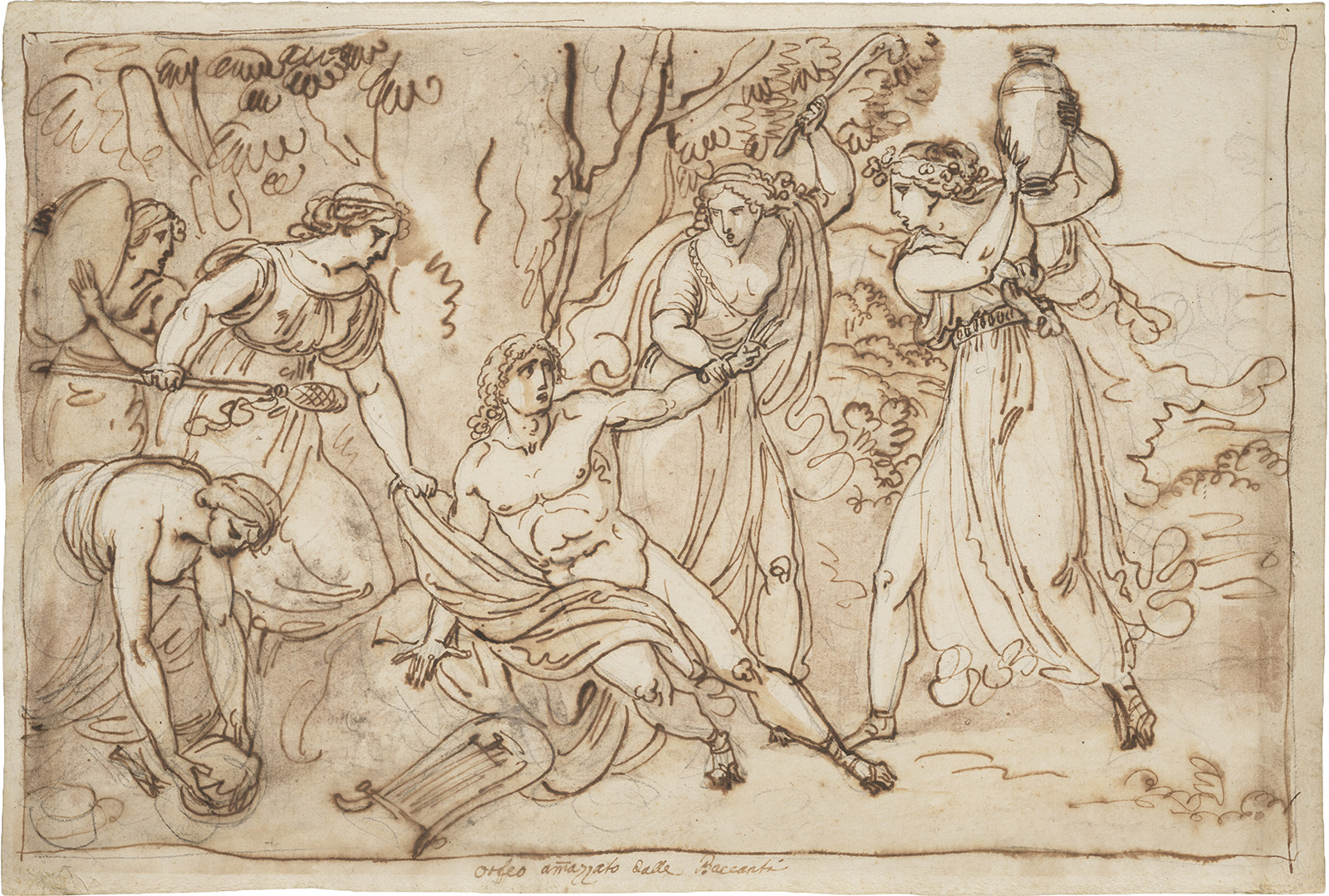
Felice Giani
(San Sebastiano Curone (Alessandria), 1758 - Rome, 1823)
Orpheus Slain by the Bacchantes, 1800-1805
Pencil, pen and brown ink with brown wash, on white paper
282 x 418 mm (11.10 x 16.46 inches)
Felice Giani
(San Sebastiano Curone (Alessandria), 1758 - Rome, 1823)
Orpheus Slain by the Bacchantes, 1800-1805
Pencil, pen and brown ink with brown wash, on white paper
282 x 418 mm (11.10 x 16.46 inches)
Re: 0296
Provenance
private collection.
Inscribed
‘Orfeo am(m)azzato dalle Baccanti’, in pen, lower centre.
The work depicts the dramatic end of the myth of Orpheus, following the account in Book XI of Ovid’s Metamorphoses, which tells of the tragic death of the Thracian singer. Inconsolable after the final loss of his beloved Eurydice, Orpheus had shunned the love of every other woman. In revenge for this affront, the Bacchantes, or Ciconian women, seized by Dionysian frenzy, attacked him during their sacred rites and killed him. In the drawing Orpheus lies on the ground, his face marked by dismay and his arm outstretched in a vain attempt to defend himself, while his celebrated lyre lies abandoned at his feet. Around him, three cloaked female figures with darting contours fall upon him, brandishing makeshift weapons (a club, some stones and a heavy amphora), ready to strike the defenceless poet.
The sheet, hitherto unpublished, has re-emerged from a private collection, where it was kept with the correct attribution to Felice Giani. The distinctive framed layout of the drawing and the explanatory caption written at the foot already point unmistakably to Giani’s modus operandi. The attribution is fully confirmed by the style.¹ The fluid, cursive and fragmented line, the speed of execution and the combined use of pen and brown wash are typical features of the master’s graphic grammar. With a few shorthand strokes, he was able to sketch the complex orchestration of volumes and chiaroscuro transitions.
The practice of isolating the scene within the sheet and adding an autograph inscription in the lower margin, moreover, finds numerous parallels in Giani’s vast corpus of drawings. One need only compare the rich series of sheets in the Cooper-Hewitt Museum, New York. Particularly relevant are the studies for the Triumph of Silenus and the Triumph of Bacchus and Ariadne, and the one for Phaethon Asking Apollo for the Chariot of the Sun. These display the same relationship between image and text, which served the painter as a true iconographic aide-mémoire to be reused in his decorative projects.²
Chronologically, the urgency of the ductus and the structural synthesis of the figures suggest that the drawing was executed in the first five years of the nineteenth century. This was the high point of Giani’s activity in Emilia-Romagna. The dating is supported by close affinities with the preparatory studies for the great painted cycles of those years. Our Orpheus seems to share the same climate that pervades, for example, the drawing of the Clemency of Alexander, preparatory for the Sala di Alessandro Magno in Palazzo Naldi, Faenza, of 1802. It also shares the dynamism of the study of King Demetrius Poliorcetes Visiting Protogenes, Painter of Rhodes for Palazzo Aldini, Bologna, completed in 1805.³
As for the intended purpose of this invention, it is highly likely that the sketch was not conceived as an independent work. Rather, it would have been a first idea for an ornament or a relief element to be inserted within a larger interior decorative scheme. This working practice, in which drawings served as nimble guides for the workshop assistants, closely reflects the procedures followed at Palazzo Milzetti, Faenza, between 1802 and 1805.â´ There, Giani’s rapid sketches, such as the drawing of Minerva Questioning Jupiter, also in New York,âµ were translated by his collaborators, above all the stuccoist Antonio Trentanove, into elegant overdoors [in painted relief]. Our sheet very probably served a similar purpose, providing the idea for a painted cameo or a stucco relief.
Finally, confirming the master’s lasting interest in this Ovidian theme, the same subject was taken up again at a later stage of Giani’s career in another drawing, now in the Istituto Nazionale per la Grafica, Rome. It likewise bears an autograph inscription: ‘Morte di Orfeo per le mani delle Bacanti’ [Death of Orpheus at the hands of the Bacchantes].â
¹ The principal reference for Giani’s drawings is the monumental monograph by Ottani Cavina 1999, II, pp. 673–934. The pioneering studies should not, however, be forgotten: Modigliani 1900, pp. 17–24; Mostra di disegni 1951; Mostra di disegni 1952; Disegni inediti 1952.
² Ottani Cavina 1999, II, pp. 826–827, nos A1.492–493. See also Vitali 2003, pp. 98–99, 105, no. A2.
³ Ottani Cavina 1999, I, p. 263, fig. 373; pp. 433–434, fig. 621. On Palazzo Aldini, see also Mampieri 2024, pp. 141–150.
â´ Ottani Cavina 1999, I, pp. 180–185. On Palazzo Milzetti, see also Bertoni 2024, pp. 75–86; Franchi, Iannucci 2024, pp. 87–100; Rossoni 2025, pp. 1–74.
âµ Ottani Cavina 1999, II, pp. 822, 825, no. A1.482.
ⶠIbid., II, p. 899, no. A2.71.