

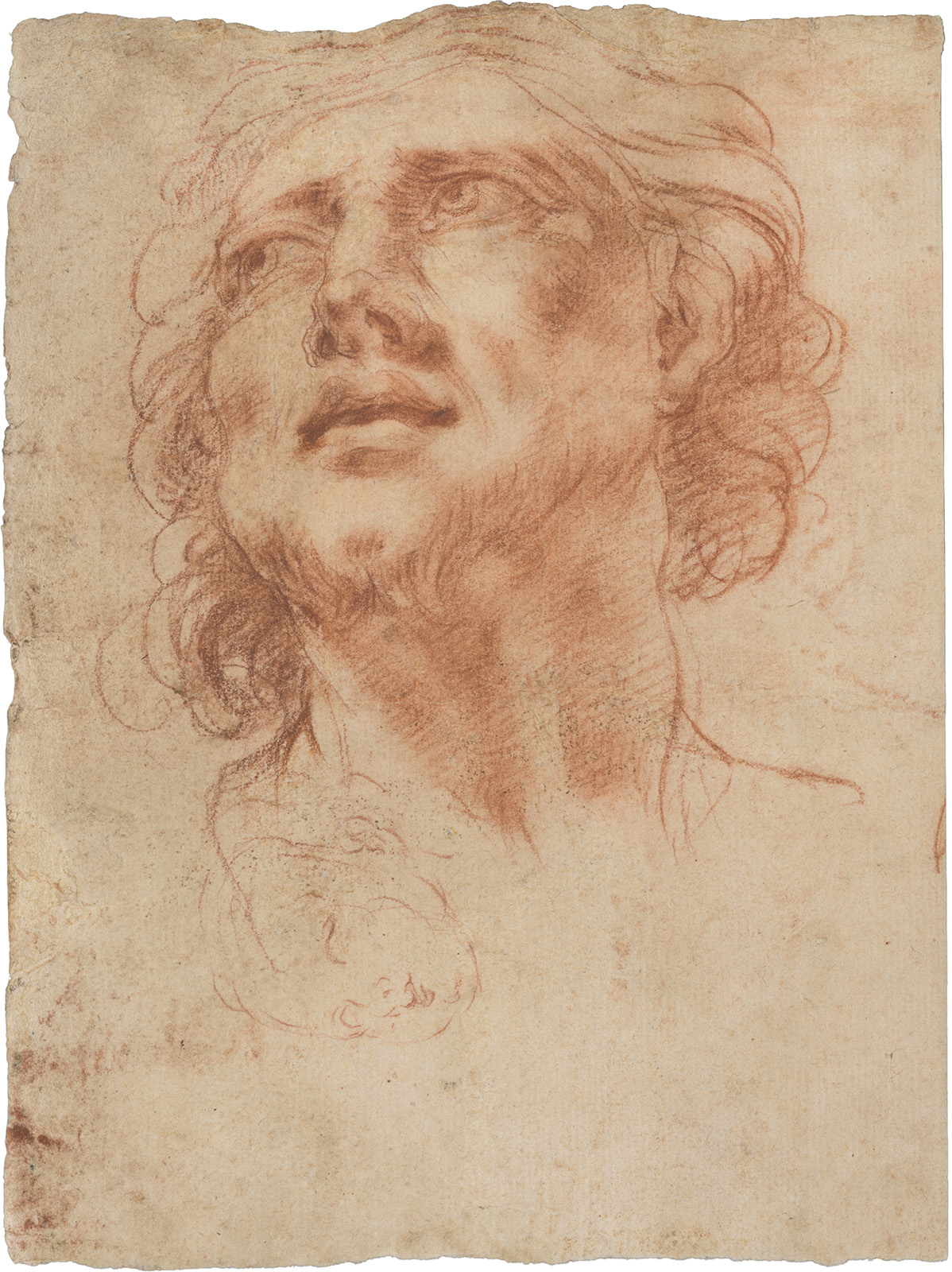
Pier Francesco Gianoli
(Vercelli, 1624 - Varallo (Vercelli), 1690)
Study of Male Head, 1675-1680
Red chalk on paper
239 x 316 mm (9.41 x 12.44 inches)
Pier Francesco Gianoli
(Vercelli, 1624 - Varallo (Vercelli), 1690)
Study of Male Head, 1675-1680
Red chalk on paper
239 x 316 mm (9.41 x 12.44 inches)
Re: 0294
Provenance
Private collection
The sheet is a study of a male face tilted backwards, caught in a pose of intense emotional impact, accompanied below by a more rapid and summary sketch of an infant’s head. From the very first glance the work declares a quintessentially Tanzio-like matrix, filtered through the sensibility of one of the most gifted and intelligent interpreters of Tanzio da Varallo’s idiom: Pier Francesco Gianoli, best known for his involvement in the decorative campaigns of the Sacri Monti of Varallo and Orta.¹ The expressive fervour and the severity of the physiognomy reveal an undeniable debt to the master from Alagna Valsesia. The intense modulation of chiaroscuro and the rigour of the drawing, however, immediately betray the hand of Gianoli, whose graphic syntax is more controlled, in line with the academic tendencies that spread through Lombardy in the second half of the seventeenth century.
This inclination towards the analytical study of physiognomic details is, moreover, precisely documented in the inventory drawn up immediately after the painter’s death. It records in his house and workshop ‘varij disegni, cioè teste, mani, gambe, bracchie, piedi nudi, et panni disegnati con lapis’ [various drawings, namely heads, hands, legs, arms, bare feet and drapery drawn in chalk].² This entry attests to the deep familiarity of the painter from Campertogno with the study of faces and limbs on paper before their transfer into paint. He produced a substantial number of working drawings, assembling a formal vocabulary on which he could draw repeatedly in the course of his decorative campaigns. An emblematic case of reuse is the Head of an Old Man now in the Pinacoteca at Varallo, which Gianoli used on two occasions. The first was for the face of one of the bystanders frescoed on the right wall of the twenty-ninth chapel of the Sacro Monte at Varallo, devoted to Christ’s second trial before Pilate and datable between 1675 and 1679. The second was for the face of the turbaned Apostle painted in 1680 in the oratory of the Addolorata at the Sacro Monte of Orta.³
In strictly stylistic terms, the drawing belongs to the Piedmontese master’s mature phase. The face displays a lyrical tension and a sensitivity to light that bring it close to the Study of Four Heads in the Pinacoteca at Varallo, which the artist likewise reused on at least three different occasions.â´ Similarly, as regards the quality of the line and the broken yet enveloping ductus of the red chalk, a close comparison can be drawn with the unpublished Head of an Old Man sold by Roseberys in London in 2026,âµ or with the Head of a Girl in the Testori collection, a preparatory study for the girl frescoed in the aforementioned Varallo chapel.ⶠIn all these sheets the red chalk defines the volumes with a softness that tempers the roughness of the skin in favour of a more persuasive atmospheric rendering. They display the ‘maestà nelle teste’ [majesty in the heads] already noted, long before any modern revival of interest, by Girolamo Lana in his Guida della Valsesia of 1840.â·
Finally, although it is not yet possible to identify the precise painted counterpart of the present sheet, it is worth noting that the pose of the face, tilted backwards, its gaze rapt upwards and its mouth parted, recalls the invention adopted by Gianoli for the Cumaean Sibyl frescoed in the same chapel of the Sacro Monte at Varallo. A preparatory drawing for that figure is, moreover, preserved in a private collection.â¸
¹ For an overview of Gianoli’s drawings, see Lazzeri 200/2007; Lazzeri 2010, pp. 73–87; more recently also Sitzia, Conterno 2025, pp. 88–89, figs 9–10.
² Sitzia 2001b, p. 115.
³ Lazzeri 2010, pp. 77–78, figs 1–3. For the work at the Sacro Monte of Varallo, see Sitzia 2001a, pp. 125–141.
â´ Lazzeri 2010, pp. 77, 80–82, figs 7, 9.
âµ Red chalk on white paper, 175 × 122 mm; 8 July 2026, lot 128.
ⶠLazzeri 2010, pp. 83–84, figs 13–14.
â· Lana 1840, p. 172.
⸠Lazzeri 2010, pp. 82–84, figs 11–12.