

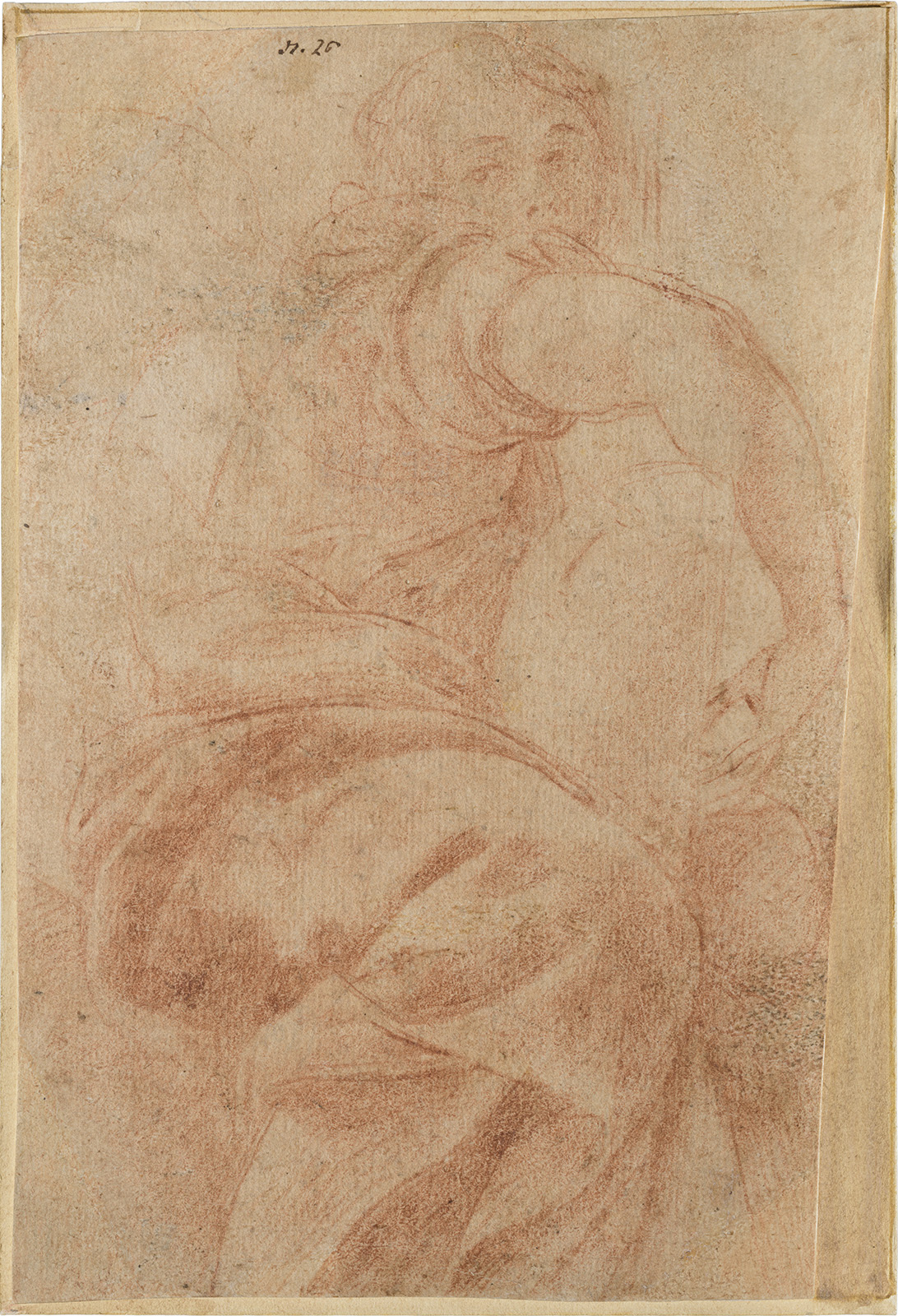
Antonio d'Enrico called Tanzio da Varallo
(Alagna Valsesia, 1580 c. - Varallo, 1633)
Study of an Angel, 1627-1629
Red chalk on paper
186 x 127 mm (7.32 x 5.00 inches)
Antonio d'Enrico called Tanzio da Varallo
(Alagna Valsesia, 1580 c. - Varallo, 1633)
Study of an Angel, 1627-1629
Red chalk on paper
186 x 127 mm (7.32 x 5.00 inches)
Re: 0291
Inscription
«n. 26», pen, in top left
Provenance
Boccioleto (Vercelli), collection Carlo Bartolomeo Borsetti (?)
Milan, collection Francesco Dubini, before 1940
Milan, collection Hoepli, post 1940 – before 1975
Milan, Finarte, 21-22 april 1975, lotto 105
Private collection
Literature
Testori 1995, pp. 120, 127, fig. 16
Ferro 2003a, pp. 163-164, n. 52
The drawing is a study of a winged figure seen from the right side, caught in the act of playing a lute. Attention is focused on the complex anatomical torsion of the heavenly musician. His body twists through space, accommodating on the one hand the bulk of the stringed instrument and displaying on the other the powerful musculature of his right arm, raised to pluck the strings. The drapery is studied with the same expressive urgency. The garments wrap from the hips down along the legs, forming broad, full-bodied and strongly shaded folds. This device, of course, is intended not so much to conceal the angelic silhouette as to amplify its dynamism and three-dimensional projection, exploiting to the full the potential of the chosen technique. This becomes immediately clear when one observes how the use of red chalk on paper prepared in a bright pink tone further heightens the vividness of the flesh and the material vigour of the fabrics.
The nervous energy of the line and the luminous modelling, capable of arresting movement in an instant charged with pathos, point unhesitatingly to Antonio d’Enrico, universally known as Tanzio da Varallo. The first to grasp the stylistic coordinates of the sheet was Edoardo Testori. Having traced the drawing in a private collection in Novara, he set out the case for its autograph status, though he identified the instrument held by the angel as a cello rather than a lute.¹ In a note, the scholar also recorded the provenance of the work. It once formed part of the important collection of Cavaliere Francesco Dubini (1848–1932), sold posthumously in Milan in the early 1940s. From there, some of the sheets entered the distinguished Hoepli collection, where they remained until its final dispersal at Finarte in 1975. Our drawing was also sold there, already correctly attributed to Tanzio.²
As Filippo Maria Ferro has also confirmed,³ the sheet is unmistakably a working drawing. It is an exploratory tool conceived by the artist during work on the chapel of the Guardian Angel, under the patronage of the Nazzari family, in the basilica of San Gaudenzio, Novara (fig.).â´ Tanzio used it to resolve specific formal problems concerning the lute-playing angel seated among the Angels Accompanying the Souls to Purgatory. These began with the anatomical rendering of the foreshortened back and extended to the articulation of the volumes of the fabric. The decorative project, whose contract was signed in early 1627, required considerable effort in the design stage, so much so that the work was completed only in 1629. The present drawing, moreover, is not an isolated sheet. It belongs to a substantial and homogeneous group of preparatory studies organically linked to this specific mural cycle.âµ This abundance of drawings suggests that the artist attached crucial importance to the chapel commission, devoting far from secondary preliminary attention and care to it.
Finally, it should be noted that the sheet bears the inscription ‘n. 26’ in pen at the upper left. This number is by no means a random mark within the artist’s corpus of drawings. On the contrary, comparison with other sheets reveals a consistent numbering system, palaeographically identical, which links the sheet to other drawings by Tanzio. These include, moreover, several studies and preparatory sketches for the Nazzari chapel. Besides those known since the memorable exhibition on the Lombard Seicento at Palazzo Reale,ⶠit is worth mentioning the drawings recently published by Silvana Bareggi and Filippo Maria Ferro. These show a Study for the Virgin and two Studies of Arms for the Shepherds, numbered ‘n. 17’ and ‘n. 2’ respectively.â· This evidence reveals that the sheet originally belonged to a single album assembled by a very early collector. Giovanni Testori tentatively identified him as the Valsesian painter Carlo Bartolomeo Borsetti (1698–c. 1759), who, given his geographical proximity, would have bought the group directly from the artist’s heirs.⸠Many sheets later reached the Milanese market, passing through the distinguished nineteenth-century collection of the dealer Giuseppe Vallardi (1784–1863). Vallardi sometimes added his own inventory numbers, of which, however, there is no trace here. Other sheets entered the collections of Giovanni Morelli and Francesco Dubini, exactly as in the present case, and later passed to the Hoepli collection.
Fig. Antonio d’Enrico, known as Tanzio da Varallo, [Angels in Glory], c. 1627–1629. Novara, San Gaudenzio
¹ E. Testori, New Drawings by Tanzio da Varallo, in «Master Drawings», XXXIII, 2, 1995, pp. 120, 127, fig. 16.
² For a summary of the question, see M. Cresseri, Per Brera. Doni e collezionisti dal 1882 al 2000, ed. by M. Ceriana and C. Quattrini, «Quaderni di Brera», 10, Florence 2004, pp. 96–100.
³ F.M. Ferro, L’officina grafica di Tanzio da Varallo, in «de Valle Sicida», XIV, 1, 2003, pp. 163–164, no. 52.
â´ On the [Nazzari] chapel, see P. Venturoli, in Tanzio da Varallo. Realismo fervore e contemplazione in un pittore del Seicento, exh. cat. (Milan, Palazzo Reale, 13 April – 16 July 2000), ed. by M. Bona Castellotti, Milan 2000, pp. 137–140, no. 32.
âµ S. Baiocco, in Tanzio da Varallo. Realismo fervore e contemplazione in un pittore del Seicento, exh. cat. (Milan, Palazzo Reale, 13 April – 16 July 2000), ed. by M. Bona Castellotti, Milan 2000, pp. 184–188, nos 54–61.
ⶠG. Bora, Disegni di figura, in Il Seicento lombardo, III, Catalogo dei disegni, libri, stampe, exh. cat. (Milan, Palazzo Reale and Pinacoteca Ambrosiana, June – October 1973), Milan 1973, pp. 31–32, nos 124–125, figs on p. 120.
â· S. Bareggi and F.M. Ferro, Alcuni disegni inediti di Tanzio da Varallo, in «Paragone», XLIV, 765, 2013, pp. 32–33, pls 18a–18b, 25a–25b, to which reference should also be made for the provenance.
⸠G. Testori, Una postilla e un inedito, in «Paragone», XVII, 199, 1966, pp. 55–56.