

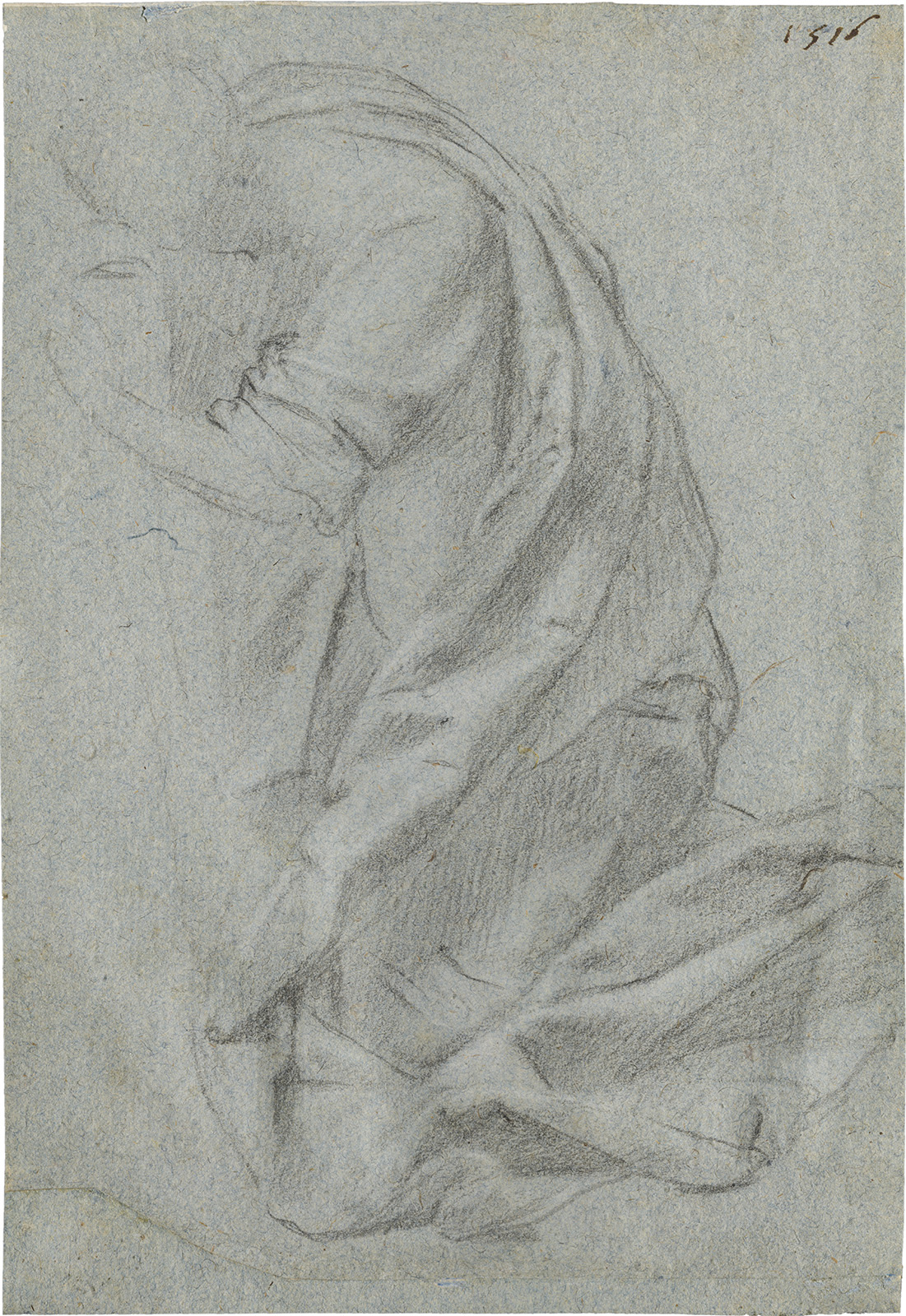
Simone Peterzano
(Venezia ?, 1535 c. - Milano, 1599)
Study for Kneeling Figure (Mary Magdalen), 1585-1590
Black chalk on blue paper
205 x 141 mm (8.07 x 5.55 inches)
Simone Peterzano
(Venezia ?, 1535 c. - Milano, 1599)
Study for Kneeling Figure (Mary Magdalen), 1585-1590
Black chalk on blue paper
205 x 141 mm (8.07 x 5.55 inches)
Re: 0287
Inscription
«1516», pen, in top, to right
Provenance
Florence, Pandolfini, 3 october 2018, lot. 34
Private collection
The work, hitherto unpublished and with no known early provenance, recently re-emerged at Pandolfini in Florence with a generic attribution to the Lombard school of the sixteenth century. The image is a study of a monumental kneeling female figure, wrapped in drapery of resonant sculptural modelling, her face bowed and deliberately left in a sketchy state. Notwithstanding the cautious classification given at the Florentine sale, the sheet displays the unmistakable features of Simone Peterzano, offering a paradigmatic example of his distinctive and exceptionally accomplished graphic grammar.¹
To place the sheet correctly, one need only turn to the extraordinary repository of drawings known as the ‘Fondo Peterzano’. This substantial group of sheets, gathered in two dense volumes, was acquired by the City of Milan in 1924 from the fabbriceria of the sanctuary of Santa Maria presso San Celso. It is now kept in the Gabinetto dei Disegni of the Castello Sforzesco, and may previously have belonged to the Milanese sculptor Annibale Fontana, a friend of Peterzano.² Within this corpus, an indispensable tool for decoding the workshop’s modus operandi, Peterzano shows a systematic preference for charcoal, often heightened with lead white, on blue paper. Of Venetian descent, this technique is used here to define the figure through regular, stereometric forms. It gives the figure a plastic power and volumetric solidity that aim to model the forms with an almost sculptural vigour, far removed from the exclusive naturalism of his early years.
In the present case, the vigorous ductus and the orchestration of sharp chiaroscuro contrasts suggest close affinities with some of the master’s most celebrated sheets. The habit of concentrating exclusively on the fall of the folds and the body’s occupation of space, omitting the head or barely suggesting it, closely recalls the conception of various studies now in the Castello Sforzesco. To see this, one need only compare the drawing with the Virgin Annunciate connected with the early altarpiece in the Musée Jeanne d’Aboville, La Fère,³ the sketches for the Angelica and Medoro in the Galerie Canesso, Paris, of about 1571–1572,â´ or the memorable sheet for the Persian Sibyl frescoed in the Certosa di Garegnano in the early 1580s.âµ Likewise, the dense use of lead white to bring out the luminous values of the garments finds a parallel in the preparatory drawings for the large canvases in the church of San Barnaba, executed around 1573–1574. The closest is the Study of Saint Barnabas Kneeling, also part of the ‘Fondo Peterzano’.â
Although they show strong connections with the drawings of the 1570s, these stylistic features suggest that the present study was executed when the painter’s Milanese idiom had fully matured, pointing to a date in the 1580s. This chronology is also supported by the emergence of a greater plastic power. Peterzano’s line tends to free itself from the studied naturalism of his early years and to embrace the monumental solidity typical of his mature projects.
A survey of the artist’s output in these years makes it possible to identify the exact purpose of the present drawing. The sheet is in fact a remarkable preparatory study, a first idea, for the figure of Mary Magdalene kneeling at Christ’s feet in the Entombment in the church of San Fedele, Milan (fig.). The dating of the painting, long debated by scholars, has recently been confirmed as 1589. On paper, the artist isolates the figure from the pathos of the dramatic context in order to focus on her pose and the ample wrapping of her mantle. This confirms an academic practice of analytical, isolated study of individual passages before the final translation into paint. The complex genesis of this important altarpiece is attested by at least two other related drawings. I refer to the overall design now in the Georgia Museum of Art, Athens, Georgia,â· and to the Study of the Face of the Grieving Virgin, also in the Castello Sforzesco.⸠The emergence of this new sheet therefore adds a key piece to our understanding of the complex design process in the workshop of the artist who liked to sign himself ‘Titiani alumnus’ [pupil of Titian].
Fig. Simone Peterzano, Entombment of Christ, 1585–1590. Milan, San Fedele
¹ On this subject, see Baroni 1944, pp. 305–308; Franco Fiorio 1974, pp. 87–100; Bona Castellotti 1979, pp. 80–82; Di Giampaolo 2000, pp. 353–354; Bora 2002, pp. 3–20; Caretta 2008, pp. 13–24; Gnaccolini 2009, pp. 179–189; Bora 2012, pp. 52–61; Dal Pozzolo 2012, pp. 143, 147–152; Brouard 2020, pp. 67–77.
² Dallaj 2012, pp. 34–41; Rossi 2012, pp. 14–33.
³ C. Brouard, in Peterzano 2020, pp. 94–97, no. I.2; pp. 200–201, no. V.2.
â´ P. Plebani, in Peterzano 2020, pp. 152–155, no. III.2; C. Brouard, in Peterzano 2020, pp. 206–209, nos V.6–7.
âµ Gregori 1973, pp. 10, 16–17; C. Brouard, in Peterzano 2020, pp. 218–219, no. V.14.
ⶠS. Facchinetti, in Peterzano 2020, pp. 164–171, nos IV.1–2; C. Brouard, in Peterzano 2020, pp. 212–215, nos V.9–12, esp. no. V.11.
â· Di Giampaolo 2000, pp. 353–354, pl. XLVIII.4; R.R. Coleman, in Disegno 2005, p. 102, no. 53.
⸠J. Bober, G. Bora, F. Rossi, in Simone Peterzano 2012, p. 117, pl. 36.