

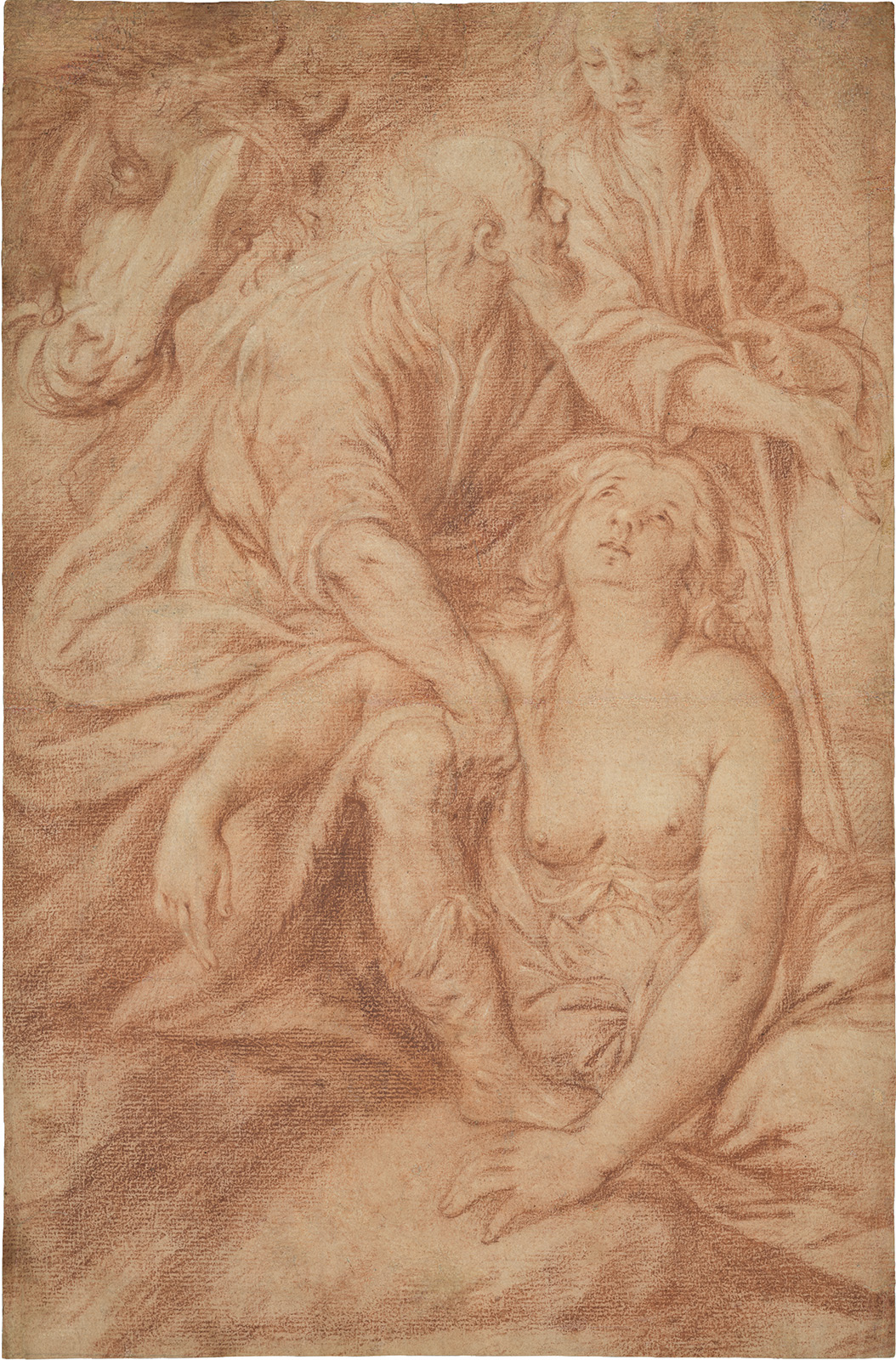
Carlo Francesco Nuvolone
(Milano, 1609 - Milano, 1661)
Silvio, Dorinda e Linco, 1650-1655
Red chald and black chalk, on paper
410 x 270 mm (16.14 x 10.63 inches)
Carlo Francesco Nuvolone
(Milano, 1609 - Milano, 1661)
Silvio, Dorinda e Linco, 1650-1655
Red chald and black chalk, on paper
410 x 270 mm (16.14 x 10.63 inches)
Re: 0286
Provenance
Cellio (Vercelli), collection Peracino, before 1788-1840 c.
Lombardy, private collection, secon half XVIII – first half XIX century
Private collection
Literature
G. Testori, in Thirty drawings 1976, n. 13; Ferro 1994, p. 202, fig. 12 e nota 23
Ferro 2003, pp. 207, 358, fig. 40c
The sheet, executed in red chalk with extraordinary refinement, depicts an episode of poignant lyrical intensity from the fourth act (scenes 8–9) of Il pastor fido by Giovan Battista Guarini, the celebrated pastoral drama published in 1589. The composition shows the moment when the nymph Dorinda, pierced in the breast by an arrow, lies in languid abandon. She is succoured by the wise Linco, in the presence of the young hunter Silvio, the unwitting cause of her wound. Following a well-established iconographic tradition, the composition moves beyond a merely rustic reading to embrace the splendours of seventeenth-century tragicomedy. Not by chance, the dying girl wears an embossed clasp below her breast, while the man supporting her wears noble buskins. These attributes attest to the aristocratic and semi-divine rank of the protagonists of Guarini’s Arcadia. On the left, the horse’s head, which conceals a homage to the memorable Martyrdom of Saints Rufina and Secunda in the Pinacoteca di Brera (the so-called ‘picture of the three hands’), reaffirms the heroic, venatic aura of the episode. On the verso, finally, there is a study, also in red chalk, of two hands, a head and a back.
The present sheet was already correctly attributed to Carlo Francesco Nuvolone at the exhibition curated by Giovanni Testori in 1976 at the Galleria La Portantina in Milan. There, a group of drawings was shown, some of which came from the collection of the Valsesian painter Lorenzo Peracino (1710–1789).¹ This collection of drawings was assembled in the house and workshop of the artist, a native of Bosco di Cellio. By inheritance it then passed first to his son Giovanbattista (†1788), then to his grandson Defendente (1762–1825) and from him to his great-grandson Lorenzo the Younger (c. 1790–1840). It was eventually bought by an unidentified Lombard family, which in turn sold it off and broke it up in the course of the twentieth century.²
After Testori’s publication, the drawing received more thorough consideration from Filippo Maria Ferro.³ He connected it closely with a painting of identical subject, shown in this exhibition (fig.), in which Carlo Francesco’s mastery works in close synergy with the contributions of his workshop.â´ The picture is indeed as successful as it is paradigmatic an example of the prolific collective practice that made the Nuvolone workshop famous. In this canvas the master’s conception and supervision are combined with the substantial and faithful contribution of his assistants. His younger brother Giuseppe would later do exactly the same: from the 1680s onwards, he made use on certain projects of the assistance of his sons, certainly Carlo and perhaps also Girolamo.âµ In the painting, the dramatic focus, imbued with the wounded, melancholy sensuality typical of Nuvolone’s idiom, is sealed by a skilful orchestration of colour. Despite a more disciplined handling, it heightens the ivory pallor of the flesh before softening into the pastoral setting. On the right, the screen of trees gives way to a broad river view, crowned by a mountainous horizon and a sky streaked with frothy clouds. Here the well-tested working habits of the workshop are more clearly reflected.
On closer inspection, at least two other versions of this composition are known, both autograph works by Carlo Francesco. The first, on panel, is almost identical in subject and layout, though airier and more refined in the rendering of the figures and the landscape. It was made known by Giovanna Grandi and its whereabouts are now unknown.ⶠThe second, in the collection of the Getty Museum, Los Angeles, is a large canvas of almost square format.â· It follows that our sheet belongs to a refined iconographic strand particularly dear to Nuvolone. In it, the fates of ill-starred heroines such as Procris or Dorinda overlap in languid, perfectly interchangeable physiognomies. As noted at the outset, however, the specific features of the figures depicted here unequivocally distinguish the scene from Ovid’s tragedy of Cephalus and Procris, pointing instead to Guarini’s drama.
In stylistic terms, the very high degree of finish of the drawing, so careful in its line and in the rendering of chiaroscuro transitions, together with its considerable size, reveals it to be a true full-scale cartoon. It was conceived to calibrate the anatomical masses and the rhetoric of the affetti before the final transfer to canvas. A useful comparison is the red chalk Allegory of Charity in the Biblioteca Ambrosiana, Milan, attributed to Carlo Francesco Nuvolone, which, not by chance, bears a grid for transfer.⸠At the same time, however, such a level of definition suggests that the present sheet served as an exemplary model to be reused within the workshop. It would thus have supported, and streamlined, the successful serial production that is a distinctive feature of the modus operandi of the Nuvolone workshop, of which the painting in the exhibition is itself clear evidence. The result is a drawing in which the mastery of a dense, rich touch succeeds in conveying the soft atmospheric qualities typical of Carlo Francesco’s expression, running parallel to the gently sentimental spirit that animates his painted versions.
Fig. Carlo Francesco Nuvolone and workshop, Silvio, Dorinda and Linco, after 1660. Private collection
¹ Trenta disegni di antichi maestri. fogli inediti di Luca Cambiaso, Tanzio da Varallo, C. F. Nuvolone, Pierre Puget, Sassoferrato, Luca Giordano, Gaspare Diziani, G. B. Bison e di altri maestri, with a note by G. Testori, exh. cat. (Milan, Galleria La Portantina, 18 December 1976 – 19 January 1977), Milan 1976, no. 13.
² G. Lazzeri, Pier Francesco Gianoli ai Sacri Monti di Varallo e Orta. Studi preparatori per gli affreschi della cappella di Gesù ricondotto a Pilato e dell’oratorio dell’Addolorata, «Sacri Monti», 2, 2010, pp. 82–84; G. Romano, Stampe in casa di Lorenzo Peracino, in Le frontiere dell’arte. Una raccolta di testi di Marco Rosci con saggi in suo onore, ed. by F. Gonzales, Novara 2013, pp. 75, 80, n. 2; E. Rame, Intorno al lascito Avondo: proposte per Giuseppe Antonio Pianca disegnatore e un’aggiunta per Lorenzo Peracino, in «de Valle Sicida», XXVIII, 2018, p. 87.
³ F.M. Ferro, Carlo Francesco Nuvolone e la ferita d’amore, in Studi di storia dell’arte in onore di Mina Gregori, Cinisello Balsamo 1994, p. 202, fig. 12 and n. 23; F.M. Ferro, Nuvolone. Una famiglia di pittori nella Milano del ‘600, Soncino 2003, pp. 207, 358, fig. 40c.
â´ Oil on canvas, 65.5 × 90.5 cm; Ferro, op. cit., 1994, p. 201, fig. 10 and n. 21; Ferro, op. cit., 2003, p. 206, no. cf 133, pl. XLII on p. 90.
âµ F. Frangi, [Nuvolone, Giuseppe], in Dizionario Biografico degli Italiani, vol. LXXIX, Rome 2013, p. 27.
ⶠOil on panel, 50 × 71 cm; G. Grandi, Dalla maniera all’Arcadia: Carlo Francesco Nuvolone, in «Commentari», 21, 1970, p. 324, fig. 11; Ferro, op. cit., 2003, p. 206, no. cf 134, fig. 40b on p. 358.
â· Oil on canvas, 172.5 × 174 cm; Ferro, op. cit., 2003, pp. 206–207, no. cf 135, fig. 41 on p. 359. It should be noted that on 27 January 2011 the Getty Museum attempted, unsuccessfully, to sell the painting at Sotheby’s, New York (lot 258).
⸠Ms. F 234 inf., no. 940.