

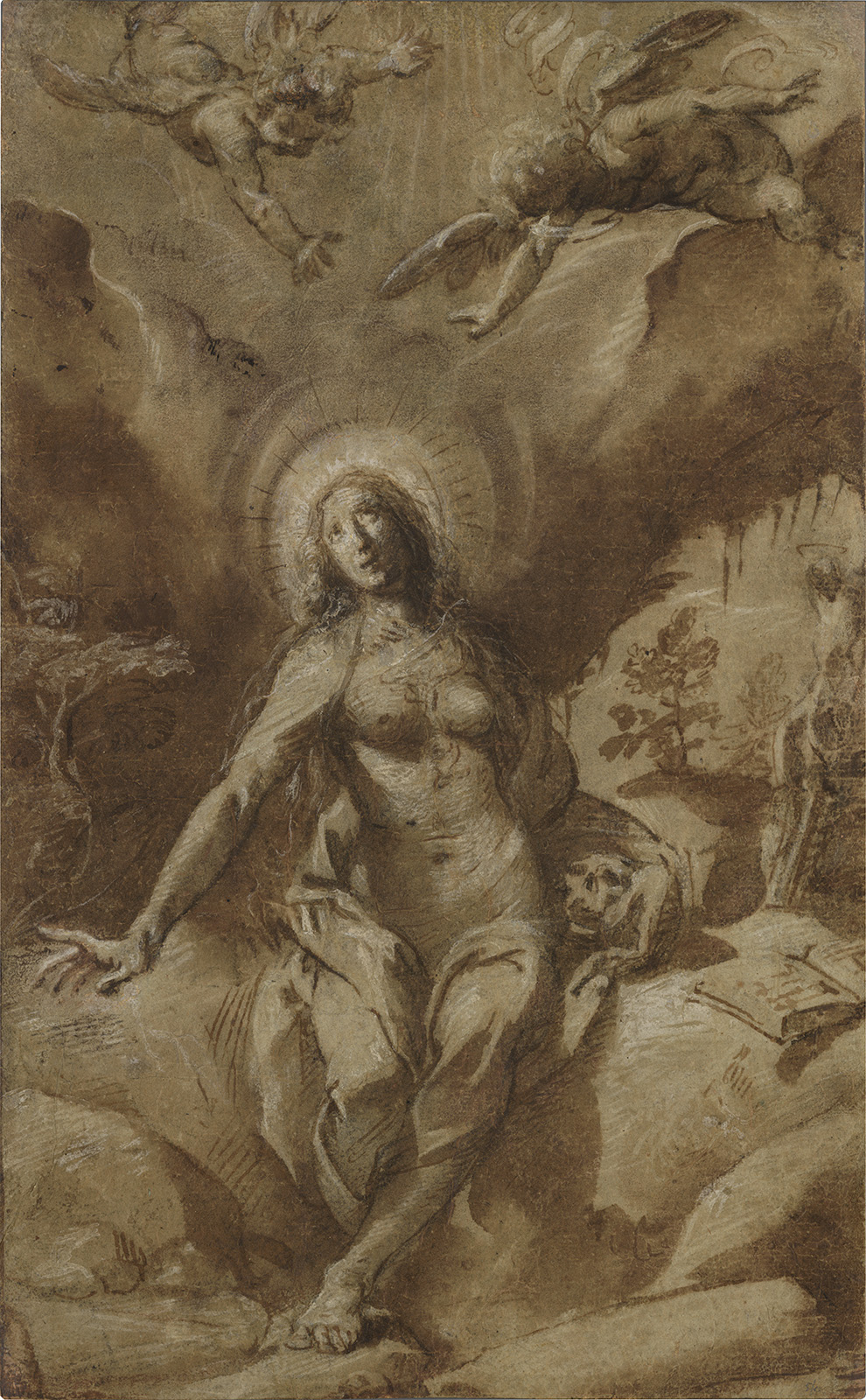
Pier Francesco Mazzucchelli called Morazzone
(Morazzone, 1573 - Piacenza, 1626)
Study for Mary Magdalen, 1610-1611
Pen, brush and brown ink, black chalk and wash heightened with white on paper
375 x 232 mm (14.76 x 9.13 inches)
Pier Francesco Mazzucchelli called Morazzone
(Morazzone, 1573 - Piacenza, 1626)
Study for Mary Magdalen, 1610-1611
Pen, brush and brown ink, black chalk and wash heightened with white on paper
375 x 232 mm (14.76 x 9.13 inches)
Re: 0285
Inscription
«5/c», pencil, below right
«Morazzone Fr Mazzucchelli d. Morazzone», pencil
Provenance
Milan, collection Francesco Dubini, before 1940
Milan, collection Hoepli, post 1940 – before 1975
Milan, Finarte, 3-4 december 1975, lot. 473
Literature
Stoppa 2003, pp. 213-214, fig. 36d
The drawing has a distinguished provenance from the collection of Cavaliere Francesco Dubini (1848–1932). This is confirmed by the collector’s mark ‘5/c’ in pencil, also found on other sheets that once belonged to the well-known Milanese textile entrepreneur.¹ On Dubini’s death, several sheets entered the Hoepli collection, where they remained until their dispersal at Finarte in Milan in 1975.² Although it was already correctly attributed on that occasion to Pier Francesco Mazzucchelli, known as il Morazzone, the work was overlooked by scholarship until its publication by Jacopo Stoppa, who established its context.³ The sheet is in fact a first idea, already at an advanced stage of elaboration, for the Magdalene Escorted Aloft by Angels. This celebrated altarpiece was completed in 1611 for the altar of the chapel of the same dedication in the basilica of San Vittore, Varese (fig.).â´
Evidence of a compositional search that was anything but hasty is provided by another, virtually identical sheet from the same phase of study, in the Kupferstichkabinett, Berlin. In that sheet, however, the absence of charcoal shows that the mise en page had already been resolved in the drawing discussed here.âµ A third sheet, in the Willumsen Museum, Frederikssund, completes the group.ⶠIt belongs to a still more advanced stage of the design, as the more finished line suggests, as does the figure of the Magdalene herself, now fully supported by a host of angels.â· A similar modus operandi, proceeding by progressive refinement, can also be observed in the genesis of the contemporary Jacob Wrestling with the Angel in the Archbishop’s Palace, Milan. Its vibrant preparatory sheet, now in the British Museum, London, is entirely akin to ours in style, dynamism and ductus.â¸
In stylistic terms, the present work is striking for its vibrant chiaroscuro and for the cursive fluency of the line, which sets down the saint on paper with expressive urgency. This confirms the preparatory nature of the sheet, conceived as a study to be tested in the midst of work on the Varese commission. It contrasts, for example, with the Pietà in the Musée du Louvre, Paris, whose degree of finish reveals that it was intended for private devotion.â¹ Here, instead, attention is focused on the anatomical torsion and ecstatic abandon of Mary Magdalene. She is roughed out through a web of pen and wash lines, enlivened by intense lead-white highlights that bring out her modelling and three-dimensional projection, reinforced by only a few strokes of charcoal.
Chronologically, the close connection with the San Vittore panel requires the drawing to be dated to around 1610. Beyond its link with that commission, this dating is also supported by the quality of the handling itself. It is still marked by a distinct transparency and atmospheric lightness, which, together with the confident use of lead white, anticipates the results reached in the sheet with Saints Sebastian and Catherine of Alexandria with a Glory of Angels in the Muzeum Narodowe, Warsaw, datable to around 1615.¹â° Towards the end of the decade, by contrast, Morazzone’s line would become appreciably more vigorous and deliberate. This is exemplified by the Saint Charles in the Morgan Library, New York, which can by now be dated close to 1620.¹¹ In the New York sheet the master used denser washes and thick layers of heightening to model the volumes with an exceptionally raw realism. In a sense, this runs parallel to the path taken by Daniele Crespi, who was nonetheless always inclined towards greater expressive economy than his colleague from Varese.
Fig. Pier Francesco Mazzucchelli, known as il Morazzone, Mary Magdalene Escorted Aloft by Angels, 1611. Varese, San Vittore
¹ By way of example, I would mention the Portrait of a Gentleman in Profile, formerly in the Dubini collection, catalogued as anonymous by G. Fusconi, in L’Artista e il suo atelier. I disegni dell’acquisizione Osio all’Istituto Nazionale per la Grafica, exh. cat. (Rome, Palazzo della Fontana di Trevi, 7 April – 11 June 2006), ed. by G. Fusconi with A. Canevari, Rome 2006, p. 178, no. 86.
² On the Dubini–Hoepli transfers, see M. Cresseri, Per Brera. Doni e collezionisti dal 1882 al 2000, ed. by M. Ceriana and C. Quattrini, «Quaderni di Brera», 10, Florence 2004, pp. 96–100.
³ Stoppa, op. cit., 2003, pp. 213–214, fig. 36d.
â´ Oil on panel, 271 × 172 cm; Stoppa, op. cit., 2003, pp. 212–214, no. 63, pl. 32.
âµ Pen and brown ink with wash, lead white, on greenish-blue paper, 406 × 246 mm; Stoppa, op. cit., 2003, pp. 213–214, fig. 36c.
ⶠPen and brown ink with wash, lead white, on grey-blue paper, 280 × 218 mm; Stoppa, op. cit., 2003, pp. 264–265, no. D 19. Besides the painted derivation in the Pinacoteca di Brera, which should be regarded as a copy, the Danish sheet is also connected with the canvas in a private collection noted by M. Bona Castellotti, L’ambiente del Sacro Monte, il Morazzone e la pittura a Varese nel primo Seicento, in Pittura tra Ticino e Olona. Varese e la Lombardia nord-occidentale, ed. by M. Gregori, Milan 1992, p. 45.
â· A further, non-autograph copy of the Magdalene is the red chalk drawing (377 × 255 mm) in the Castello Sforzesco, Milan, published in Il Morazzone, exh. cat. (Varese, Villa Mirabello, 14 July – 14 October 1962), ed. by M. Gregori, Milan 1962, p. 154.
⸠Stoppa, op. cit., 2003, p. 207, no. 29, pl. 26, and fig. 29a for the drawing.
â¹ Stoppa, op. cit., 2003, p. 264, no. D 15.
¹â° G. Bora, in Isidoro Bianchi di Campione. 1581–1662, exh. cat. (Campione d’Italia, Galleria Civica, 13 April – 15 June 2003), ed. by D. Pescarmona, Milan 2003, pp. 128–129, no. 17.
¹¹ G. Bora, in Il Seicento lombardo, exh. cat. (Milan, Palazzo Reale and Pinacoteca Ambrosiana, June – October 1973), III, Milan 1973, pp. 28, 112, no. 102.