

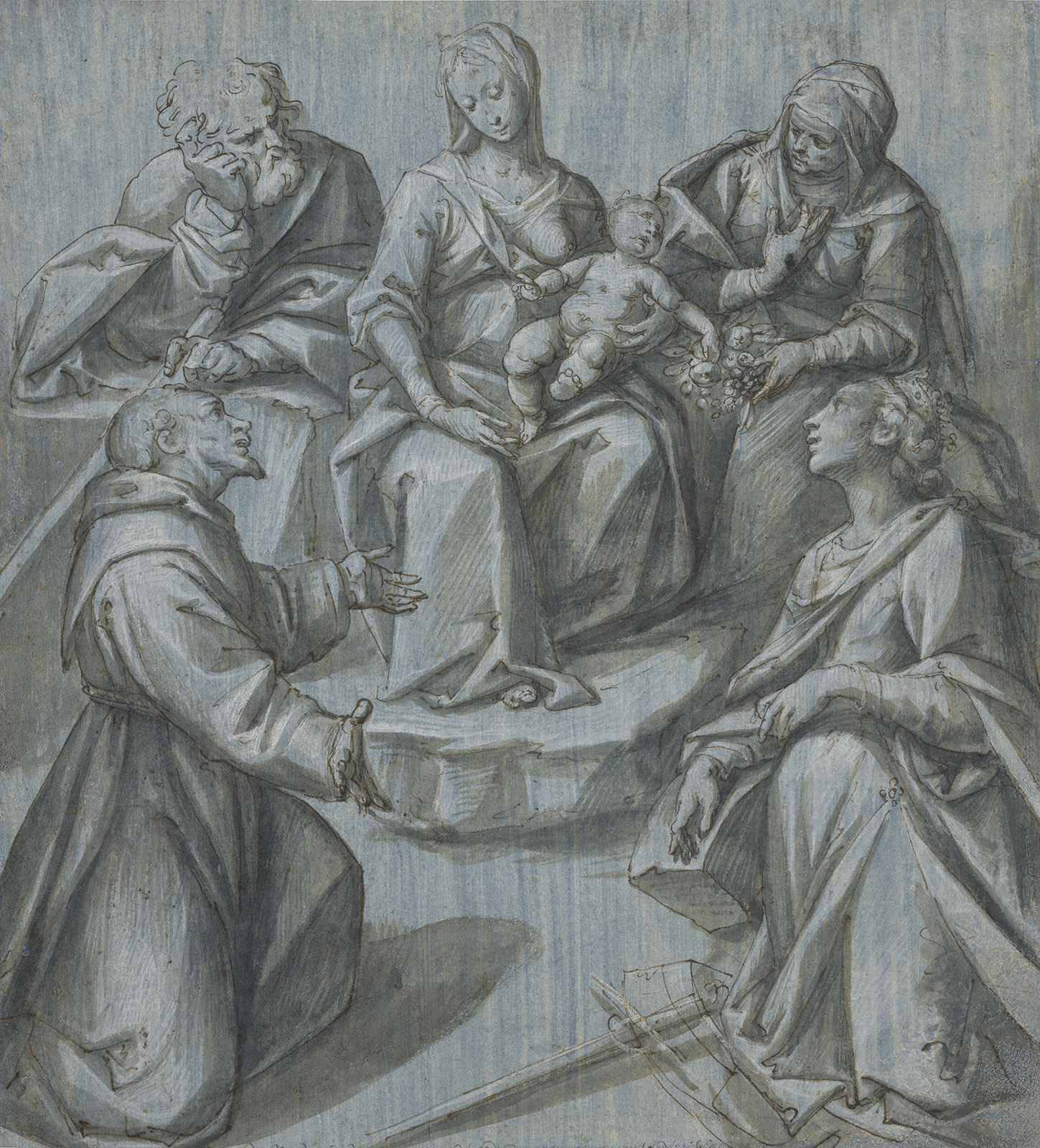
Guglielmo Caccia detto il Moncalvo
(Montabone (Asti), 1568 - Moncalvo (Asti), 1625)
Madonna and Child Enthroned Flanked by Saints Giuseppe, Anna, Francesco of Assisi and Catherine of Alesssandria, 1615 - 1620
Pen, brush, brown ink and wash heightened with white, on paper
329 x 298 mm (12.95 x 11.73 inches)
Re: 0284
Provenance
London, Sotheby's, 28 june 1979, lot. 100
Milan, Gallery Stanza del Borgo, 1982
Private collection
Letterature
M.L. Lazzati, Disegni di antichi maestri 1982, p.1, n.1
The work reappeared on the art market at a Sotheby’s sale in London in 1979, already bearing the attribution to Guglielmo Caccia, known as il Moncalvo.¹ The attribution was repeated at the exhibition held at the Stanza del Borgo in Milan in 1982, accompanied by a catalogue edited by Maria Luisa Lazzati.² Exceptionally highly finished, the sheet depicts the Virgin and Child at the centre of a sacred setting formed by four saints. The composition is finely calibrated on two registers, following a chiastic scheme with two figures in the upper section and two in the lower. Above, flanking the Marian group, are a pensive Saint Joseph on the left, of Michelangelesque descent, and on the right the elderly Saint Anne, offering a selection of fruit to her grandson. In the lower register, kneeling in devout adoration, are Saint Francis of Assisi and Saint Catherine of Alexandria, with the inevitable instruments of her martyrdom at her feet: the sword and the spiked wheel.
From a technical point of view, the sheet stands out for its markedly painterly approach. The rapid pen work and the transparent washes are perfectly in line with the typical ductus of the Monferrato painter. In this drawing, however, the artist goes further, dwelling insistently on the effects of light through dense, full-bodied lead-white heightening. This particular richness of material and chiaroscuro is not especially frequent in Moncalvo’s repertory, and it is not far removed from the sensibility displayed by the Fiammenghini brothers.³ Nevertheless, it is not an absolute unicum within Caccia’s catalogue.â´ This is shown by the Saint Julius of Novara in the Biblioteca Ambrosiana, Milan, and the Visitationin the Musée du Louvre, Paris. In both, just as in the present case, Guglielmo combined pen and wash with lead white on blue-tinted paper.âµ Given its subject, however, an even more decisive comparison is perhaps a sheet that appears still unpublished, sold by Finarte in Milan in 1983 (fig. 1).ⶠThat sheet shares with ours the extensive use of lead-white heightening, applied in this case on grey-tinted paper. Beyond the technique, the compositional links are also quite evident, since here too the iconography presents Saint Anne bending down to play with the Christ Child. In this respect, it is worth noting that the same distinctive motif of Saint Anne with the Child, drawn in a disjointed pose, also appears in a pen and wash study in the Szépművészeti Múzeum, Budapest.â·
In this respect too, then, the attribution to Caccia is entirely uncontroversial, and it finds continual, close confirmation throughout the painter’s corpus of drawings. The sharp facial type of the Virgin and the fall of the drapery, gathered in broad folds at the base, closely match the Virgin and Child in Glory in the Biblioteca Reale, Turin.⸠The same face of the Virgin recurs precisely in another drawing in a private collection, depicting God the Father, the Virgin and Child and Saints Christopher and Roch. There, the figure of the Eternal Father offers a close physiognomic parallel for the Saint Joseph in our study.â¹ Equally close parallels can be found for the cursive, vibrant profile of Saint Francis. It is close to the wonder-working saint in the study for an altarpiece of the Virgin and Child in Glory Adored by Saints Sebastian and Roch, also in Turin,¹â° and to his kneeling counterpart in the marvellous yet neglected sheet in the Museo del Prado, Madrid.¹¹ The features of Saint Catherine of Alexandria, for their part, find perfect parallels in the Mystic Marriage of Saint Catherine sold at Sotheby’s, London, in 1975,¹² and in the Virgin and Child with Saints Catherine and Michael in a private collection in Turin.¹³ The latter is a very late sheet, in which even the Virgin appears almost identical to ours. Equally decisive is the analysis of the Child, with his plump, unruly build. His kicking, ‘sprawling’ pose recurs verbatim in the canvas of the Rest on the Flight into Egypt, now in a private collection.¹â´ Such inventions also fit perfectly into the rich repertory of putti in Caccia’s workshop. These can be traced in key works such as the study for a Concert of Angels in the British Museum, London,¹âµ and the marvellous sketch in the Brera,¹â¶ preparatory for the altarpiece formerly at Castellazzo Bormida and now in the Capuchin church at Tortona, datable to around 1620.¹â· They also appear in the throng of chubby, boisterous little angels surrounding the Assumption in the Ospedale at Nizza Monferrato.¹â¸
On closer inspection, it is precisely the very high degree of pictorial finish and the carefully calibrated reuse of figures typical of Caccia’s vocabulary that suggest the work may be a true assembly modello. As Gianni Romano has observed,¹â¹ in his maturity Moncalvo used to redraw and combine his most characteristic motifs to supply them to his daughter Orsola Maddalena, also a painter, for professional reuse. One example is the Saint Luke as Sculptor in San Francesco at Moncalvo, painted by Orsola drawing on, and varying, the Saint Luke as Painter drawn by her father, now in the Musei Civici, Turin.²â° This practice was explicitly authorised in the master’s will, in keeping with a deep-rooted custom of preserving drawings for the needs of the workshop.²¹ A function as a painting modello also seems supported by the evident links between the drawing and Guglielmo’s finished canvases, beginning with the aforementioned altarpiece formerly at Castellazzo Bormida. Our sheet shares with that painting not only the Virgin’s face and the dense texture of her mantle, but also the unmistakable rounded morphology of the Child’s face and the pose of Saint Francis, which is very close in intensity and gesture. Finally, the case is sealed, and a firm terminus post quem provided, by the affinities with the altarpiece executed around 1615 for the parish church of the Natività della Vergine at Sala Monferrato (fig. 2). There, a Saint Francis and a Saint Catherine appear side by side,²² related, especially in the case of the sponsa Christi, to those in the composition of our sheet.
Fig. 1. Guglielmo Caccia, known as il Moncalvo, Virgin and Child with Saint Anne, Saint Jerome, a Bishop Saint and a Putto, c. 1615–1620. Private collection
Fig. 2. Guglielmo Caccia, known as il Moncalvo, Virgin and Child in Glory with Saints Francis of Assisi and Catherine of Alexandria, c. 1615. Sala Monferrato, Natività di Maria Vergine
¹ The principal references on Moncalvo are Romano 1968; Romano 1972, pp. 758–762; Bava 1997, pp. 17–25.
² M.L. Lazzati, in Disegni di antichi maestri 1982, p. 1, no. 1.
³ For the drawings of the Fiammenghini, see the relevant entries in this volume, pp. xx–xx.
â´ For Moncalvo’s drawings, see Bertini 1958, nos 249–250, 252, 262; Moccagatta 1959, pp. 325–327; Romano 1984, pp. 758–762; Romano 1996, pp. 141–143; G. Romano, in Guglielmo Caccia 1997, nos 5–9, 12, 14, 17, 20–23, 26–29, 36–37, 39–40, 42–44, 46–47.
âµ V. Guazzoni, in Ospedale Maggiore 1988, pp. 24–25, no. Q 28. For the Paris sheet, the reference is inv. 11244, recto.
ⶠPen and wash with lead white on grey-tinted paper, 302 × 223 mm; Milan, Finarte, 24 November 1983, lot 7; previously 30 November 1982, lot 65.
â· Fenyö 1965, no. 70.
⸠Romano 1984, p. 539, no. 260.
â¹ The sheet was shown in the exhibition Il Moncalvo e la sua bottega. Movimento e sentimento nella controriforma (Alessandria, Palatium Vetus, 7 March – 30 September [21 December] 2025), curated by M. Cairo, V. Oneto and L. Rey Varela, for which no catalogue was published.
¹â° Romano 1984, p. 540, no. 266.
¹¹ Turner 2008, p. 320.
¹² 9 December 1975, lot 35.
¹³ 6–7 July 1987, lot 110. G. Romano, in Guglielmo Caccia 1997, pp. 133–134, no. 44.
¹â´ Formerly London, Sotheby’s, 30 October 1996, lot 157.
¹âµ Romano 1984, pp. 539–540, fig. 529.
¹â¶ Romano 1984, pp. 538–539, no. 60, fig. 528; L. Arrigoni, in Disegni lombardi 1986, pp. 74–75, no. 20; A. Chiodo, in Seicento lombardo 2013, pp. 131, 143, no. 2.
¹â· Romano 1968, p. 12.
¹â¸ Romano 1968, p. 18; A.M. Bava, in Guglielmo Caccia 1997, pp. 110–111, no. 33.
¹â¹ Romano 1984, p. 539.
²â° G. Romano, in Guglielmo Caccia 1997, pp. 128–129, no. 42.
²¹ Negri 1896, p. 120.
²² Romano 1968, p. 19.