

Francesco Londonio
(Milan, 1723 - Milan, 1783)
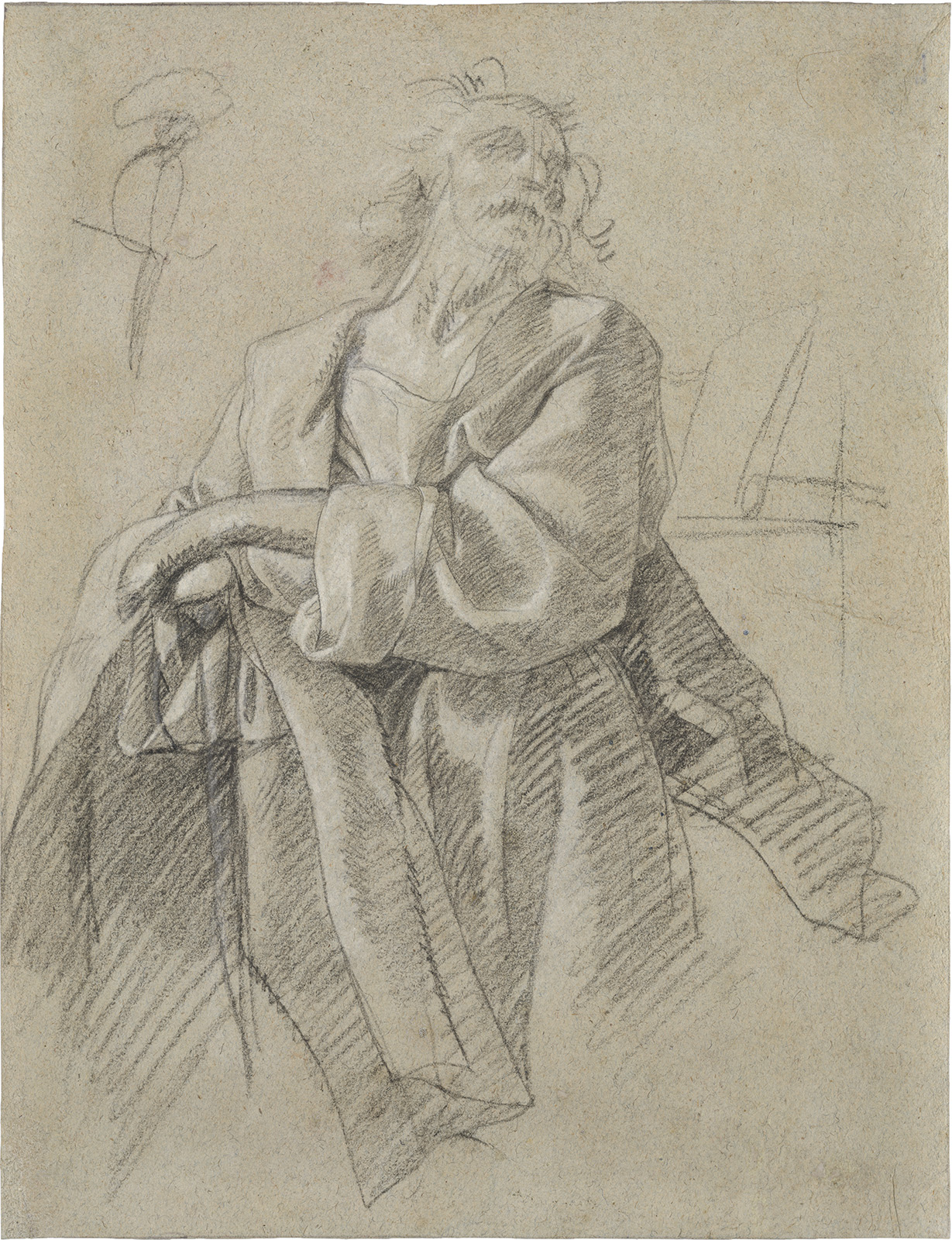
Study for a Saint Paul, 1750-1760
black chalk and white chalk on paper
323 x 248 mm (12.72 x 9.76 inches)
Francesco Londonio
(Milan, 1723 - Milan, 1783)
Study for a Saint Paul, 1750-1760
black chalk and white chalk on paper
323 x 248 mm (12.72 x 9.76 inches)
Re: 0283
Inscription
«4», pen, top left, on the verso
Provenance
Private collection
The sheet, unpublished, presents a study of a vigorous cloaked male figure, his head turned upwards and his right arm bent in a firm, monumental pose. At first glance the object held in his hand may be difficult to make out. Any doubt is dispelled, however, by a rapid sketch in the upper left corner, which clearly shows a hand resting on the hilt of a sword, with the quillons and the base of the blade unmistakably visible. Thanks to this iconographic attribute, the subject can be identified with certainty as Saint Paul.
The work is striking for its masterly exploration of volume, achieved by orchestrating a skilful contrast between the black chalk shading and the white chalk highlights. The handling is marked by a cursive, zigzagging ductus, in which the shaded areas are resolved through dense parallel hatching drawn with urgency, the chalk almost never lifted from the paper. This distinctive way of structuring form and the plastic tension of the modelling unmistakably betray the name of Francesco Londonio. The attribution may at first seem surprising, since, as far as is known, the Milanese master almost never devoted himself to religious subjects. The exception is his well-known production of presepi, Nativity crib figures painted on paper.¹
Any doubt about the attribution is dispelled, however, by close stylistic parallels with a series of sheets executed by Londonio in his very early maturity. From a technical point of view, the drawing clusters around the study of a Cow and Bull at Rest in the Biblioteca Ambrosiana, Milan, dated 1753.² Further close comparisons can be made with the Reclining Shepherd Boy, which passed through the market at Cambi,³ the Shepherd with Cattle in the British Museum, London, and, above all, the two Wayfarers and the Shepherd Eating in private collections.â´ Another firm link is provided by the Study of a Shepherd with a Staff presented in this same exhibition. The present Saint Paul shares with that sheet not only the same graphic vocabulary but also the same provenance. This is shown by the traces of oxidised adhesive tape on the verso and by the same handwriting used to inscribe the collection number at the upper left.âµ
Beyond the unusual subject, further confirmation of Londonio’s authorship comes from the marvellous study on the verso of the sheet (fig.). It is a passage of ground with boulders, pebbles and tufts of grass, drawn in red chalk and heightened with white chalk. It is executed with a freshness and a sensitivity to nature that fully embody the artist’s taste. The use of red chalk should come as no surprise. Although Londonio is best known for his systematic use of black chalk, his catalogue also includes works in red chalk, a technique he learned from his first master, Ferdinando Porta.ⶠOne example is the Mule with a Shepherd in the Gabinetto dei Disegni of the Castello Sforzesco.â· That sheet, however, should be placed in a later phase of his career, given its far more meticulous and less synthetic anatomical definition compared with the expressive urgency that animates our sheet.
It is difficult, on the other hand, to establish the actual purpose of this study, and to determine, for example, whether the figure was conceived as part of a series of Apostles or as a pendant to a Saint Peter. What is certain is that, beyond his highly successful pastoral scenes and Arcadian Nativities, the artist at least occasionally explored biblical themes as well. In this respect, it is worth recalling that the posthumous inventory of the possessions of his brother Carlo, drawn up in 1794, lists an overmantel painting depicting a ‘Rachele’ [Rachel].⸠As Marco Bona Castellotti has suggested, this subject was probably resolved by disguising the Old Testament heroine as a shepherdess, thus absorbing the religious episode into the bucolic world favoured by the painter.â¹ In the lost Rachel and in the more celebrated presepi, contamination with the rural world served as the keystone of the invention. In the present drawing, by contrast, there is no concession whatever to such rustic conventions. The Saint Paul stands clearly apart from any genre inflection and thus emerges, in the current state of research, as the first purely religious work known in Francesco Londonio’s catalogue.
Fig. Study of Saint Paul: verso with Landscape Study
¹ Francesco Londonio 2021; Francesco Londonio 2024.
² Geddo 2002, p. 42, n. 12; Geddo 2005, p. 610.
³ 18 March 2021, lot 97; 220 × 255 mm. Illustrated in this volume on p. xx.
â´ Respectively: Paris, Christie’s, 25 March 2015, lot 116; 340 × 271 mm. New York, Sotheby’s, 5 February 2025, lot 22; 323 × 254 mm.
âµ See the relevant entry in this volume.
ⶠBasan 1791, pp. 112–113.
â· I disegni del Principe 2022, p. 186, no. 85.
⸠Bona Castellotti, Geddo 1998, p. V, doc. E.
â¹ Bona Castellotti 1998, p. 4.