

Francesco Londonio
(Milan, 1723 - Milan, 1783)
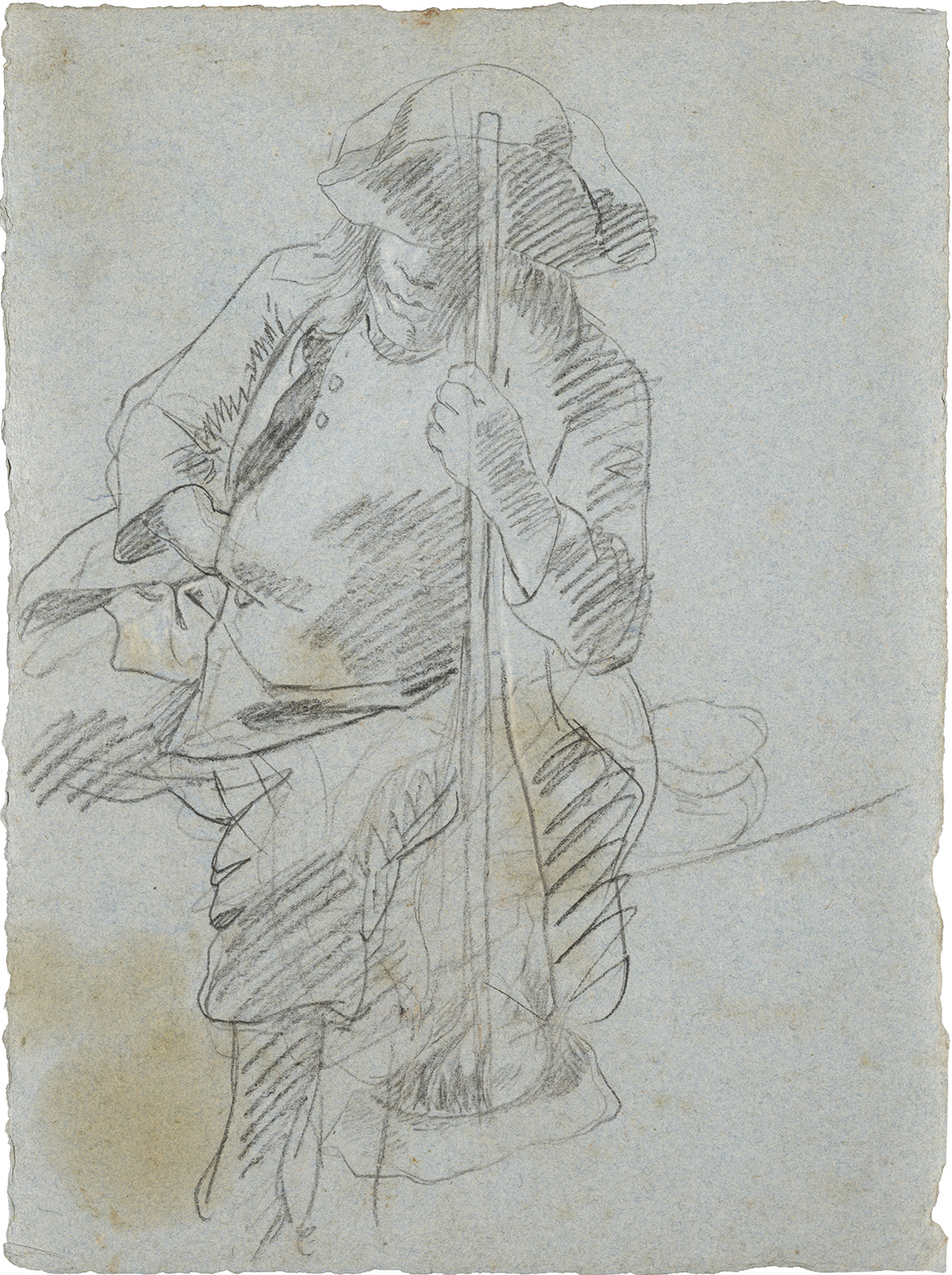
Study of a Shepherd with Staff, 1750-1760
black chalk, charcoal and white chalk on paper
308 x 230 mm (12.13 x 9.06 inches)
Francesco Londonio
(Milan, 1723 - Milan, 1783)
Study of a Shepherd with Staff, 1750-1760
black chalk, charcoal and white chalk on paper
308 x 230 mm (12.13 x 9.06 inches)
Re: 0282
Inscription
«2», pen, top left, on the reverse side
Provenance
Private collection
The work, hitherto unpublished, depicts a man in rustic dress, caught in an attitude of rest as he leans firmly on a staff. His head is protected by a broad-brimmed hat that casts a deep shadow over his face, whose features are defined with scrupulous care. At the bottom of the sheet is a sketch of a peasant on the ground, drawn upside down. On the verso is a sketch of a tree.
As regards attribution, in the current state of research there appear to be no links with specific paintings or with the artist’s vast output of prints. Nevertheless, the genre subject, the type of figure and the distinctive stylistic grammar betray the hand of Francesco Londonio. He was an incomparable interpreter, in both painting and printmaking, of the pastoral world of eighteenth-century Lombardy, whose drawings still await a study that properly surveys their catalogue.¹
In terms of execution, this is a first sketch, an idea set down urgently on paper. This preliminary stage differs markedly from the more controlled and meticulous drawings intended for etching.² It also differs from the independent sheets conceived from the outset as finished works to be hung on the wall, as in the case of the series dedicated to Count Giacomo Mellerio shortly after 1776.³ Two extraordinary examples from that series, unknown to scholarship, recently reappeared at auction.â´ At the same time, the present work is also distinct from the more elaborate arrangements of figure groups. These are best represented by several drawings in the Biblioteca Ambrosiana, Milan.âµ To these should be added the fine Peasant Woman with a Boy in the Louvre, Paris, which bears at the foot the important inscription ‘Di Francesco Londonio Milanese 1767’ [By Francesco Londonio of Milan 1767],ⶠand the marvellous Mule in the Istituto Centrale per la Grafica, Rome.â·
In our case, although the image forgoes an analytical definition of the shepherd’s silhouette, the figure is solidly structured in its rendering of volumes through chiaroscuro. This vigorous plasticity is achieved through a carefully calibrated handling of light, based on the contrast between robust black chalk hatching and strategic white chalk heightening that brings light and breadth to the composition. Comparisons can be drawn with the Young Peasant in the Ambrosiana,⸠the Shepherd Eating, formerly at Sotheby’s, New York,â¹ and the two Wayfarers, formerly at Christie’s, Paris.¹â° The latter are unpublished and close to our sheet in their combined use of black chalk, charcoal and bright white chalk highlights to model the forms.
Compared with the assured command of expressive means that distinguishes the sheets just mentioned, however, the present drawing displays a structural synthesis. It aims at a rendering of the modelling as rapid as it is effective, through a zigzagging, cursive ductus that roughs in the shaded areas in patches. The result is a modus operandi entirely akin to that found in the study of a Cow and Bull at Rest now in the Ambrosiana.¹¹ Dated 1753, that sheet is the artist’s first securely dated work,¹² and it also provides a reasonable chronological reference for the present drawing. This approach also brings our sheet close to other first sketches by the master, beginning with the unpublished Reclining Shepherd Boy sold by Cambi in Genoa (fig.).¹³ Returning finally to the drawing under discussion, it is worth noting that the way the tree trunk on the verso is laid out reveals a strong affinity with the landscape passages surrounding the Shepherd with Cattle in the British Museum, London.¹â´
Nothing, on the other hand, is known about the early history of the drawing, which almost certainly remained at first in the artist’s workshop. On Londonio’s death in 1783, his working materials passed to his son Antonio.¹âµ It was only on Antonio’s death in 1832, however, that the collection began to be broken up, divided among the painter’s four grandchildren, Cecilia, Giuseppa, Carlo and Antonietta.
A significant portion of this inheritance, in particular Carlo’s share, was bequeathed to the Accademia di Brera by his will of 1836 and definitively acquired by the Pinacoteca in 1847. The materials assigned to his granddaughter Antonietta took a different path. She received ‘una quantità di studi ad olio ed a matita’ [a quantity of studies in oil and in chalk]. Unlike the sheets and bozzetti that entered the Milanese civic collections, these were soon placed on the market through the dealer Antonio Franchetti. As early as 1834 he began buying up, en bloc, the plates and works on paper in Antonietta’s possession. In light of these patterns of inheritance, it is not unlikely that the Study of a Shepherd followed a similar path.
Fig. Francesco Londonio, Reclining Shepherd Boy, 1750–1760. Private collection
¹ The case of the paintings on paper is different; for these, see Coppa 2002, pp. 11–20; Baccanelli 2021, pp. 71–83; Francesco Londonio 2021; Francesco Londonio 2024.
² On this subject in general, see Scola 1994.
³ Scola 1994, pp. 78–88, nos 66–75.
â´ Rome, Finarte, 28 May 2026, lot 178; each 380 × 540 mm.
âµ A. Barigozzi Brini, in Disegni del Settecento 1973, pp. 46–47, nos 54–56; A. Barigozzi Brini, in Settecento lombardo 1991, pp. 275–276, no. I.295.
ⶠTo my knowledge, the sheet (inv. RF 41305, recto) has not yet been studied.
â· G. Fusconi, in L’Artista e il suo atelier 2006, fig. on CD-ROM.
⸠Cod. F 267 inf. no. 51 recto.
â¹ 5 February 2025, lot 22; 323 × 254 mm.
¹â° 25 March 2015, lot 116; 340 × 271 mm.
¹¹ Geddo 2002, p. 42, n. 12.
¹² Geddo 2005, p. 610.
¹³ 18 March 2021, lot 97; 220 × 255 mm.
¹â´ Inv. 1991,0615.2, which seems to recall a drawing in the Uffizi Gabinetto, already restored to Londonio by Giglioli 1928, p. 30, fig. 2.
¹âµ On this, see Geddo 2002, p. 37.