

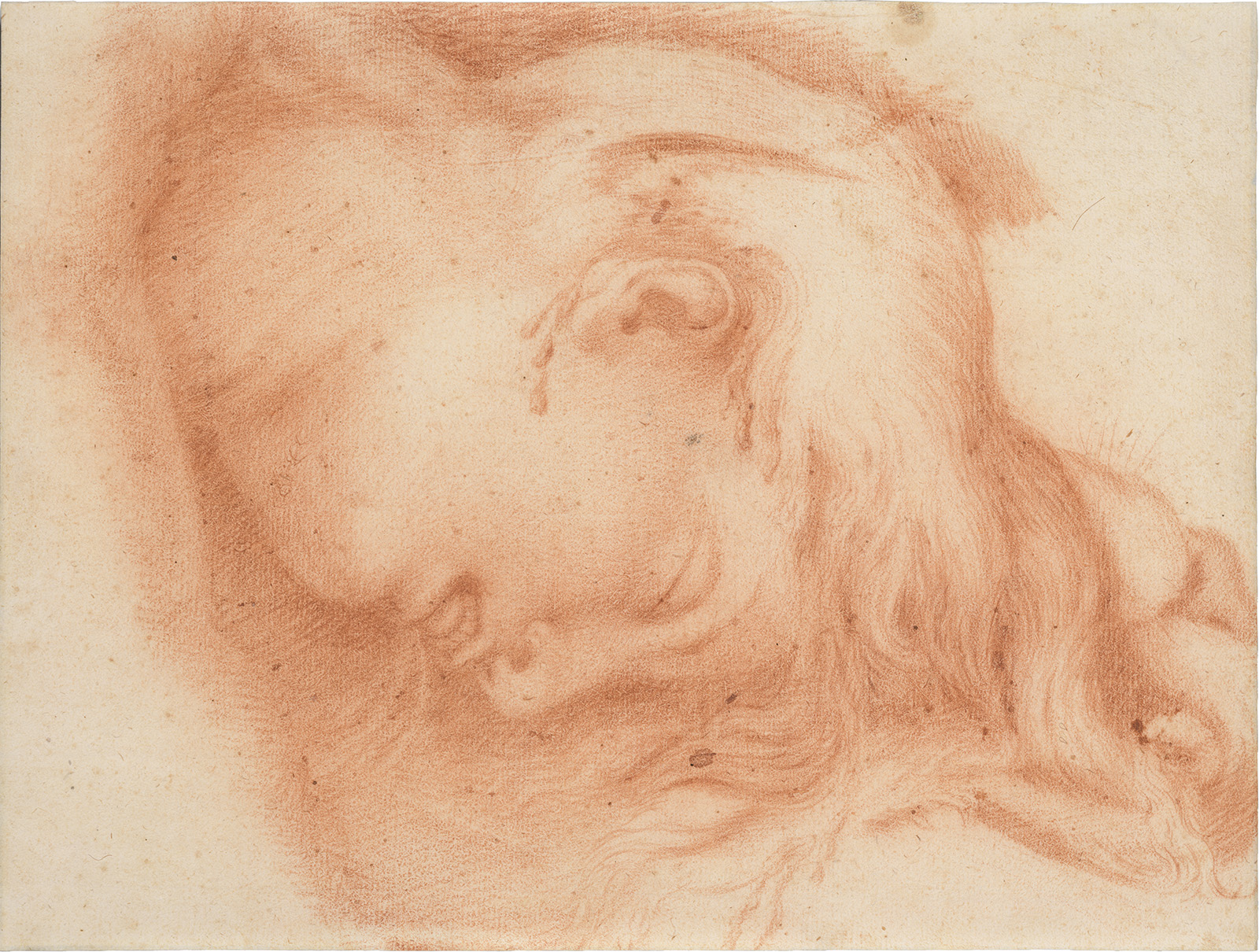
Vittoria Ligari
(Milano, 1713 - Milano, 1783)
Study Female Head, 1750-1760
Red chalk on paper
239 x 316 mm (9.41 x 12.44 inches)
Vittoria Ligari
(Milano, 1713 - Milano, 1783)
Study Female Head, 1750-1760
Red chalk on paper
239 x 316 mm (9.41 x 12.44 inches)
Re: 0281
Provenance
Private collection
The sheet depicts the head of a pale, lifeless woman lying on the ground. At first glance the subject might seem to be a severed head. Closer observation, however, reveals an arm lying above the head, disclosing the pose of a lifeless body stretched out on the ground. With no early provenance known to the present writer, the sheet recently re-emerged from a private collection bearing an attribution to Carlo Preda. This attribution is as telling as it is misleading, and it cannot be accepted. Preda’s graphic style is best exemplified by the two sensational watercolours in the Biblioteca Ambrosiana, Milan, whose ductus is radically different, marked by a distinctive liquidity and a looser, more cursive line.¹
Nevertheless, it is precisely within that cultural background that the origins of the present drawing must be sought. It belongs to the fervent moment of transition from the Baroque climate to the new elegance of the Milanese barocchetto. This world was animated by figures of the calibre of Andrea Lanzani, Stefano Maria Legnani, Filippo Abbiati, Federico Bianchi and Carlo Preda. Their teaching underpins the experience of the true protagonists of the Lombard eighteenth century, among them Pietro Antonio Magatti from Varese and Pietro Ligari from Sondrio. It is within the flourishing Ligari workshop, a thriving family enterprise in which the founder Pietro worked alongside his children Cesare and Vittoria, that the present work finds its reasonable stylistic place.
An examination of the various hands active in the workshop led by Pietro points to his eldest child, Vittoria Ligari, as the author of the sheet.² The involvement of her younger brother Cesare can be excluded with certainty. His line is more nervous and angular, resulting in sharp, incisive contours.³ The line of this drawing, by contrast, is softer and more blended, in close continuity with the results achieved in Pietro’s work, such as the Prostrate Nude in the Fondo Ligari,â´ now in the Museo Valtellinese di Storia e Arte, Sondrio.âµ What tips the balance towards an attribution to Vittoria, however, is the richness of the red chalk cross-hatching. This finds a close parallel in several sheets in the Fondo Ligari:ⶠthe Woman’s Hand on Drapery, the Half-Length Swaddled Infant and the Clasped Female Hands, a preparatory study for the Virgin in the Addolorata altarpiece at Lanzada, dated 1756.â·
As for the nature of the sheet, it is a valuable working tool. It was probably inspired not by the observation of sculptural models, a practice in fact very common in her father’s workshop,⸠but by the study of a painted invention by her father Pietro or her brother Cesare.â¹ In this respect, a suggestive comparison can be drawn with the heads of lifeless women lying on the ground in the Brazen Serpent in the Pinacoteca Ambrosiana. Cesare painted it in Venice in 1740 on the model of Tiepolo’s frieze that [decorates] the church of Santi Cosma e Damiano in Venice.¹â° Although conceived in Venice, the invention nonetheless reached Lombardy, as happened with two other altarpieces that Cesare produced in the city of Saint Mark and sent home. Proof of this is a copy of the right-hand portion of the Ambrosiana canvas, now in the Museo Valtellinese di Storia e Arte, Sondrio, whose attribution has been debated between Cesare himself and the nineteenth-century Angelo, a faithful imitator of his predecessors’ style.¹¹ The drawing here restored to Vittoria thus seems to point in this direction. It is a sheet executed after the authoritative family models, in keeping with the constant practice of copying and study that marked the painter’s entire career. She continued this practice even when, in her fifties, she was by every measure an established professional.¹²
¹ R. Bossaglia, in Disegni del Settecento 1973, pp. 60–61, no. 85; see also the sheet in the Accademia Carrara, Bergamo: A. Barigozzi Brini, in Settecento lombardo 1991, p. 268, no. I.275.
² Dell’Oca 2008, pp. 111–113.
³ L. Meli Bassi, in Disegni dei Ligari 1982, pp. 76–85, nos 42–85; A. Barigozzi Brini, in Settecento lombardo 1991, pp. 273–274, nos I.288–289; Dell’Oca, Angelini 2008, pp. 241–244.
â´ On the Fondo Ligari, see Meli Bassi 1982, pp. 23–26; Dell’Oca, Angelini 2008, p. 233.
âµ Dell’Oca, Angelini 2008, pp. 235, 241, 243, fig. 23.
ⶠL. Meli Bassi, in Disegni dei Ligari 1982, pp. 123–125, nos 86–88; A. Dell’Oca, in I Ligari 2008, pp. 202–203, no. 43.
â· A. Dell’Oca, in I Ligari 2008, pp. 200–201, no. 42.
⸠Zanuso 2008, pp. 83–93.
â¹ The drawing of the Head of the Virgin is a copy after her father: L. Meli Bassi, in Disegni dei Ligari 1982, p. 129, no. 91.
¹â° Ambrosiana.
¹¹ Meli Bassi 1974, pp. 76, 202.
¹² L. Meli Bassi, in Disegni dei Ligari 1982, pp. 127–128, nos 89–90.