

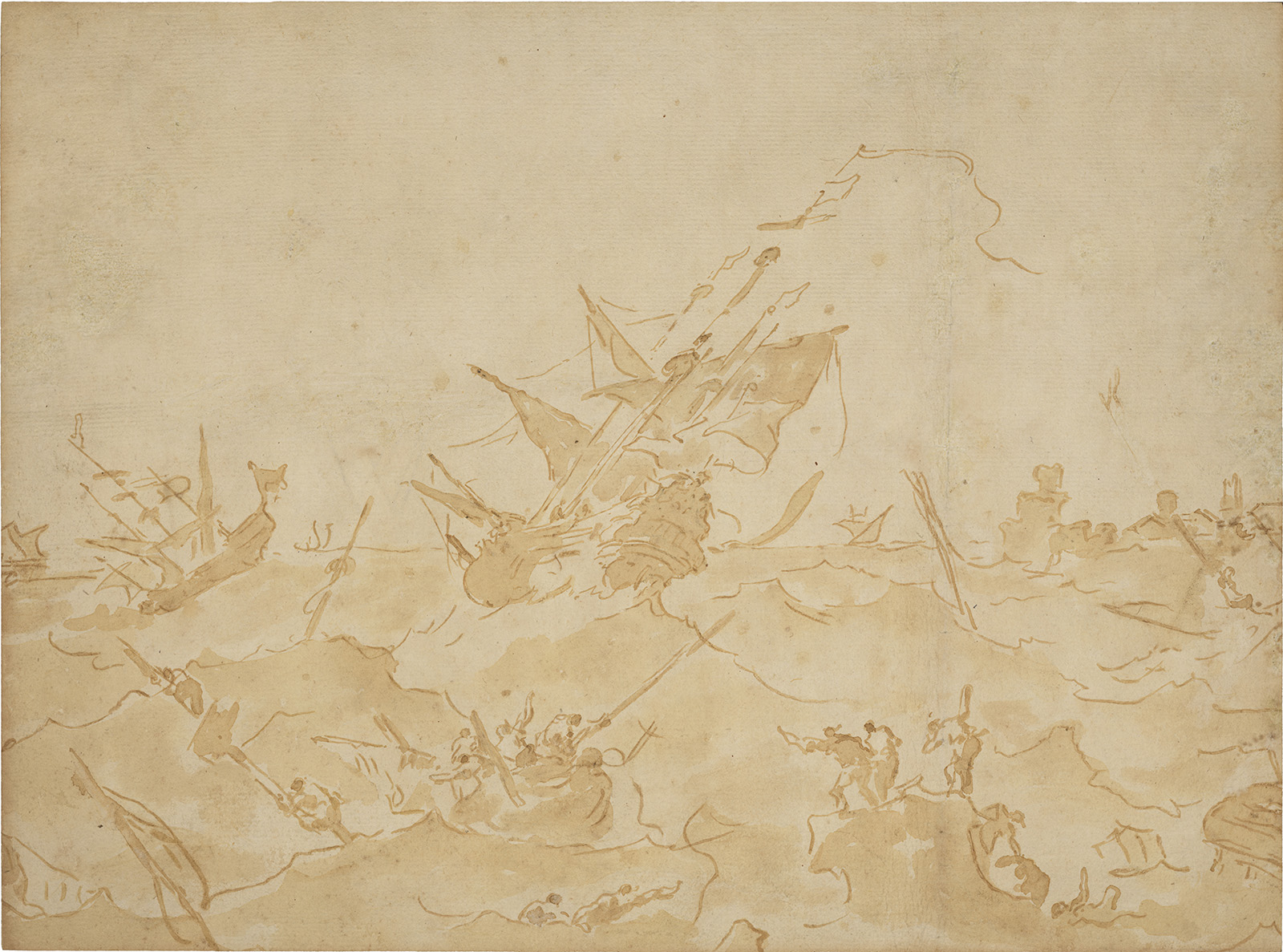
Francesco Guardi
(Venice, 1712 - Venice, 1793)
Study for a Storm, 1775-1790
Pen brush and brown ink on paper
294 x 396 mm (11.57 x 15.59 inches)
Francesco Guardi
(Venice, 1712 - Venice, 1793)
Study for a Storm, 1775-1790
Pen brush and brown ink on paper
294 x 396 mm (11.57 x 15.59 inches)
Re: 0280
Provenance
Private collection
Unpublished and of outstanding documentary importance, the sheet is a vibrant study for a storm at sea. With captivating dramatic verve it sketches the outlines of sailing ships at the mercy of the raging waves, sheer cliffs and shipwrecked figures in the foreground. Now emerging from a private collection, it fully deserves its place in the small corpus of Guardi drawings devoted to this particular subject. On closer inspection, the theme proves rather rare in his paintings too, numbering little more than a handful of works, which the artist moreover treated mainly in the latest phase of his career.¹
The sheet, in pen and wash, is in fact a valuable preparatory idea for the small panel of a Storm at Sea published by Rodolfo Pallucchini as an autograph work by Francesco Guardi, when it was in the Assheton-Bennett collection in London (fig.).² A counterpart to this new discovery is a pen drawing in the Museo Correr, Venice, already recognised first by Pallucchini and then by Antonio Morassi as the sketch for the London picture.³ The essentially preparatory nature of the two sheets is betrayed by the liveliness of the line and by slight variations in the arrangement of the spaces, evidence of a compositional search still in progress. The difference in technique between the two sheets must therefore be read in this light. Guardi used the bare pen line of the Venice study to establish the overall compositional framework. Here, by contrast, with the washes, the artist made a preliminary test of the pictorial effect and the values of light of the final version. He explored these further in a third drawing in pen and wash, in the Städelsches Kunstinstitut, Frankfurt, which is, however, limited to the passage with the two sailing ships on the left.â´
In the present case, what stands out is the cursive fluency of the line. Together with the sustained quality of the ductus and the intense vibration of the chiaroscuro, it brings this sheet close to other drawings by the master devoted to stormy seascapes. These are well exemplified by the Storm at Sea in a private collection in Paris, with which our drawing shares its expressive impetuosity, the energy of the bistre washes and the dramatic effects of shadow.âµ The work thus crystallises the highly personal idiom of the late Guardi. Having abandoned descriptive view painting in favour of the pure capriccio, the artist orchestrates the scene by emptying the northern model of any documentary residue. Indeed, as in his paintings, echoes of Alessandro Magnasco’s storms resound on paper too. They are blended with a profound reworking of seventeenth-century Dutch painting, ranging from the stormy seas of Willem van de Velde the Younger to the compositions of Jan Peeters. Guardi, however, sublimates this Netherlandish grammar to arrive at genuinely anguished visions, sustained by a blatantly decorative and theatrical intent.
This shift in meaning is clearly evident in the treatment of the human figure. The sailors clinging to the rocks or to the shattered rigging lose all anatomical substance. They become darting macchiette, drawn with the tip of the pen, feigning a mannered terror and reduced to a mere scenic pretext for orchestrating the chorus of frantic movement around the nautical disaster. The nervous allure, the broken slashes of ink and the cursive rhythm confirm the great atmospheric sensibility of a master able to whip up the sea spray on paper with the same implacable violence as the nature he observed.
Fig. Francesco Guardi, Storm at Sea, c. 1775–1790. Formerly London, Assheton-Bennett collection
¹ A. Morassi, Guardi. I dipinti, Venice 1973 [1993 ed.], I, pp. 262–265; II, pp. 439–441, nos 694–701.
² Oil on panel, 12 × 17.8 cm; R. Pallucchini, I disegni del Guardi al Museo Correr di Venezia, Venice 1943, p. 58, no. 153; Morassi, op. cit., 1973, II, p. 440, no. 699, fig. 655.
³ Pen and brown ink on grey paper, 197 × 340 mm; G. Damerini, L’arte di Francesco Guardi, Venice 1912, pl. XLII; Pallucchini, op. cit., 1943, p. 58, no. 153; A. Morassi, Guardi. I disegni, Venice 1975 [1993 ed.], pp. 157–158, no. 443, fig. 446; Francesco Guardi. Disegni del Museo Correr di Venezia, exh. cat. (Valle di Sole, Castel Caldés, 26 June – 22 August 1993), ed. by G. Romanelli and A. Dorigato, Valle di Sole 1993, pp. 76–77, no. 29.
â´ Pen and brown ink with wash on grey paper, 399 × 275 mm; Pallucchini, op. cit., 1943, p. 58. Pallucchini also mentions a fourth sheet, ‘forse però non autografo’ [perhaps not autograph, however], which passed through the Fauchier-Magnan collection in Paris in the early twentieth century. As the scholar pointed out, that drawing, in pen and wash (650 × 400 mm), is a partial replica of the Museo Correr sheet. See also Morassi 1973, II, p. 440; 1975, p. 158, who, however, gives different measurements.
âµ Morassi, op. cit., 1975, p. 158, no. 444, fig. 445.