

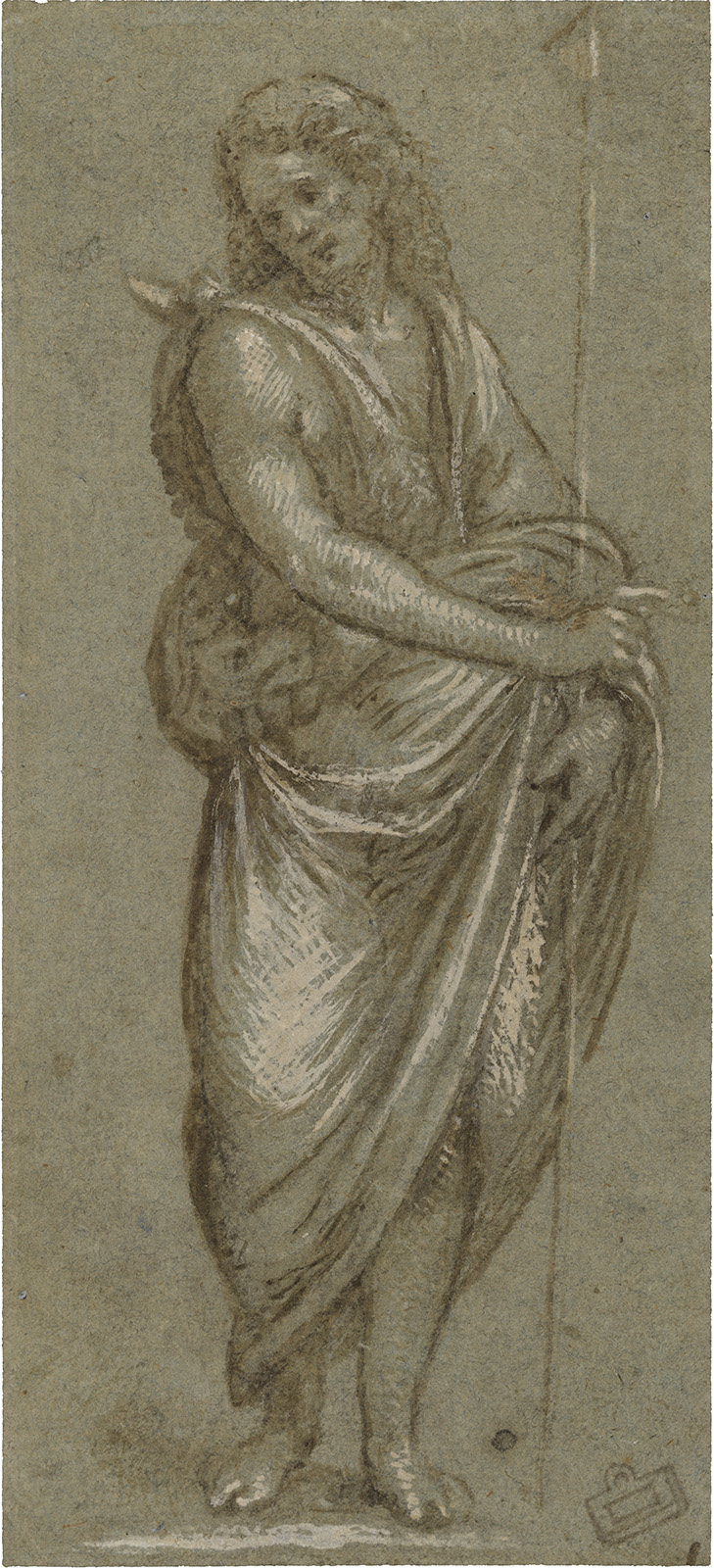
Gerolamo Giovenone
(Vercelli, 1490 c. - Vercelli, 1555)
Saint John the Baptist, c. 1520
Pen brush and brown ink, black chalk and wash heightened with white on paper
191 x 87 mm (7.52 x 3.43 inches)
Gerolamo Giovenone
(Vercelli, 1490 c. - Vercelli, 1555)
Saint John the Baptist, c. 1520
Pen brush and brown ink, black chalk and wash heightened with white on paper
191 x 87 mm (7.52 x 3.43 inches)
Re: 0279
Provenance
Private collection
The drawing depicts a standing, cloaked male figure holding in his left hand a long, slender cross of marsh reeds, which allows the subject to be identified as Saint John the Baptist. At the lower right, the sheet bears a collector’s mark stamped in brown ink which, unfortunately, does not correspond to any of those recorded in the repertory begun by Frits Lugt. Nevertheless, a survey of that repertory shows that the tablet shape (tabula), used in early times by engravers to frame their monograms, was often adopted by dealers and collectors devoted to gathering prints.¹
From a technical point of view, the artist followed the workshop practice of early sixteenth-century northern Italy. On grey-blue prepared paper, he delineated the contours and shaded areas with the brush and brown ink, probably starting from a charcoal underdrawing. He then worked over it with a dense network of lead-white heightening to model the volumes in light. Turning to style, the sheet points directly to the intricate landscape of the Vercellese Renaissance. In this field of study, the interplay between the various masters has often made it difficult to delimit their respective catalogues of drawings, and in many cases of paintings too. Nevertheless, with all due caution, the drawing displays features close to the early maturity of Gerolamo Giovenone, coinciding with the shift in idiom observable in the artist’s career between the 1510s and the 1520s.
To place the work correctly, attention must first be drawn to its twofold stylistic matrix. On the one hand, the facial features recall the painter’s earliest activity, when the lesson of Martino Spanzotti and his associate Defendente Ferrari was still fresh. These features include the narrow, deep-set eyes, the furrowed cheeks below the cheekbones and the slightly elongated, tilted oval of the face. Such physiognomic inflections, together with a certain staid and slightly wooden stiffness of the silhouette, find their points of comparison in the panels painted by Giovenone between 1513 and 1515 in the Museo Borgogna, Vercelli. These are the Nativity with Adoring Angels of about 1513, the Adoration of the Child, formerly in San Bernardino, of 1514, and the slightly later Saint Anthony Triptych.²
On the other hand, the treatment of the drapery and of the anatomical volumes reveals an explicit desire for renewal. The dense web of lead white, used not in isolated touches but more structurally to sculpt fabric and skin, documents Gerolamo’s attempt to assimilate the disruptive plastic and luministic modernity of Gaudenzio Ferrari. In those years Gaudenzio’s success was upsetting the balance of the Vercelli art scene. This is, however, a still superficial Gaudenzianism. On closer inspection, it seems rather to nod to certain Raphaelesque stylistic features, transmitted directly through the engravings of Marcantonio Raimondi. Giovenone had in fact already had occasion to study Raphael’s inventions early on, going so far as to replicate, more than once, the celebrated Orléans Madonna, which passed through Spanzotti’s workshop in 1507.³
That Gaudenzio’s teaching had not yet left an evident mark on Giovenone’s idiom is shown by the fact that the handling of light here struggles to move through space with the organic naturalness that animates the works of his Valsesian colleague. Conversely, this way of making the light stand out in relief, almost as if it were worked metal, finds a suggestive parallel in painting. One example is the treatment of the Virgin’s sleeve in two copies of the aforementioned Orléans Madonna, divided between a private collection in Turin and the [Walters Art Museum], Baltimore.â´ Another is the garments of the figures in the so-called Buronzo altarpiece of 1514, originally in San Paolo, Vercelli, and now in Palazzo Madama, Turin.âµ In short, there is no trace of the more cursive, languid and loose ductus typical of a strict follower of Gaudenzio such as Bernardino Lanino. Under Gaudenzio’s aegis, Giovenone did indeed have exchanges with Lanino, but only from the 1530s onwards.ⶠTheir bond was sealed many years later, in 1543, by Lanino’s marriage to Giovenone’s daughter Dorotea.â· This evidence therefore argues against both an attribution and a dating in that direction.â¸
On the basis of these considerations, it seems reasonable to place the execution of the present drawing at a fairly precise critical juncture, around 1520. The sheet thus serves as a link between two phases. The first is the legacy of Spanzotti and Defendente, progressively left behind once Giovenone set up an independent workshop.â¹ The second is the full achievement of the volumetric solidity that would begin to appear in the painter’s catalogue in the mid-1520s. It is seen in works such as the altarpiece in San Lorenzo, Mortara, of about 1524, and the Lochis triptych in the Accademia Carrara, Bergamo, of 1527.¹â° Together with the Virgin and Child with Two Female Saints at Vanderbilt University, Nashville, Tennessee,¹¹ and the later triptych for San Francesco, Vercelli,¹² these works mark Giovenone’s decisive change of pace under the ascendant star of Gaudenzio. It was to Gaudenzio, not by chance, that the training of Gerolamo’s younger brother Giuseppe Giovenone had been entrusted in 1521.¹³ The cartoons preserved under Gerolamo’s name in the Accademia Albertina, Turin, datable between 1527 and 1535,¹â´ likewise display a fully achieved sculptural structure. They may find a precedent in the Virgin and Child in the National Gallery of Ireland, Dublin,¹âµ and a continuation in the one in the Uffizi, Florence.¹â¶ Indirectly, they thus support an earlier dating for the drawing discussed here.
Unlike the majestic sheets in the Accademia Albertina, the present work is clearly not a pounced cartoon. It is rather a finished modello, essentially devoted to exploring the fall of light and shade before the painting was executed. This working practice is consistent with the master’s modus operandi. It is confirmed by a similar chiaroscuro modello, perhaps slightly later, depicting a Bishop Saint, which recently passed through the London art market. That sheet shares several technical and executive devices with ours, beginning with the insistent scrutiny of the effects of light.¹â·
Finally, the Baptist’s pose, with his torso turned to the left and his gaze lowered in the same direction, seems to indicate that the saint was conceived to address a figure kneeling at his feet. Following a well-established Renaissance tradition, this figure is most probably to be identified as the patron. The Baptist’s action, however, is not confined to a silent dialogue with the devotee below. With the peremptory gesture of his hand, he directs the devotee’s attention towards an element outside the scene, on the right. This suggests that the image was conceived for a larger ensemble, probably as a side panel of a polyptych or as a lateral figure in a unified-space altarpiece. In this way, the Forerunner of Christ could act as intermediary, introducing the devotee-patron towards the focal centre of the altarpiece. That centre was almost certainly occupied by an enthroned Virgin and Child, of the type seen in the aforementioned Buronzo altarpiece or in the Raspa triptych, now in San Bartolomeo at Trino Vercellese, for which a date of 1516 is recorded.¹â¸
Moreover, the existence of such working drawings is not contradicted by the archival documents concerning the commissions undertaken by Giovenone and his workshop in these years. It suffices to recall the contract of 23 May 1519, by which the vicar general of the Curia of Vercelli, Giovanni Battista Avogadro, commissioned from the artist two altarpieces that remain unidentified. One was for the church of San Marco and the other for the cathedral of Sant’Eusebio, and both were completed by 4 June 1521.¹â¹ Given the identity of the saint depicted in the present drawing, it is tempting to suggest that this Saint John the Baptist was originally intended for one of those lost altarpieces, appearing as the name saint and protector of the distinguished patron. Despite its appeal, however, the absence of any firm evidence requires this reasoning to remain a working hypothesis, pending future documentary or visual discoveries that may shed definitive light on the sheet’s true destination.
¹ Lugt 1921, no. 1875, s.v. Marseille Holloway; Lugt 2010, no. 5284, s.v. Charles Davies Sherborn.
² Romano 1986, pp. 24–25, 28–29; Baiocco 2018, p. 37.
³ Gallino 1964, p. 62.
â´ S. Baiocco, in Corti e Città 2006, p. 454, no. 236; Baiocco 2010, pp. 143–144; Baiocco 2018, pp. 36, 42, figs 8–9.
âµ Romano 1986, pp. 24, 27, 29; Baiocco 2018, pp. 37–38.
ⶠOn this juncture, see also Riccardi 2018, pp. 763–797.
â· G. Agosti, in Disegni del Rinascimento 2001, p. 282.
⸠For Lanino’s drawings, see G. Romano, in Bernardino Lanino 1986, pp. 284–289.
â¹ Romano 1986, p. 24; Baiocco 2001, p. 412.
¹â° Romano 1986, pp. 32–34. A sheet of the same subject now in the Metropolitan Museum of Art, New York, is connected with the Saint Sebastian of the Mortara altarpiece: [Autore], in Gaudenzio Ferrari 2018, p. xxx, fig. xxx.
¹¹ Baiocco 2018, [p.] 38, fig. 4.
¹² Romano 1985, pp. 13–15; Baiocco 2004, p. 179; Riccardi 2018, pp. 769–773.
¹³ Colombo 1881, p. 304; Schede Vesme, IV, 1982, pp. 1334–1335.
¹â´ M. Dell’Omo, M. di Macco, S. Ghisotti, in Gaudenzio Ferrari 1982, pp. 91–122, nos 9–16. On the Albertina works, see also Zanellati 2018, pp. 86–87, figs 2–6; and I cartoni 2020.
¹âµ Baiocco 2003, p. 17; Baiocco 2004, p. 180, fig. 49; but see A. Mazzotta, G. Romano, in Gaudenzio Ferrari 2018, pp. 358–359, no. 54, for a cautious attribution to Gaudenzio.
¹â¶ G. Agosti, in Disegni del Rinascimento 2001, pp. 273–276, no. 55, figs 62–63 on p. 272.
¹â· G. Romano, in Zwiegespräch 2013, no. 24; Chiodo 2018, p. 143, fig. 4.
¹â¸ Romano 1986, pp. 20–21; Baiocco 2004, pp. 176–177.
¹â¹ Colombo 1883, pp. 273–277; Schede Vesme, IV, 1982, p. 1339.