

Giovanni Battista della Rovere, called il Fiammenghino
(Milano, 1561 - Milano, 1628/1633)
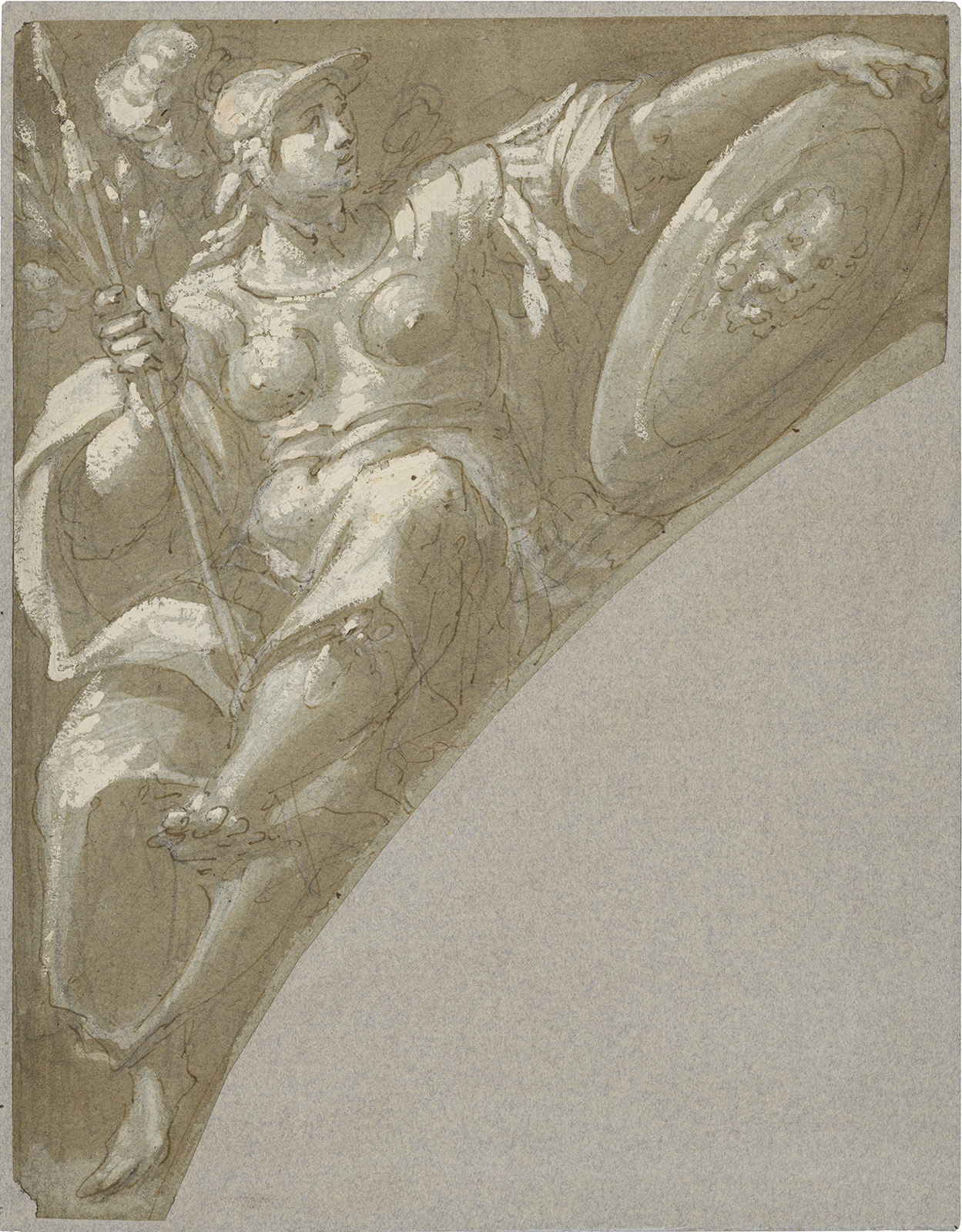
Study Allegory of Wisdom, 1635-1640
Pen brush and brown ink, black chalk and wash heightened with white, on paper
228 x 178 mm (8.98 x 7.01 inches)
Giovanni Battista della Rovere, called il Fiammenghino
(Milano, 1561 - Milano, 1628/1633)
Study Allegory of Wisdom, 1635-1640
Pen brush and brown ink, black chalk and wash heightened with white, on paper
228 x 178 mm (8.98 x 7.01 inches)
Re: 0278
Provenance:
London, Christie’s, 8 december 1981, lotto 39;
Private collection
The sheet, hitherto unknown to scholarship, is dominated by the image of a female figure armed with a spear and shield, readily identifiable as Minerva, goddess of Wisdom. The diagonal, centripetal arrangement of the composition, together with the architectural framework, unequivocally indicates that the drawing was intended as a preparatory study for a left-hand spandrel. The work appeared on the London art market at Christie’s in 1981, already correctly attributed to Giovanni Mauro Della Rovere, though without any indication of earlier provenance.
In strictly stylistic terms, the drawing should therefore be confirmed as the work of the younger of the Fiammenghini brothers, departing clearly from the working habits of Giovanni Battista. As in the other two sheets shown in this exhibition,¹ the drawing here begins with a summary black chalk underdrawing, swiftly reinvigorated by pen work laid down in a cursive, darting manner. Nevertheless, the purpose of the work lies not so much in a considered study of masses as in the desire to orchestrate the fall of light. As usual, the artist concentrates on plastic effect. He tints the paper with broad grey-green washes, allowing the masterly weave of lead white to model the volumes with forceful materiality. In this the sheet fully accords with the mature works in his catalogue, by now oriented towards the achievements of the high Lombard Seicento.
Compared with the Study of Two Apostles discussed in this volume, the ductus here takes on an even more nonchalant and abbreviated inflection, a sign of a slightly later date. In this respect, fitting chronological support comes from the affinities with the superb Allegory of Italy in the Nationalmuseum, Stockholm,² which should be read together with the Allegory of Spain in the Victoria and Albert Museum, London.³ Further support comes from the allegories adorning the design for the frontispiece of Orazio Archinto’s (1611–1683) Delineationes Picturae et Architecturae.â´ The latter work was never printed, and not even its manuscript is known. It seems reasonable, however, to date it after 1633, the year in which Archinto was first appointed vicario di provvisione in Milan. Likewise, the figure’s arrangement becomes more expansive and twisting, breaking free in space in keeping with some of the master’s late sheets. These are well exemplified by the Mars, Saturn and Triton in the Galleria Estense, Modena,âµ and the Miracle of the Poisoned Food in the Albertina, Vienna.â
Giovanni Mauro’s inclination towards secular allegorical figures for architectural spandrels seems linked to a repertory of poses and subjects established by his brother Giovanni Battista in a design for a ceiling. That sheet was formerly in the Zauli collection in Bologna, then appeared in 1971 at the Galleria Artelevi in Milan,â· and was finally sold by Gonnelli in Rome in 2019.⸠Although it shares the diagonal arrangement and the vibrant rapidity of the ductus, that sheet groups multiple allegorical studies of female and male figures in paratactic fashion. Moreover, it renders them in brown ink alone, thus forgoing the luminous accents in lead white that are the substance of Giovanni Mauro’s output.
Although the painted counterpart of the present work is unknown, the logic of its design becomes clear once what is to all intents and purposes its natural pendant is identified. Almost certainly, the image of Wisdom was completed, on the opposite side of the arch, by the figure of Justice. This appears in a drawing of essentially identical dimensions, sold at Sotheby’s in London in 1996 with the correct attribution to Giovanni Mauro (fig.).â¹ Indeed, when compared with the allegory under discussion, the London sheet, now untraced and apparently still unpublished, displays impeccable technical and stylistic consistency. Its composition and iconological ratio are also perfectly mirror-symmetrical.
This was, moreover, a compositional solution that the Fiammenghino adopted on several occasions to decorate pendentives. Examples include the Prophets frescoed in the church of Santi Vittore ed Eusebio at Peglio, in the Alto Lario, part of a larger commission begun in 1614 and completed only in 1623.¹â° Among drawings, an excellent example is the powerful Prophet Ezekiel in the Gallerie dell’Accademia, Venice. It is dated 1631 and is thus roughly contemporary with the present sheet.¹¹
Fig. Giovanni Mauro Della Rovere, Study for an Allegory of Justice, c. 1630–1640. Whereabouts unknown
¹ See the relevant entries in this volume, pp. xx–xx.
² Bjurström 1979, no. 290.
³ Ward-Jackson 1979, p. 85, no. 808.
â´ Bora 1973, pp. 35, 127, no. 154.
âµ Ruggeri 1969, pp. 124–125, fig. 7.
ⶠBirke, Kertész 1992–1997, I, no. 593.
â· Disegni del Manierismo 1971, no. 34.
⸠4–6 February 2019, lot 193.
â¹ 220 × 177 mm; London, Sotheby’s, 18 April 1996, lot 6; inscribed lower right with the curious note ‘J.B.M:’.
¹â° Coppa 1970, pp. 63–68; Tenchio 2000, p. 65.
¹¹ Ruggeri 1982, p. 107, no. 93.