

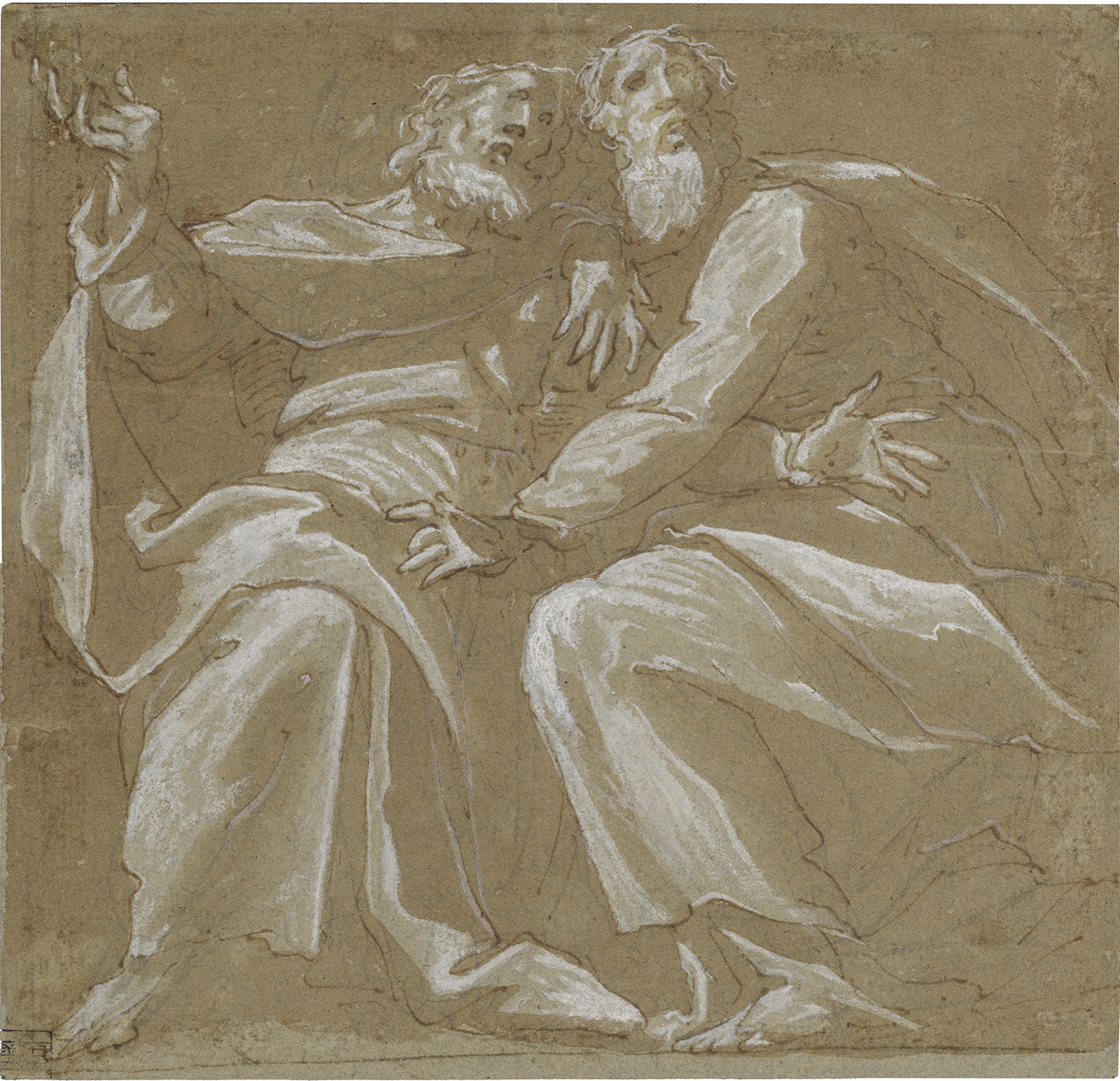
Giovanni Battista della Rovere, called il Fiammenghino
(Milano, 1561 - Milano, 1628/1633)
Study of two Apostles, 1630-1635
Pen brush and brown ink, black chalk and wash heightened with white on paper
167 x 173 mm (6.57 x 6.81 inches)
Giovanni Battista della Rovere, called il Fiammenghino
(Milano, 1561 - Milano, 1628/1633)
Study of two Apostles, 1630-1635
Pen brush and brown ink, black chalk and wash heightened with white on paper
167 x 173 mm (6.57 x 6.81 inches)
Re: 0277
Inscription
«A», pen, below left
«Balducci», pen, below left
Collector's mark
Jànos Scholz, before 1980, black ink, below, left
Provenance
New York, collection Janos Scholz, before 1980
Londra, Sotheby’s, 17 april 1980, lotto 58
private collection
The sheet depicts two monumental bearded figures in cloaks, their gaze turned upwards in an attitude of intense ecstatic participation. Formerly attributed to the Florentine Giovanni Balducci, the drawing passed at an unspecified date through the distinguished collection of János Scholz (1903–1993). Scholz was a Hungarian cellist but, above all, a formidable collector of Italian drawings, as the stamp in the lower left corner attests.¹ The work subsequently appeared on the London art market at Sotheby’s in 1980, where it was correctly restored to the catalogue of Giovanni Mauro Della Rovere.
The authorship of the younger of the Fiammenghini brothers is betrayed by the technique and by the stylistic evidence. These distinguish the sheet from the practice of his elder brother Giovanni Battista, with whom he nonetheless collaborated systematically on numerous decorative undertakings.² The initial black chalk underdrawing is followed by cursive pen work, a habitual procedure also found in Giovanni Battista’s drawings. Here, however, the ductus is even swifter and more nonchalant, in keeping precisely with Giovanni Mauro’s modus operandi. Yet this impetuous handling is not confined to merely defining the silhouette. It goes further, probing effects of light through a vibrant, richly textured symphony of lead-white highlights. These stand out against the broad grey washes laid over the paper beforehand to cancel out its neutral tone.
A similar taste for strong plastic relief recurs constantly in Giovanni Mauro’s mature output, especially from the 1620s onwards, when the echo of Morazzone resounds most clearly. In this respect, besides the Allegory of Wisdom shown in this exhibition,³ further decisive comparisons, in terms of both idiom and figure types, are offered by several works. These include the two Kneeling Figures in Adoration in the Accademia Carrara, Bergamo,â´ the Prophet Ezekiel in the Gallerie dell’Accademia, Venice, dated 1631,âµ and the Figure in Adoration in the Biblioteca Ambrosiana, Milan, which should be compared with the Prophets frescoed in the sanctuary of the Madonna dei Miracoli at Cantù.ⶠThis chronological range is fully consistent with the present sheet too, as the exuberance of the modelling and the marked chiaroscuro tension confirm, perhaps bringing it closest to the Venice drawing.
The drawing is the preparatory study for the image of the same subject frescoed in the church of Sant’Ambrogio at Rozzano. It belongs to a cycle depicting the twelve Apostles arranged in pairs across six compartments. Giovanni Mauro had already tested this arrangement on several occasions, for example in 1621 for the Prophets in the parish church of Santi Faustino e Giovita at Bienno.â· The final version also allows the initial iconographic uncertainties to be resolved. The figure on the right can be identified as Saint Bartholomew, thanks to the knife he brandishes in the Rozzano mural. Equally noteworthy is the letter ‘A’ drawn on the lower left edge of the sheet, a detail that helps to reveal how the project was organised. It suggests the original existence of a group of sheets, probably marked in alphabetical sequence, used to study the entire assembly of the Apostles. These sheets would have been designed to facilitate the spatial arrangement of the sequence of six compartments within the architectural setting. Owing to their poor state of preservation, the Rozzano frescoes have received little critical attention. They were only generically associated with the Fiammenghini workshop in the cataloguing campaign promoted in 1977 by the then Soprintendenza per i beni artistici e storici di Milano.⸠The secure attribution of this study to Giovanni Mauro thus makes it possible to elucidate the decorative scheme at Rozzano, pointing to the younger of the Della Rovere brothers as its author.
Fig. Giovanni Mauro Della Rovere, Apostles, c. 1630–1635. Rozzano, Sant’Ambrogio
¹ Lugt 1956 [and 2010], no. 2933b, s.v. János Scholz.
² Caviglioli 1989b, pp. 342–344.
³ See the relevant entry in this volume, pp. xx–xx.
â´ Ruggeri 1972, pl. 12.
âµ Ruggeri 1982, p. 107, no. 93.
ⶠBora 1973, pp. 34–35, 127, no. 150; see also Bora 1976, pp. 91–92, 150, nos 94–95, 156.
â· Fusari 2007, pp. 88–89.
⸠Catalogo Generale dei Beni Culturali, no. 0300058948A-5.