

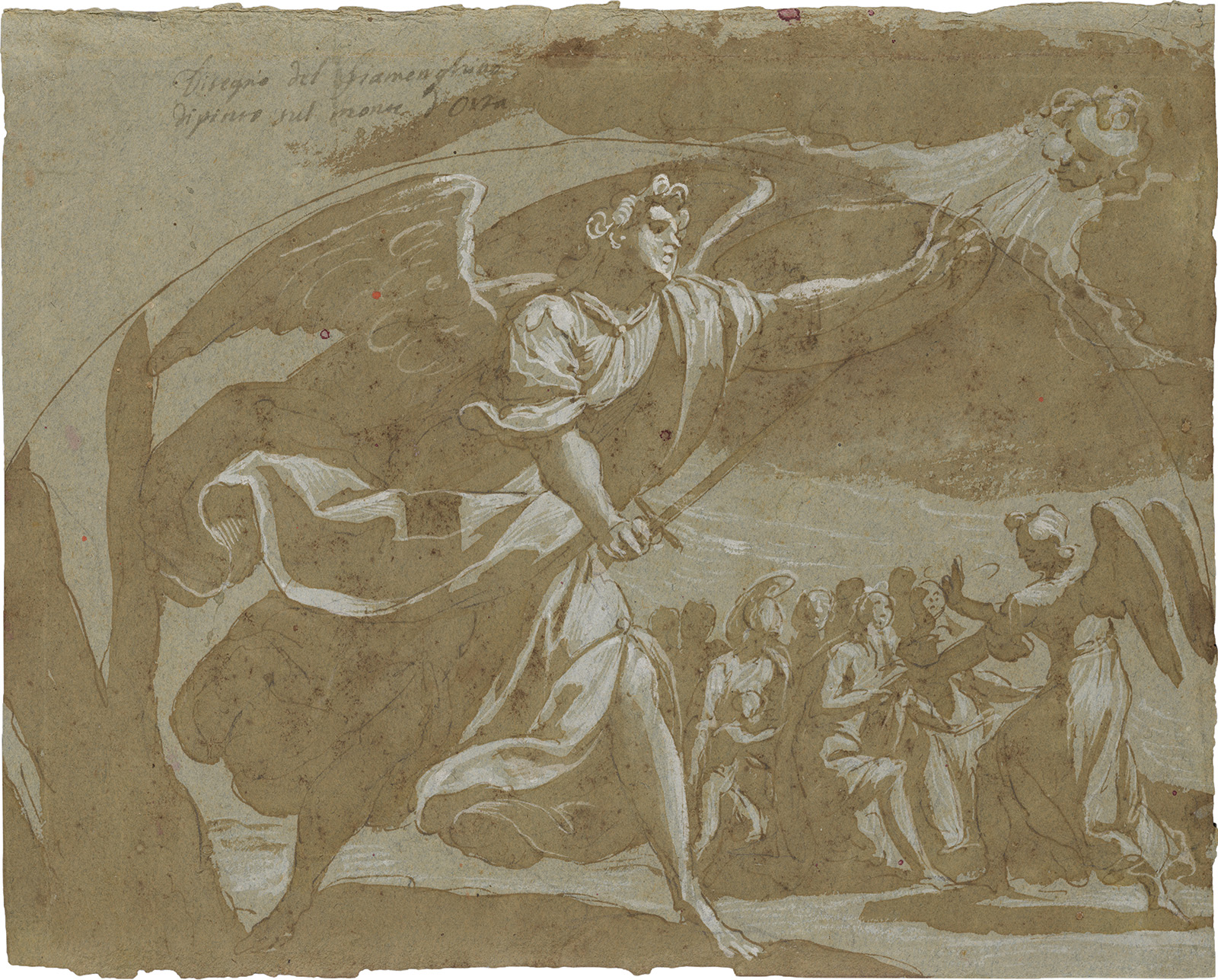
Giovanni Battista della Rovere, called il Fiammenghino
(Milano, 1561 - Milano, 1628/1633)
Study for an Angel, 1614-1615
Pen brush and brown ink, black chalk and white on paper
193 x 240 mm (7.60 x 9.45 inches)
Giovanni Battista della Rovere, called il Fiammenghino
(Milano, 1561 - Milano, 1628/1633)
Study for an Angel, 1614-1615
Pen brush and brown ink, black chalk and white on paper
193 x 240 mm (7.60 x 9.45 inches)
Re: 0276
Iscriptions: «Disegno del Fiamenghino / dipinto sul monte d'Orta», pen, top left; «Al molto Mag», white lead, top left, on the reverse side
Inscription
«Disegno del Fiamenghino / dipinto sul monte d’Orta», pen, top left
«Al molto Mag», wash heightened with white, top left, on the reverse side
Provenance
Private collection
Having re-emerged from a private collection with no information on its earlier provenance, the sheet, unknown to the literature, is a preparatory study for an angelic image set within a lunette-shaped architectural space. The scene is dominated by a peremptory heavenly messenger, clad in ample, billowing garments. He is caught in the act of drawing his sword with his right hand, while with his left he reaches to seize the divine breath blown by a cherub. In the background behind him, human figures crowd agitatedly around another winged creature, who is issuing them orders. The arched upper edge, drawn by the artist himself, unambiguously indicates the intended destination of the work.
Any doubt as to the genesis of the project is dispelled by the autograph inscription in pen in the upper left corner: ‘Disegno del Fiamenghino / dipinto sul monte d’Orta’ [Drawing by the Fiammenghino / painted on the Monte d’Orta]. The sheet thus documents the design phase of one of the decorative cycles executed by the Della Rovere brothers, better known as the Fiammenghini, within the celebrated project of the Sacro Monte at Orta San Giulio, devoted to the life of Saint Francis of Assisi. Allowing for a few minor variations, the scene corresponds more precisely to the second lunette from the left frescoed in the apse conch of the fifth chapel, dedicated to the spread of the Franciscan Order (fig.).¹ As the account books of the Sacro Monte show, Giovanni Mauro had already worked there with his elder brother Giovanni Battista in 1607–1608, in the second and third chapels of the sanctuary. In 1615 he was engaged once again to work in that setting, receiving the advance payment in July and the final payment in October.²
In stylistic terms, the drawing clearly reveals the hand of the younger of the Fiammenghini at the moment when he was developing a new idiom, increasingly indebted to Morazzone. An undeniable closeness to the manner of his brother Giovanni Battista can still be felt, the two having long collaborated almost symbiotically.³ Here, however, there is a plastic tension entirely foreign to the idiom of his predecessor. The forms thus lose the measured stiffness more typical of the elder brother and expand into broad, majestic volumes. The present sheet does not yet display the unbridled and at times overexcited freedom of execution that would characterise his output of the 1620s and 1630s. That freedom would culminate in results of astonishing impetuosity, as the David and Goliath in the Raccolta Bertarelli of the Castello Sforzesco, Milan, demonstrates.â´ Yet the angel already moves with that broad, theatrical stride, almost a dance step, in which the early, tentative lesson of Camillo Procaccini merges with the renewed, overpowering fury of Morazzone. These qualities are by now far removed from the drawings securely datable to Mauro’s youth, such as the Holy Women at the Sepulchre in the Staatliche Graphische Sammlung, Munich, inscribed ‘J.M.R. 1594 magio’,âµ or the Saint Catherine of Alexandria in the Albertina, Vienna, signed ‘G.M.R. 1600 novembre’.ⶠThey are closer, rather, to the Tavern Interior in the Nationalmuseum, Stockholm, inscribed ‘G.M.R. 1617 marz ix’.â·
From a technical point of view, the sheet rests on a black chalk underdrawing, swiftly overtaken by a cursive brown pen, before the focus shifts to the exploration of atmosphere and light. To this end, the paper is tinted with grey wash, allowing the dense, closely packed touches of lead white to bring out the sculptural development of the drapery. This reflects the expressive impatience that would dominate the following decades. Such a handling of materials, and of figure types, finds close analogies in the Stockholm sheet. It also recalls the Warrior Seen from Behind in the Biblioteca Ambrosiana, Milan, which is, not by chance, inspired by a figure painted by Morazzone at the same Sacro Monte,⸠and the Male Figure in the Istituto Centrale per la Grafica, Rome.â¹ Not to mention the quivering Woman Attacked by a Soldier in the Pinacoteca at Varallo, datable close to the decorative campaign at the Certosa of Chiaravalle, where in 1615 the two brothers once again found themselves working side by side.¹â°
On the verso, as a corollary to this graphic invention, there is a dedication written in lead white, which, however, omits the name of the recipient. Given the tone of the heading, he is evidently to be sought among the leading figures in charge of the Novarese project, to whom the drawing was presumably presented. In this light, the recipient may well be identified with Father Cleto da Castelletto Ticino (1556–1619). A Capuchin friar and an architect of distinction, he was above all the originator, designer and superintendent of the works of the Sacro Monte from its very beginnings, and over time became the principal point of contact for the masters active on the site.
Fig. Giovanni Mauro Della Rovere, Angel, 1614–1615. Orta, Sacro Monte, fifth chapel
¹ Melzi d’Eril 1977, pp. 144–154.
² Orta, Sacro Monte, Archivio, Libro delle spese, Giornale A, fol. 78.
³ For observations on the drawings of Giovanni Battista, see pp. xx–xx in this volume.
â´ Ruggeri 1969, pp. 124–125, fig. 8.
âµ Bora 1973, pp. 34, 125, no. 144.
ⶠBirke, Kertész 1992–1997, III, no. 2788.
â· Bjurström 1979, no. 292, where the date is read as 17 March 1617.
⸠E. Spina Barelli, in Disegni di maestri 1959, p. 79, no. 74.
â¹ G. Bora, in L’Artista e il suo atelier 2006, pp. 68–71, no. 11.
¹â° Bora 1973, pp. 34, 126, no. 146; V. Zani, in Pittura a Milano 1999, pp. 210–211, pl. 9 on p. 69.