

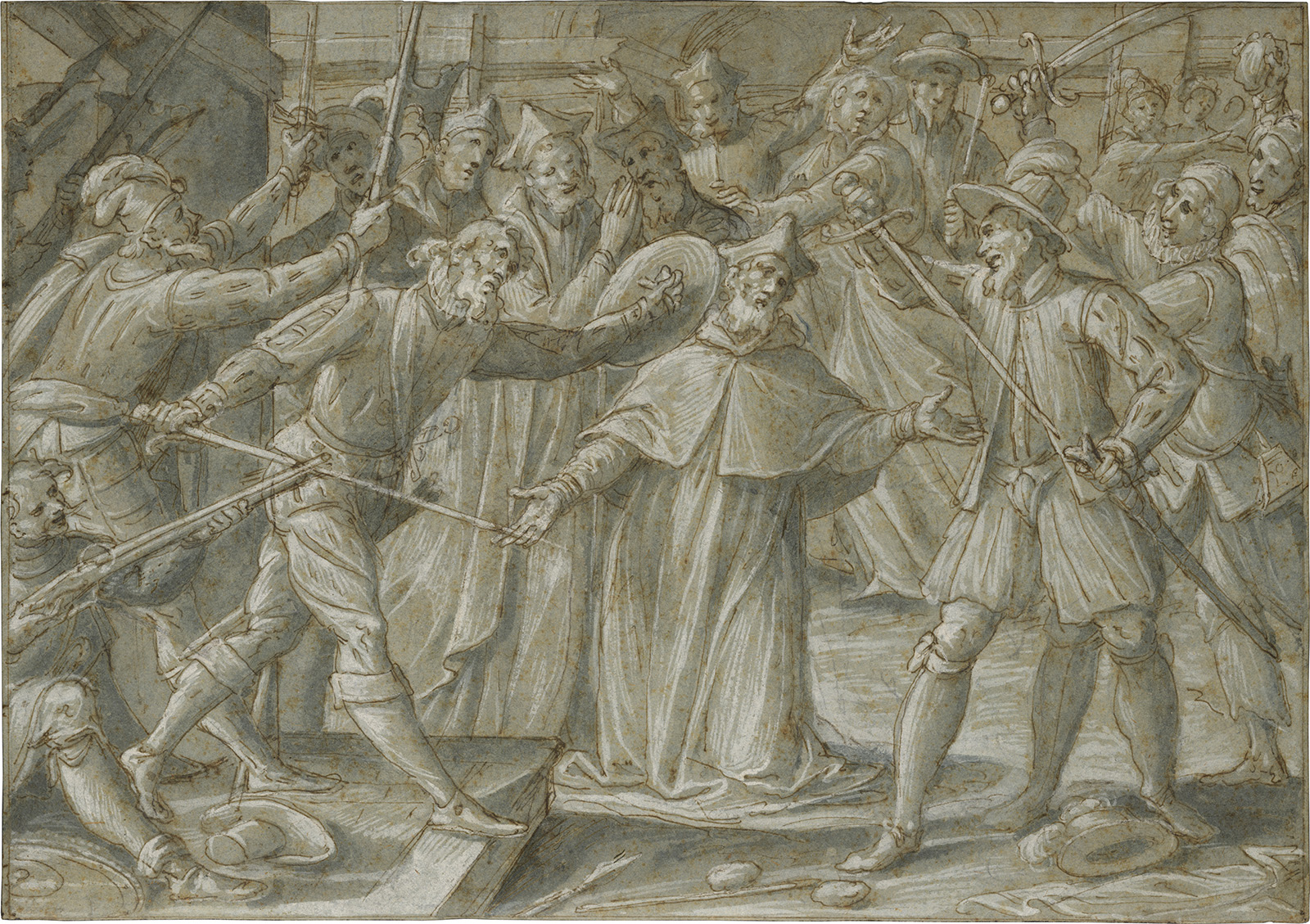
Giovanni Battista della Rovere, called il Fiammenghino
(Milano, 1561 - Milano, 1628/1633)
Federico Borromeo Pacifying Two Warring Factions, 1618
Pen brush and ink grey, black chalk and wash heightened with white on paper
235 x 333 mm (9.25 x 13.11 inches)
Giovanni Battista della Rovere, called il Fiammenghino
(Milano, 1561 - Milano, 1628/1633)
Federico Borromeo Pacifying Two Warring Factions, 1618
Pen brush and ink grey, black chalk and wash heightened with white on paper
235 x 333 mm (9.25 x 13.11 inches)
Re: 0275
Iscrizioni
«J·B·P / 1618», pen, top left, on the reverse side
«41», a graphite, in below, in center, on the reverse side
Provenance
Private collection
Having re-emerged from a private collection, with no precise information on its early provenance, the drawing is an unpublished addition of exceptional interest to the corpus of early seventeenth-century Lombard drawings. Not easy to interpret, the image depicts a heated scene of street fighting in which two armed factions confront one another in the presence of several clerics. At the centre of the composition, a prelate intervenes with a peremptory gesture to calm tempers and separate the combatants.
The pen work was laid down urgently over a preliminary underdrawing in black chalk and subsequently enriched with judicious lead-white heightening applied with the tip of the brush. These technical features point without hesitation to the hand of Giovanni Battista Della Rovere, the elder of the Fiammenghini brothers.¹ According to Paolo Morigia, they were so called because ‘il padre loro nacque in Anversa principalissima città della Fiandra, ma da giovane venne a Milano’ [their father was born in Antwerp, the foremost city of Flanders, but came to Milan as a young man].² Beyond the technical evidence, it is above all the inflections of the style that support the attribution.³ The ductus is measured and controlled, sustaining a clear, orderly composition. These qualities rule out any possible confusion with the manner of his younger brother Giovanni Mauro,â´ Giovanni Battista’s regular collaborator, whose drawing style is always appreciably more cursive and exuberant.âµ The attribution is, moreover, definitively confirmed by the autograph monogram ‘JBR’ on the verso, to be read precisely as ‘Johannes Baptista Ruberio’.
From a historical and critical standpoint, however, the most significant element is the date ‘1618’, inscribed below the monogram. It provides a valuable chronological anchor, indispensable for navigating the vast body of sheets ascribable to the Milanese master. The drawing thus takes its place in the artist’s full maturity. It follows immediately upon the study of 1617 for a Coronation of the Virgin, with the Christ Child, Saints Paul and Jerome and a Donor, now in Paris at the Fondation Custodia.ⶠIt sits alongside the study for the Death of Saint Dionysius, which passed through the hands of Herbert List in the last century and likewise bears the date 1618.â· It precedes by exactly a decade the Moses in the Szépművészeti Múzeum, Budapest, inscribed ‘J.B.R. 18 MR 1628’.â¸
In formal terms, the composition recalls the arrangements Giovanni Battista had already successfully tested in one of the key undertakings of his career: the execution, in 1602–1603, of the quadroni for the cycle of the Life of Saint Charles Borromeo in Milan Cathedral. More specifically, there are close spatial analogies with the preparatory sheet for the Attempt on the Life of Saint Charles in the collections of the Castello Sforzesco, Milan (fig.).â¹ As in the studies for the Borromeo commissions, the present work, despite an essentially narrative and didactic conception, displays great immediacy of representation. The figures unfold in space, elongated with a measured elegance still of Mannerist descent. Compared with the drawings produced in the very first years of the century, the line here becomes more flowing and fluid, though without ever yielding to the excesses of nonchalant cursiveness typical of his younger brother. On the other hand, the insistent attention to effects of light through controlled hatching in lead white is also found in the other drawings mentioned above, dating from 1617–1618. It reveals that in his late maturity Giovanni Battista had absorbed some of the luministic concerns pursued by Giovanni Mauro, while interpreting them with a far more disciplined formal rigour. Finally, the physiognomic types, in particular the bearded faces rendered with rapid touches of the pen, find precise parallels in countless drawings by the master, exemplified by the well-known Study of God the Father in the Biblioteca Ambrosiana, Milan.¹â°
As already noted, identifying the episode depicted proves extremely difficult. A first attempt at decipherment required a review of the commissions undertaken by the Della Rovere brothers around 1618. The first of these is the sixth chapel of the Sacro Monte at Orta, commissioned from Giovanni Battista in 1615, with final payment made to Giovanni Mauro in 1619.¹¹ Being devoted to the spread of the Franciscan Order, however, it contains no trace of such an episode. The situation is much the same if one turns to the decorative campaign at the Certosa of Chiaravalle, which unfolded between 1614 and 1618.¹² Although it includes several bloody scenes of martyrdom, from those of the nuns to that of Saint Thomas Becket, none of the Cistercian subjects fits the invention. Moreover, the kneeling protagonist at the centre cannot be identified as a monk of that order.
Once such destinations have been ruled out, a certain suggestion arises from the presence of a soldier armed with an arquebus on the left. At first sight, this would bring to mind the aforementioned attempt on the life of Saint Charles Borromeo, a theme frequently treated by the Fiammenghini workshop. One example is Giovanni Mauro’s version of 1622, a signed and dated canvas formerly in the church of San Benedetto in Padua, destroyed during the Second World War.¹³ Here too, however, the hypothesis proves untenable, since the date of the sheet reveals a decisive iconographic discrepancy. Charles Borromeo was canonised in 1610, and in 1618 the orthodox Giovanni Battista would certainly not have failed to give the saint a halo, in compliance with strict post-Tridentine precepts. The evident absence of any mystical attribute therefore rules out Saint Charles. It points instead to an event of contemporary history and, consequently, to the depiction of a prelate still living at the time.
Moreover, the protagonist’s pose is not that of the victim of an ambush but that of an authority who steps between two warring factions to pacify them. It is therefore tempting to read the invention as the celebration of a crucial event in the tenure of Archbishop Federico Borromeo, recounted in 1656 in Francesco Rivola’s biography. The prelate drawn by the Fiammenghino, portrayed in mature age, with a well-trimmed beard, mozzetta and biretta, fits perfectly with the figure of Federico. His episcopate was marked by a bitter, exhausting tug-of-war with the Spanish government, documented by Rivola in his accounts of the ‘controversie di Giurisdittione’ [disputes over jurisdiction], which culminated in the final triumph of concord between the ecclesiastical and secular courts.¹â´ The soldiers armed with swords and arquebuses, the weapons of choice of the Spanish troops and of the governor’s bravi, thus become the embodiment of the clashes that bloodied Milan. The archbishop, meanwhile, stands at the centre of the composition, cloaked in the weight of his pastoral authority, stretching out his arms to halt the blades.
The professional relationship between the painter and Federico Borromeo, moreover, had long roots, going back to the last decade of the sixteenth century. In 1595 the Fabbrica del Duomo commissioned Giovanni Battista to execute the triumphal arch ‘fatto sopra la porta’ [made above the door] for the installation of the newly elected archbishop.¹âµ Although absolute certainty is lacking, it is highly probable that the sheet is an important visual document, capable of translating the bitter political and jurisdictional tensions of seventeenth-century Milan into an image of solemn and vibrant eloquence.
¹ Caviglioli 1989a, pp. 340–343.
² Morigia 1595, p. 281.
³ For observations on the drawings of the Della Rovere brothers, see Ruggeri 1969, pp. 119–126; Bora 1973, pp. 16–17, 32–35, nos 132–154; Bora 1980, pp. 71–73, nos 84–87; Ruggeri 1982, pp. 101–109, nos 87–95; and, most recently, Loda 2013, pp. 477–497; and M. Pavesi, in La collezione Galli 2024, p. 122, no. IV.5.
â´ Caviglioli 1989b, pp. 343–347.
âµ See the relevant entries in this volume, pp. xx–xx.
ⶠByam Shaw 1983, I, pp. 396–397, no. 399; III, pl. 451.
â· Ruggeri 1969, p. 125, fig. 9. The sheet reappeared at Christie’s, London, on 6 July 1999 (lot 33).
⸠Czére 2004, pp. 266–267.
â¹ Bora 1973, pp. 33, 123, no. 137.
¹â° Bora 1973, pp. 33, 123, no. 136.
¹¹ Melzi d’Eril 1977, p. 163.
¹² Neilson 1968, pp. 123–128; V. Zani, in Pittura a Milano 1999, pp. 210–211, pl. 9 on p. 69.
¹³ Arslan 1960, p. 59.
¹â´ Rivola 1656, books III–IV.
¹âµ Annali della fabbrica 1881, p. 303.