

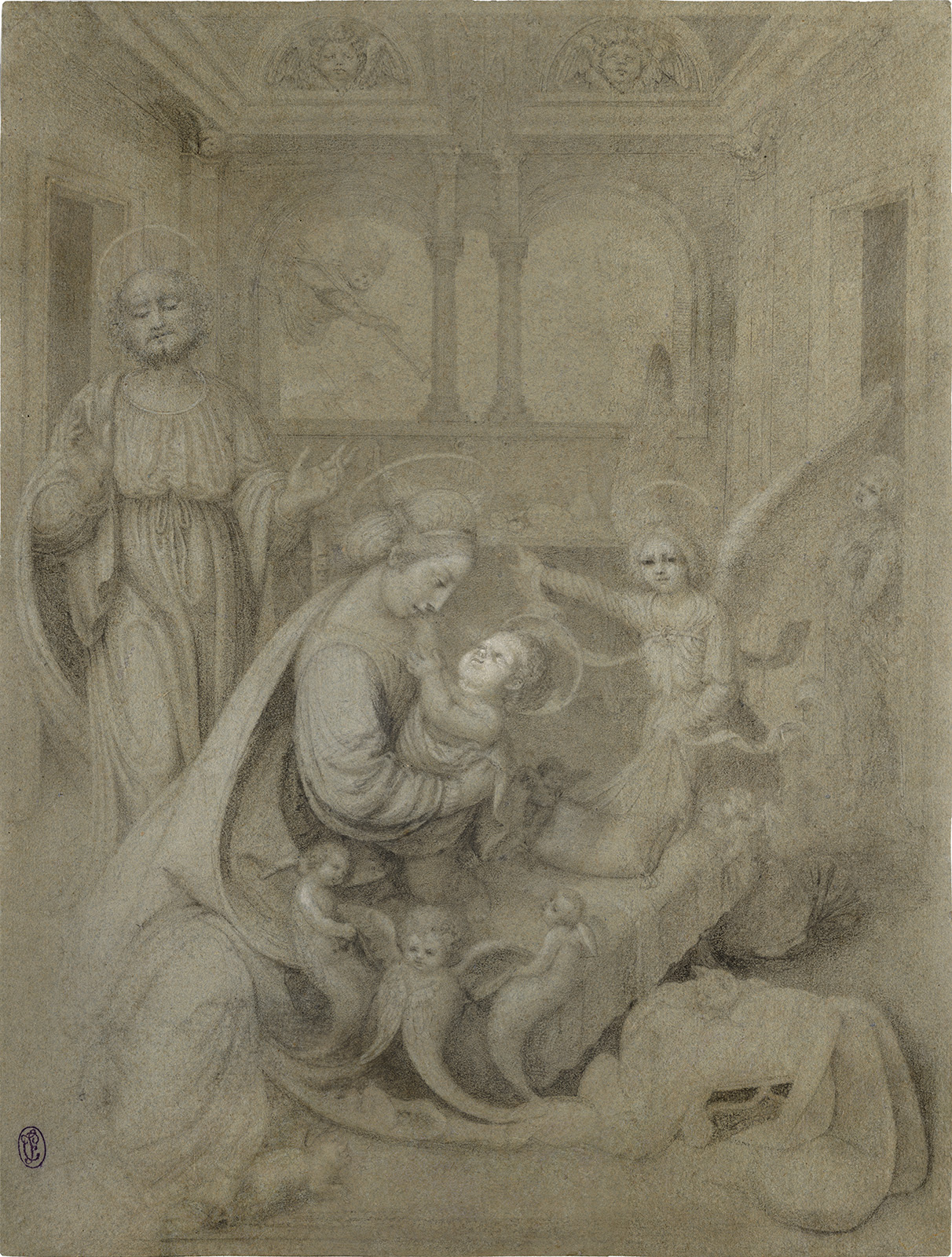
Giovanni Battista della Cerva
(Novara ?, 1515 - Milano, 1580)
The Holy Family, 1550 -1560
Black chalk, wash heightened with white, on paper
404 x 306 mm (15.91 x 12.05 inches)
Giovanni Battista della Cerva
(Novara ?, 1515 - Milano, 1580)
The Holy Family, 1550 -1560
Black chalk, wash heightened with white, on paper
404 x 306 mm (15.91 x 12.05 inches)
Re: 0274
Collector's mark:
Cesare Frigerio (Lugt 4263), purple ink, below, left
Provenance:
Milan, collection Cesare Frigerio, post 1910 – before 1977
Florence, Pandolfini, 3 october 2018, lotto 19
The sheet, unpublished as far as can be ascertained, depicts an intimate yet crowded domestic interior dominated by the Virgin and Child, surrounded by several putti, an angel and, on the left, Saint Joseph. The iconographic invention is steeped in subtle theological portents. The little angels in the foreground seem to raise heavenwards the cradle from which Mary has just lifted the divine infant. Meanwhile, the little angel at the head of the cradle invites us to discern the image of the Crucifix borne by another heavenly messenger, framed in the window in the background, prefiguring the Passion that awaited the Redeemer. As regards condition, it should be noted at the outset that the face of Saint Joseph has been partly compromised by an old retouching in pen. Like other passages of the composition, it was evidently only sketched in originally.
At the foot of the sheet is the violet ink stamp of the accountant Cesare Frigerio, a collector about whom, unfortunately, very little is still known. An employee of the Cassa di Risparmio delle Province Lombarde in Milan, Frigerio confided in a letter to Frits Lugt in 1969 that it was sheer passion for art that drew him to collecting. This passion led him, at around the age of twenty, to buy a small drawing attributed to Salvator Rosa.¹ His collection consisted mainly of Italian Old Master drawings. He did not, however, disdain nineteenth-century sheets, such as those by Mosè Bianchi, or works of the Spanish school, encouraged by his acquaintance with connoisseurs of the calibre of Herbert List and Giorgio Dalla Bella. From the 1970s onwards Frigerio sold a number of pieces to Giacomo Bargellesi, while another part of his collection passed to List himself.² Since he died without heirs, his collection was irretrievably dispersed, and several sheets bearing his mark began to appear on the art market around 1977. Even so, the exact date of acquisition, the original attribution and the immediately subsequent changes of ownership of this sheet all remain unknown. The trail resumes only with its recent reappearance in 2018 at Pandolfini in Florence, where it bore a generic attribution to the Venetian school of the first half of the sixteenth century.
This is a drawing of the utmost complexity, and deciphering it leads us to look not to Venice but to Lombardy. The drawing is in fact a fascinating stylistic pastiche, poised between the world of the late Gaudenzio Ferrari (the Milanese Gaudenzio, that is) and the renewed cultural climate of mid-sixteenth-century Milan. The work displays an eccentric coexistence of elements. On the one hand, there are archaising survivals of Piedmontese stamp. These are evident, for example, in the facial type of the angel on the right, not far from certain solutions adopted by Bernardino Lanino. On the other, there are quintessentially Milanese refinements, rooted in the early-sixteenth-century Renaissance of Bernardo Zenale and, above all, Bernardino Luini. The soft oval of the Virgin’s face seems to look to Luini. The architectural layout of the scene, articulated by piers and openings in the background, reprises almost literally the perspectival severity of the Annunciation in the Pinacoteca di Brera. That painting most probably comes from the church of Santa Marta in Milan, and its attribution has, not by chance, been debated between Luini and Zenale.³ The whole is reinterpreted in a purely ornamental key, as the bizarre invention of the cradle tilting on the angels’ wings and the cherubim set into the lunettes and corners of the room suggest.
Faced with such learned eclecticism, one might at first be tempted, for purely theoretical reasons, to invoke the name of Giovanni Paolo Lomazzo. On closer examination, however, it becomes clear that the sheet, while anticipating some of his concerns, has an allure that is less monumental than Lomazzo’s inventions, which also differ in technique. In a sense, it is as if we were faced with the hand of an artist who, in the middle of the century, attempted a distinctly local path to Mannerism. He sought to temper the appeal of Gaudenzio’s models through a deliberate recovery of the idiom of Leonardo and Luini. This orientation is not an isolated phenomenon; on the contrary, it fits fully within the cultural milieu of Milan in the 1540s.â´ The revival of Leonardesque models, reaffirmed by Giampietrino’s late works, took on in these years the character of a genuine programme, aimed at re-establishing the autonomy of the Milanese figurative tradition. It was a kind of ‘return to origins’. Its purpose was to stem the success in the city of Gaudenzio Ferrari from the Valsesia and of his followers, led by Lanino. It also sought to check the spreading fashion for the animated colourism of the Venetian masters, from Titian to Tintoretto, from Paris Bordon to Giovanni Demio,âµ and for the grandiloquent Mannerism of Giulio Romano, which reached Milan in 1550 with the arrival of Bernardino Campi.â
It is within this redefinition of stylistic coordinates, embraced early on by the young Girolamo Figino, that the author of the drawing seems to have shaped his path. He set aside, more or less deliberately, the canonical Tuscan-Roman models, absorbing them, if at all, precisely through the teaching of Figino himself around the middle of the century. Indeed, the sculptural articulation of Joseph’s drapery seems to follow in the wake of Figino’s cool elegance. It recalls the folds in the garments of some of the saints in a pair of altarpieces by Figino datable to either end of the 1550s. These are the Virgin and Child with Saints Peter and Paul in the Fogg Art Museum, Cambridge, Massachusetts,â· and the Virgin and Child with Saints Mary Magdalene and Martha, which came to the Uffizi from the oratory of Santa Marta dei Disciplini in Milan.⸠The Florentine panel is connected with the drawing in the Gallerie dell’Accademia, Venice, of the Virgin and Child with Saints John the Baptist and Andrew.â¹
One name is capable of coherently bridging this complex trajectory, which leads from Gaudenzio’s Milan in the 1540s to Figino’s in the 1560s and anticipates the later climate of Lomazzo. It is that of Giovanni Battista Della Cerva, who first appeared in Milan in 1543.¹â° An assistant of Gaudenzio from 1537, Della Cerva is documented in 1552 as Lomazzo’s master. He thus acted as a crucial hinge between two otherwise distant worlds of Milanese culture. Lanino, his fellow pupil in the Valsesian master’s workshop, remained a strict follower of Gaudenzio. Della Cerva, by contrast, distanced himself increasingly from Ferrari’s teaching after the death of the master in 1546. He developed a predominantly decorative kind of painting, strongly oriented towards perspectival display,¹¹ as can be seen in the Deposition in the basilica of Sant’Ambrogio, Milan, which can be assigned to this period.¹² It is Lomazzo himself, moreover, who provides crucial testimony in this respect in his verse autobiography of 1587. On closer inspection, this testimony also helps to explain the genesis of eccentric sheets such as the present one. Recalling his beginnings, the Milanese theorist wrote: ‘... al pinger mi diei / sotto... Gian Battista Della Cerva. / Il qual mi spinse innanzi contemplando / Quel ch’io era pronto à far nel arte sola. / Però in quei tempi feci diverse opre / Si come quadri, bizzarrie historie, / Fregi grotteschi et partimenti varij...’ [... I devoted myself to painting / under ... Gian Battista Della Cerva, / who urged me onward, perceiving / what I was ready to accomplish in that art alone. / And so in those years I made various works, / such as pictures, capricious histories, / grotesque friezes and sundry compartments ...].¹³ In short, the abandonment of Gaudenzio’s legacy in favour of a more hybrid and eclectic style, suited to the new demands of Milanese patrons, seems to account for such bizzarrie, grotteschi and partimenti. They are not hard to identify in the present drawing as well.
The attribution to Giovanni Battista Della Cerva must nevertheless be advanced with considerable caution. Not least, in the current state of research, the Novarese painter lacks a reference corpus of drawings against which precise comparisons could be made. Equally difficult is the reconstruction of his activity after 1550, in the decade preceding the serious illness that struck him in 1561 and left him effectively unable to work for the rest of his life.¹â´ With this necessary caveat, Della Cerva’s orbit currently appears to be the most fitting hypothesis to account for the complex stylistic layering of the sheet. It is supported, moreover, by a series of close analogies with the master’s paintings of the previous decade. Several important physiognomic affinities link the Virgin’s profile to that of Saint John the Evangelist on the right of the aforementioned Deposition. These include the full, fleshy cheeks; the triangular cut of the eyes, with heavy, drooping upper lids and densely shaded lashes; the straight bridge of the nose, softening towards the nostrils; and the small, half-open mouth, with the lips receding towards the tip of the chin. An even more decisive comparison, however, emerges from the putti and cherubim. With their swelling anatomy and wild-eyed expressiveness, they find a parallel in the crowded host of unruly little angels above the rear niche of the oratory of Santa Caterina at San Nazaro, Milan. This was a joint undertaking with Lanino, to whom the scenes from the saint’s life and the main scene of the Martyrdom on the Wheel should be assigned.¹âµ Within the latter composition, however, scholars agree in giving to Della Cerva’s hand the rigorous Serlian perspective that serves as a backdrop to the scene. This is far from a secondary feature of his practice. On the contrary, it finds a suggestive echo in the same insistence on architecture displayed in the present drawing, and thus offers a further valuable argument in favour of the present attribution.
¹ Lugt 2010, no. 4263, s.v. Cesare Frigerio.
² Schleier 1972, p. 376, no. 45.
³ P.C. Marani, in Pinacoteca di Brera 1988, pp. 222–224, no. 126.
â´ On this, see Frangi 2020, p. 16.
âµ On ‘pro-Venetian’ Milan: Fossaluzza 1998, pp. 44–52; and the new insights in Tanzi 2018, pp. 45–55; Tanzi 2020, pp. 339–346.
ⶠTanzi 2004, pp. 17–20.
â· Frangi 1997, pp. 34, 38, n. 20, fig. 60; Frangi 2020, pp. 11, 14, 23, fig. 4.
⸠Frangi 1997, pp. 34–35, 38, n. 20, fig. 65; Frangi 2020, pp. 11, 17, 33, fig. 19.
â¹ Frangi 1997, p. 35, fig. 63. Another, later sheet by Figino is published in Bora 2003, p. 286.
¹â° Sacchi 1988, pp. 730–733.
¹¹ Bora 1998, pp. 55–56; Di Lorenzo 1998, pp. 42–43.
¹² M. Rossi, in La basilica 1995, II, pp. 542–545; A. Di Lorenzo, in Pittura a Milano 1998, p. 258, fig. C.
¹³ Lomazzo 1587, pp. 529–530.
¹â´ Sacchi 1988, p. 733.
¹âµ Sacchi 1986, pp. 131–132, 134, fig. on p. 130; but see A. Di Lorenzo, in Pittura a Milano 1998, pp. 256–258, pl. 81 on p. 149, for the correct chronology.