

Giuseppe Bernardino Bison
(Palmanova, 1762 - Milan, 1844)
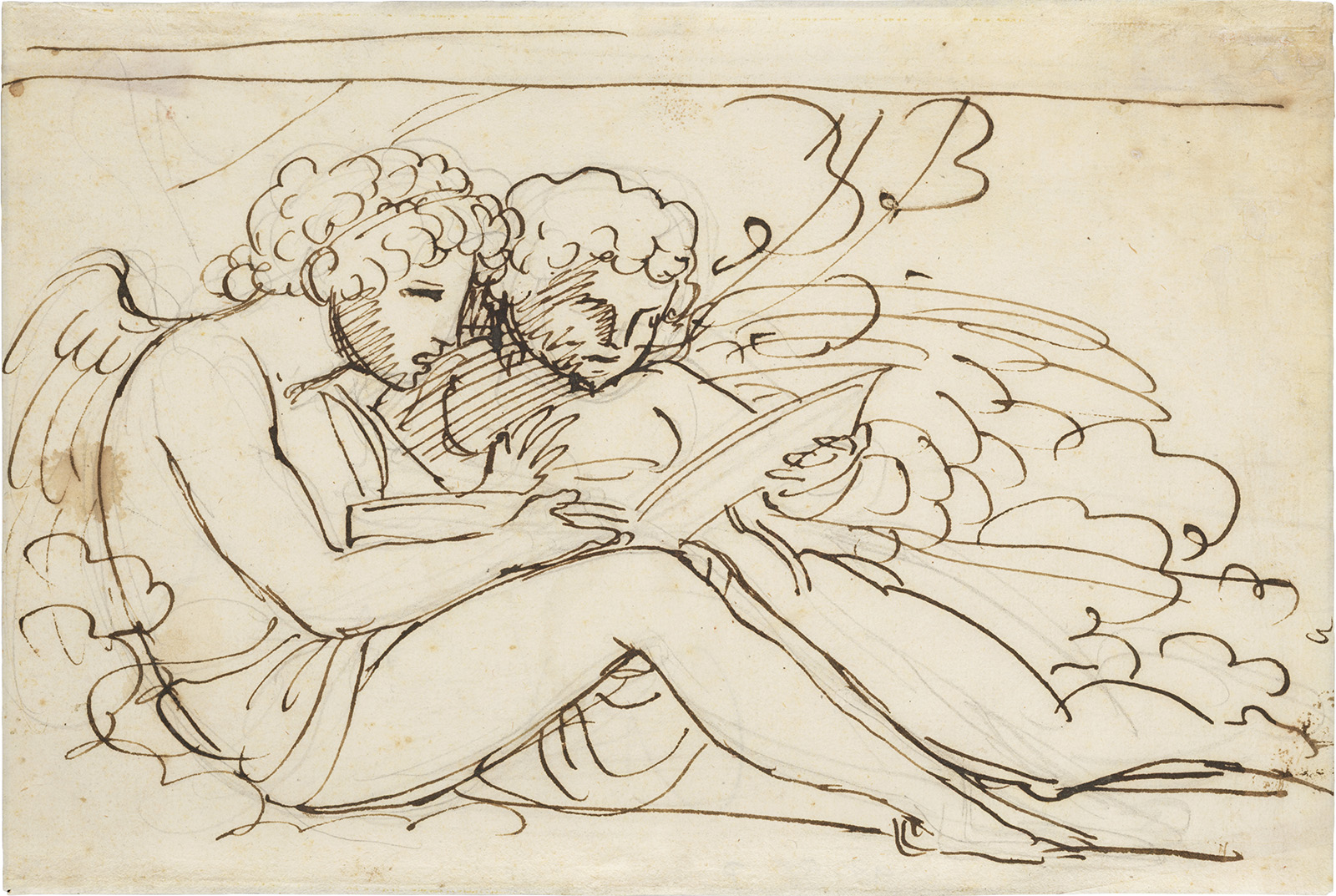
Study of Singing Putti, 1800-1810
Pen and brown ink on white paper
169 x 252 mm (6.65 x 9.92 inches)
Giuseppe Bernardino Bison
(Palmanova, 1762 - Milan, 1844)
Study of Singing Putti, 1800-1810
Pen and brown ink on white paper
169 x 252 mm (6.65 x 9.92 inches)
Re: 0271
Signed
"BB"
Provenance
Private collection
Hitherto overlooked by scholarship, the drawing depicts two cupids caught in the midst of a song, jointly holding and reading from a musical score. Laid out within summarily ruled framing lines, the composition presents the figures reclining on a soft suggestion of clouds, their wings outspread in keeping with the dynamism of the invention. Although rendered in shorthand, the faces display a certain concentration, heightening the measured gestural counterpoint that binds the two protagonists. The underlying black chalk, faintly discernible yet essential, serves as a swift structural armature, at once reinvigorated and overridden by the impetuous slashes of ink that define the anatomical masses and the plumage.
In stylistic terms, the ductus is fluid and energetic, almost cursory. These are very specific qualities, and they betray an unmistakable affinity with the graphic oeuvre of Giuseppe Bernardino Bison, whose distinctive signature lies precisely in a loose, rough, zigzagging linearity.¹ These forms arise not from the objective observation of nature but from the brilliant recomposition of a vast visual memory rooted in the eighteenth century, here bent to new formal concerns. Compared with other independent sheets by Bison,² the present one is notable for the complete absence of wash, a medium on which the Friulian artist frequently relied to orchestrate shading and tonal values. Without his customary painterly effects, the modelling of the bodies depends entirely on the continuous vibration of the contour and on nervous internal hatching. The same can be observed in the splendid Study of a Seated Male Nude in the Castello Sforzesco, Milan,³ and in other sheets in the same collection depicting sketches of putti.â´
The absence of wash, together with the economy of line, suggests that we are dealing with a primo pensiero: a study intended to resolve the correct pose of the figures and the space they occupy. Although it does not appear to be directly related to a painting or to a specific decorative scheme, the subject seems to be a free variation conceived for a wall frieze of some kind. This hypothesis is consistent with the vast and inventive ornamental repertoire that the master deployed throughout his successful career.âµ
The sheet’s character as a working note, in all likelihood not intended for the market, seems further corroborated by the particular manner in which it is signed. The drawings the artist sold alongside his paintings were normally signed in full with the surname ‘Bison’, in pen or graphite. Here, by contrast, a conspicuous monogram appears, at the centre of which the initials ‘BB’ can be made out. The same is found on other drawings of this type, such as the two Dancing Winged Female Figures in the Castello Sforzesco, Milan, initialled ‘B’.ⶠThis detail supports the view that the sheet was meant to enrich the precious private repository of ideas and motifs that the artist kept in his workshop. There it was ready to be reworked and incorporated into more complex inventions, repeated and varied even years later.â·
Establishing a chronology for the Friulian artist’s immense graphic output is difficult. Even so, the stylistic features of the work allow at least a reasonable, if cautious, dating to the first years of the nineteenth century. Following Aldo Rizzi’s observations,⸠the jagged linearity, the distinctly Neoclassical taste and the structural concision of the drawing suggest that it was executed on the threshold of the artist’s Trieste period. This places it before the further stylistic development that would mark his output after his move to Milan in 1831. It was precisely in these years, which coincided with the urban expansion of Trieste, that Bison was repeatedly sought out by the city’s bourgeoisie to refurbish the rooms of their palazzi.â¹ It must therefore have been in such projects, poised between large-scale interior decoration and nimble scenographic invention, that this varied repertory of cupids, putti and expansive allegorical figures could have found its most felicitous application.
¹ On this, see Disegni del Bison 1962; Zava Boccazzi 1973, pp. 236–249; Rizzi 1976; Magani 1993, pp. 107–120.
² Rizzi 1976, nos 44–66.
³ Zava Boccazzi 1973, pp. 239–240, fig. 338.
â´ Inv. Au. A 219r; B 231.
âµ Magani 1993, p. 108.
ⶠInv. Du. B 45.
â· Rizzi 1976, pp. 18–19.
⸠Rizzi 1976, p. 24 and nos 82–118.
â¹ Magani 1993, pp. 29–31, 54–59, pls 5–6.